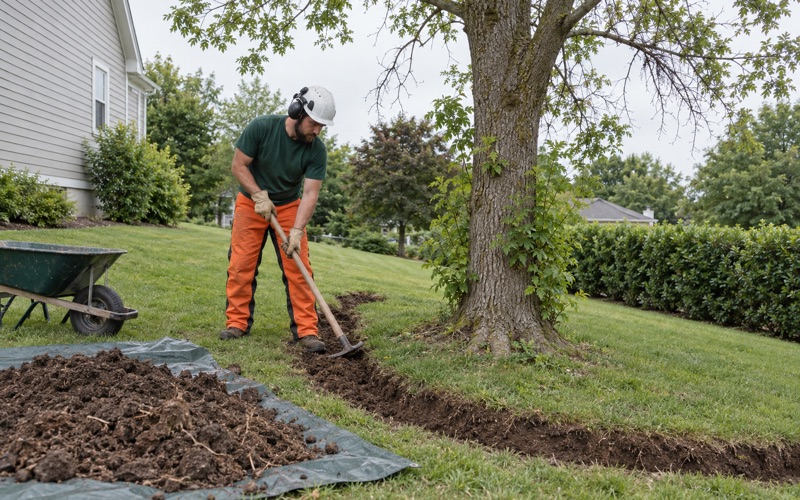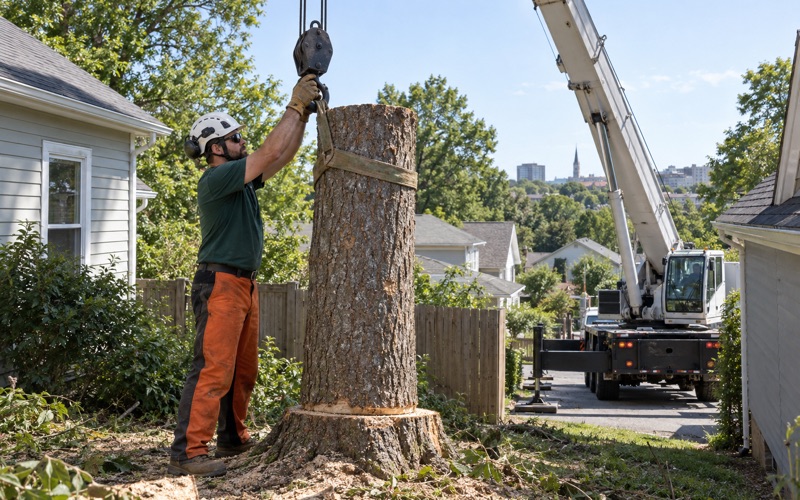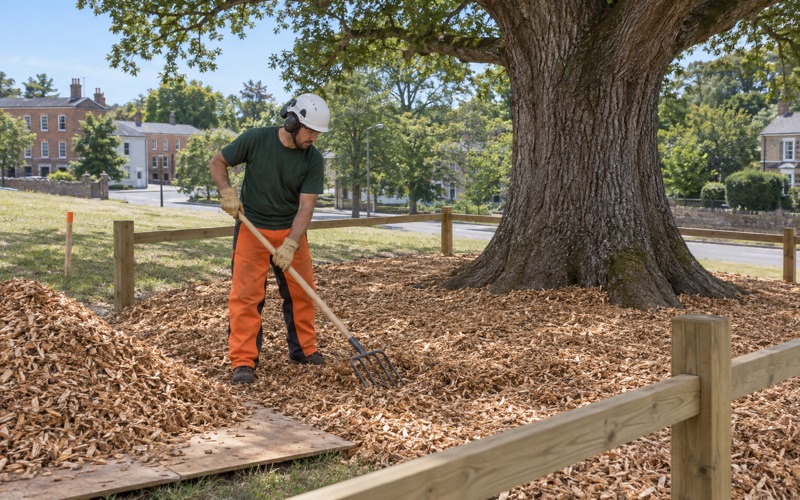
Greenville Tree Removal Team has handled tree-removal in Woodruff for more than twenty years, and the work here splits early between a yard tree and a stand of timber. A pine behind a house on a quarter-acre lot and a pine in the middle of a working stand are the same species doing two different jobs, and they get valued, cut and hauled under different rules. We quote both, and we tell you which one you have before we price it.
That distinction is not ours; it is written into state law. South Carolina registers foresters and issues no arborist license at all, so nobody working in this trade here can honestly call themselves state-licensed. What we can do is tell you which professional the statute actually names for the question in front of you, and bring one in when the answer is a forester.
Our crews cover the Upstate from Greenville out to this end of Spartanburg County, and every estimate here starts with two questions: what stands on the property, and where the wood is allowed to end up. Both answers change at the city line. We put the inclusions in writing before a saw runs, including the trunk rounds, the stump, the grindings and the chips.
What South Carolina registers and what it does not license
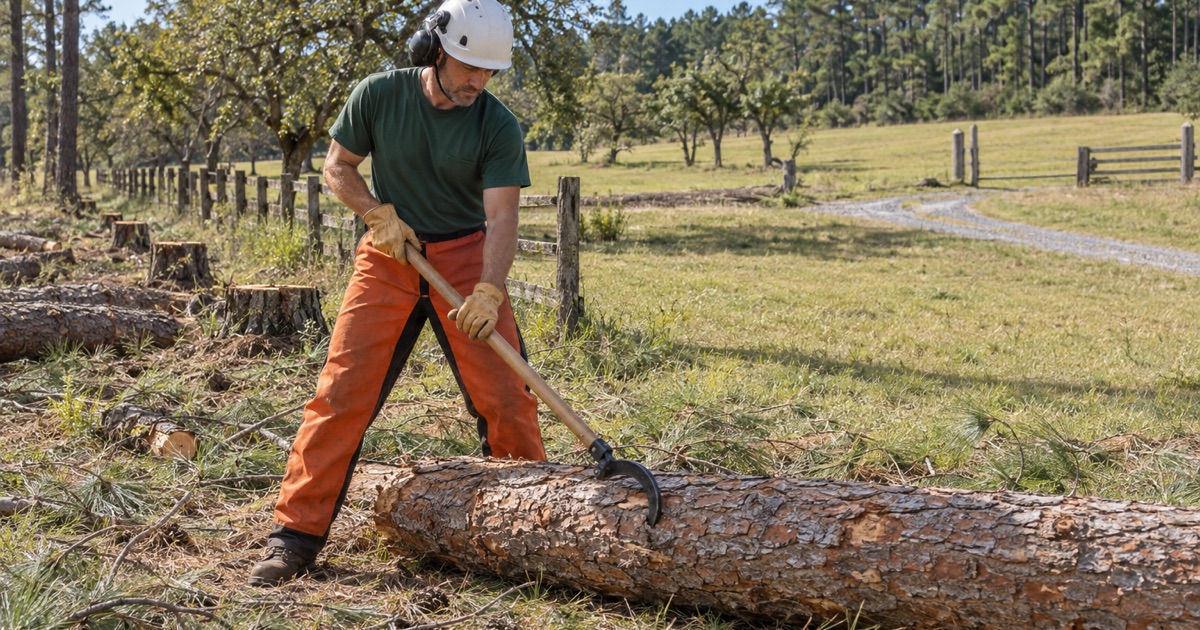
The state maintains a Board of Registration for Foresters under Title 48, Chapter 27 of the state code, and the practice of forestry it defines is broad: consultation, investigation, evaluation, planning or responsible supervision of forest management, protection, silviculture, measurements, utilization, economics, education, or other forestry activities. There is no parallel board for arboriculture and no tree-removal classification to hold. That is the honest answer to a question we get on nearly every rural quote.
None of that means a homeowner needs a registered forester to take a dead water oak out of a back yard. The registration matters when the value of standing timber becomes the issue, and on this side of the county that happens more often than people expect.
Three times fair market value, established by a forester
South Carolina Code Section 16-11-615 allows civil damages of up to three times the fair market value of timber taken, and the statute requires that the value be established by a registered forester. On acreage, that turns the damages figure into a purchased professional opinion rather than a contractor’s estimate. The criminal companion, Section 16-11-580, defines forest products as timber, trees, logs, lumber, or pine straw, and tiers its penalties by dollar value.
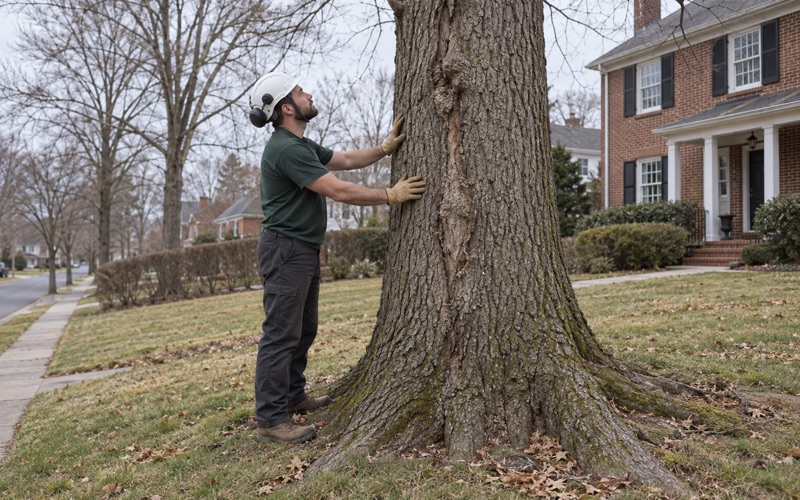
This is why we ask about property lines before we cut anything near one. If a boundary is unclear, or a neighbor disputes which side a tree stands on, we stop and put it in a written tree condition report you can hand to the neighbor, an adjuster or a surveyor. A morning of paperwork is cheaper than the treble-damages arithmetic.
The scale behind the question
The South Carolina Forestry Commission’s 2019 county table puts Spartanburg County at 216,867 acres of forest and timberland out of 522,012 acres of land area. The agency attaches its own caveat to that table, noting that the underlying inventory data is not intended for county-level use because of small sample size and higher standard errors. We read it the way the agency asks it to be read, as an indication of scale rather than a precise measurement.
Looking for tree-removal closer to Belton? See Belton Tree-Removal.
Reading a pine before it comes down
Southern pine beetle drives much of the pine work on this ground, and loblolly and shortleaf are the two hosts it presses hardest. The first sign is usually not in the crown. The initial attack frequently results in an extrusion of resin the Forestry Commission calls a pitch tube, and those show on the bark while the tree still looks healthy from the driveway.
After that the needles fade dull green, then to yellow and finally to a reddish brown before defoliation, and by then the beetles that killed the tree have usually moved on. Exit holes are clean and free of resin, which is the tell that separates an active spot from one that has already run through. Populations rise on trees already stressed by drought, flooding, fire, mechanical damage or poor nutrition, so a stand that got scraped by equipment two summers ago is worth walking first.
Cutting a spot instead of a tree
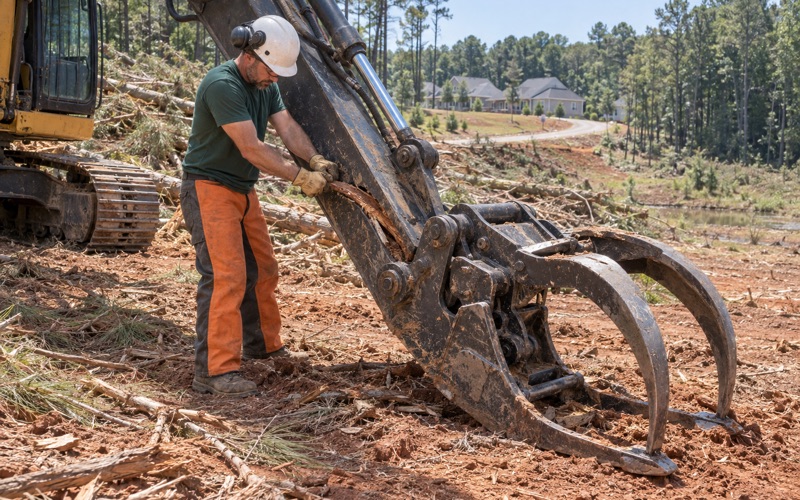
Once a spot is active, the Forestry Commission’s guidance is commercial harvest or cut and leave, and in either case to cut a buffer strip of green, uninfested trees at least equal to the height of the dominant trees in the stand. The agency puts cut and leave at about 80% effective in summer and about 60% in winter. That seasonal difference is worth knowing in October, because it decides whether the work waits for a mill or happens on your schedule.
The nine-month clock on storm-damaged pine
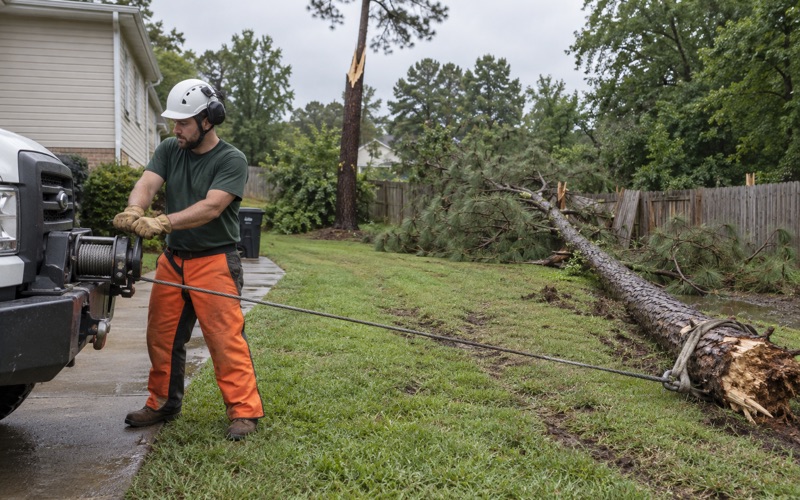
The Forestry Commission states that damaged pines hold salvage value for up to nine months after a storm. That number is the difference between a stand that pays for its own clearing and one that becomes a disposal bill, and it starts running the day the wind stops. We say so plainly when we walk a wind-thrown block, because waiting for an insurance decision can eat the whole window.
When the tree does not have to come down
Not every pine on a place with an active spot has to come down, and not every hardwood we look at needs removing at all. Where a tree can be cabled, braced or pruned instead, we say so and price both options, with pruning worked to the objectives and cut types the ANSI A300 standard defines. We do not top trees, on acreage or in a yard.
Acreage, fencerow and old orchard ground around Woodruff
Before World War II, agriculture supplemented textiles in this town, and the peach orchards ran to more than 200,000 trees within a ten-mile radius. Those rows are gone as a commercial crop, but the ground remembers them. Old orchard blocks and grown-up fencerows are a recognizable kind of removal here, with stems on a spacing nothing natural would have chosen and a wire line buried somewhere in the middle of them.
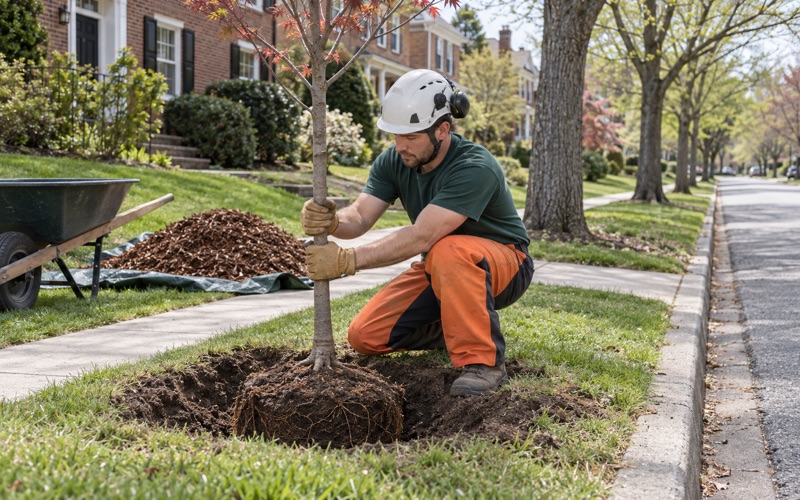
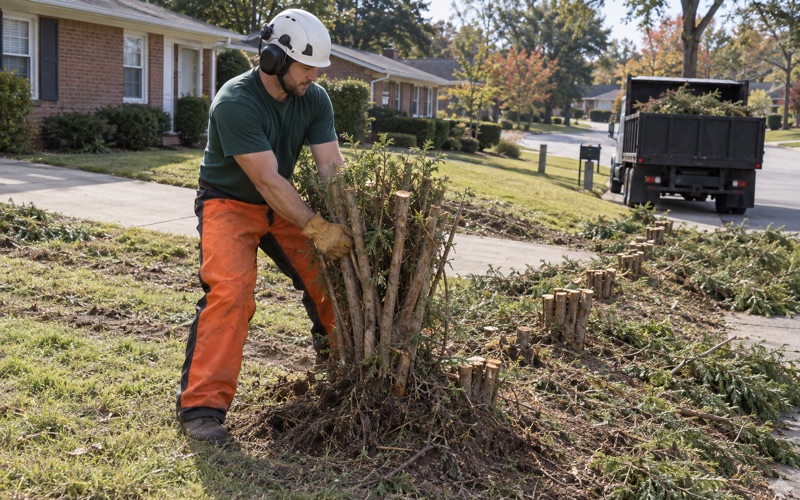
Callery pear, sold for decades as Bradford pear, colonizes exactly that kind of edge. South Carolina ended nursery sale of the species on October 1, 2024, though the ban covers sale and not possession, so the trees already on a fencerow are yours to deal with. It resprouts from lateral roots, which means the stump has to come out with them or the row grows back thicker than it started.
What the soil does to a stump grinder
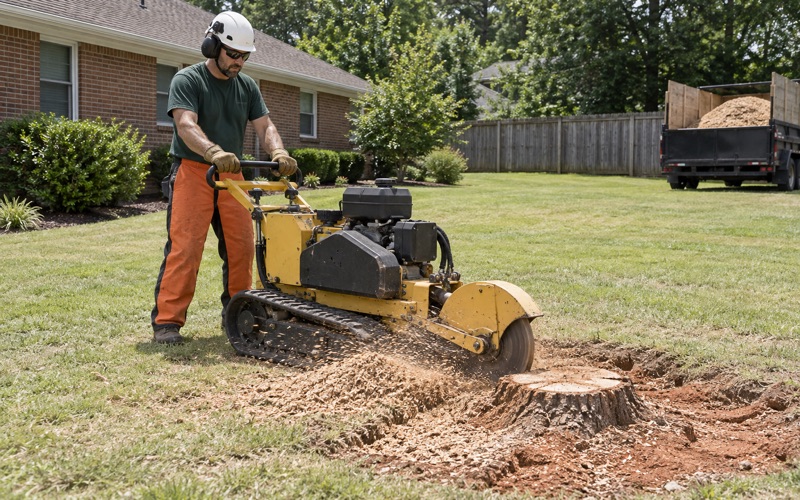
This is Southern Outer Piedmont ground, and the residual soils under it, the Cecil, Pacolet and Madison series, run more than 60 inches to bedrock. A tracked stump grinder is rated for a cut of 12 to 25 inches, so the machine, not the soil, sets the depth. What actually costs time is wear from quartz and rock fragments through the upper horizon, and on the steeper Pacolet slopes, the angle the machine can safely hold.
Getting equipment to the tree
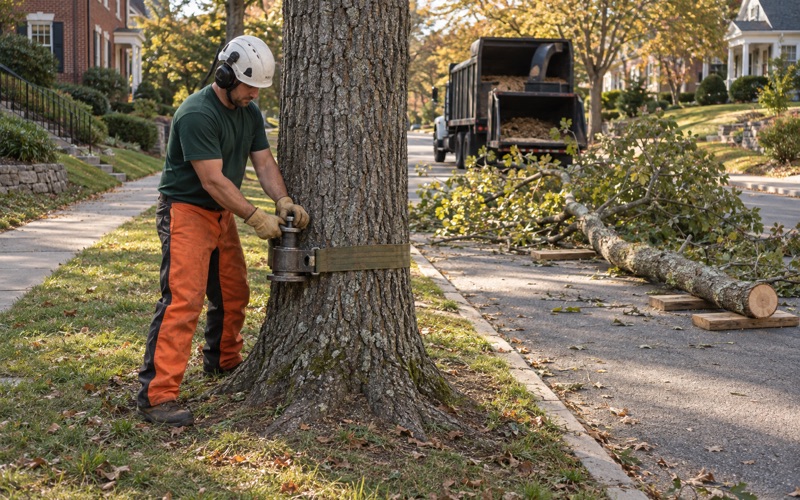
Access decides the equipment more than size does on this ground. Compact tracked machines fit a back-yard gate and keep a subdivision removal from becoming a crane job, while a mature stem over a roof on one of the older mill-village streets gets rigged with a friction lowering device or lifted out by crane. Housing here runs old, with 32.7% of units built in 1939 or earlier, so the canopy over those roofs has had a long time to get large.
Two utilities, one town
Electric service here is split by address between Duke Energy and Laurens Electric Cooperative, which runs a district office at 11471 Highway 221. The cooperative serves more than 64,000 consumers across seven counties, spends close to a million dollars a year on right-of-way, and states a clearance of 20 feet on each side of its line. We confirm which company owns the conductors before we quote work near a pole, and we hold to the ANSI Z133 safety requirements around energized lines, including the weather limits that stop the job.
Where the wood is allowed to go
The City of Woodruff publishes its debris and trash collection policy in plain terms, and it decides how a removal gets priced. Tree limbs cannot be longer than six feet or larger than four inches in diameter, and tree stumps will not be picked up. Total debris volume per collection is capped at three cubic yards, and pickup typically falls on Thursday without a guarantee, since staffing and equipment decide the day.
Two lines in that same policy matter more to you than the size limits. The city will not collect trees or limbs cut by a contractor, landscaper or tree service, and it will not collect debris that was generated outside of the city limits. The first follows who cut the wood; the second follows where it was cut, and they are separate refusals.
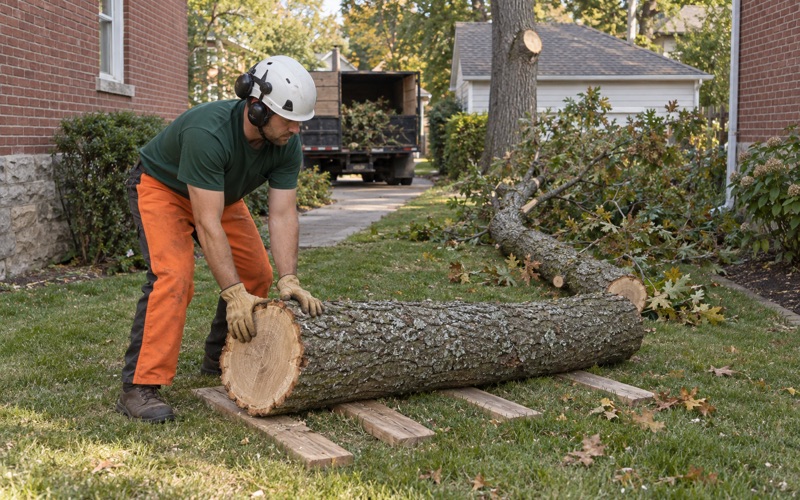
So the pile from our work is ours to haul, and we price it that way from the start. Overflow goes to the county landfill the city names on its own page, at 595 Little Mountain Road in Wellford, where the published schedule prices yard waste debris at $30.00 per ton. We quote disposal for the county the job is actually in, because one gate charges by the yard and the next by the ton.
Burning starts at the city line
State law requires that citizens notify the Forestry Commission before burning outdoors, and that requirement applies only to unincorporated areas of the state. It covers leaves, limbs and branches as well as land-clearing burns. An address inside the city sits outside that notification rule while the adjoining county acreage sits inside it, which is exactly the split that runs through the old field ground on the rural edge of town.
Clearing that counts as land disturbance
Spartanburg County defines land disturbance to include clearing, removal of vegetation that disturbs the soil, stripping, grading, grubbing, excavating, filling, logging and storing of materials, and it issues no grading permit without an approved stormwater management plan. There is no statewide tree-removal permit in South Carolina; the floor is the state land-disturbance permit that applies to anyone clearing, excavating or grubbing. We read the county chapter and the city rules for the address in question before we quote, because this service area crosses five counties and the answer changes at the line.
What the estimate covers
Estimates here are free, and the number we give you holds whether the wood ends up at a mill, at the county gate or chipped on site. If a job is worth an insurance claim we will say so, and if it is not we will say that too. Call and we will come read the tree on the ground before anyone quotes it over the phone.
- 20+ Years in the Upstate
- Free Estimates
- Written Tree Condition Reports