Emergency tree removal is the call Greenville Tree Removal Team takes at four in the morning, in Greenville, SC and out through Gantt, Mauldin, Five Forks, Powdersville and Simpsonville, and the first thing we do on arrival is nothing. We look at what is holding what, where the load is going, and what is underneath it, because a trunk on a roof is a loaded structure and cutting into it in the wrong order is how a bad night becomes a worse one.
Two decades of storm work here has also taught us that the second call matters as much as the first. Which utility owns the line at your address, whether the drop can be de-energized before a crew works, whether the damage belongs to a homeowners policy or an auto policy, and what documentation your adjuster is going to want — those get sorted while the site is being made safe, not afterwards.
We plan for what the Upstate actually records rather than for a generic coastal storm script. The September 2024 hurricane sat inside a FEMA incident period running from the twenty-fifth of September to the seventh of October, and its effect here was measured in county-scale outages and hundreds of thousands of cubic yards of debris rather than in surge.
The First Hour on an Emergency Call
Reading the Load Before Anyone Cuts
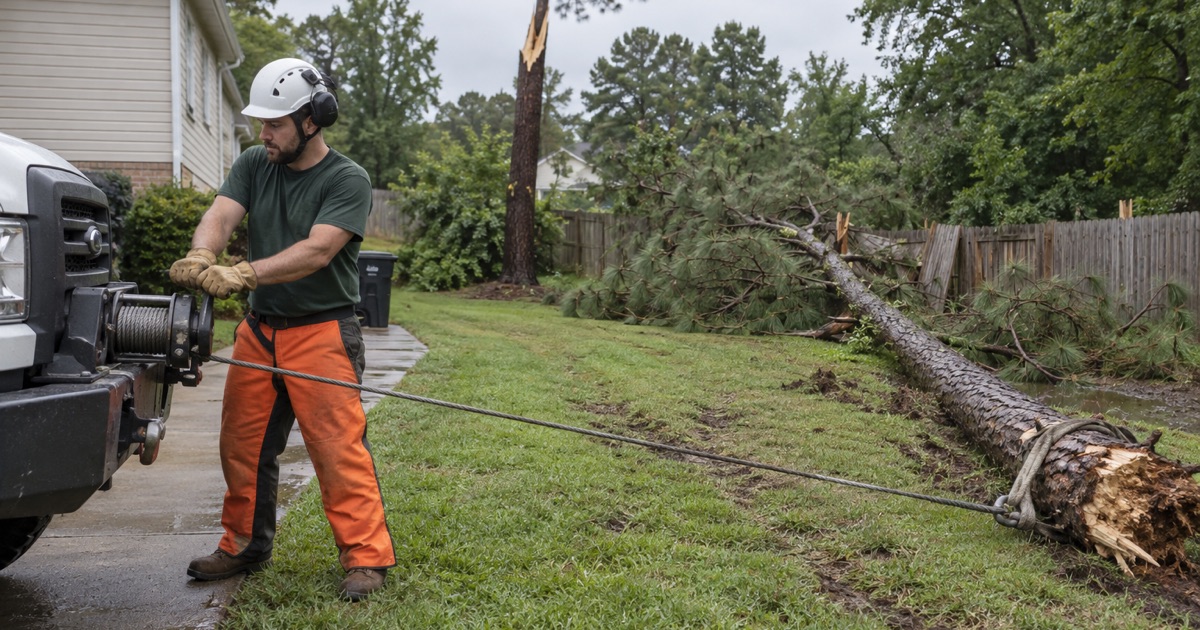
A fallen trunk is holding tension and compression in places that are not obvious from the ground, and a limb under bend releases with real force when it is severed. We work out the sequence first: what is supporting what, which cut relieves pressure and which one drops weight, and where every person will be standing when each one is made. That analysis takes minutes and it is the difference between a controlled removal and a second incident.
Securing the Scene and the People In It
Everybody comes out from under the tree and stays out, including the owner who wants to show us something. Downed conductors are treated as energized until the utility says otherwise, and the ground around them is treated as energized too. Where a structure is compromised we say so and keep people out of that part of the building until somebody qualified has looked at it.
Documenting the Failure Before It Is Disturbed
Once the removal starts, the evidence goes into a chipper. We photograph and note the position of the tree, the point of impact, the failure surface at the base or the union, and the direction everything traveled, because that is the record your claim gets decided on. It costs us a few minutes and it has settled a number of coverage arguments that would otherwise have been one person’s word.
Trees on Structures, Vehicles and Lines
A Tree Through the Roof
When a trunk is resting on a roof it is transferring load into a structure that was not designed for it, and taking that load off in the wrong order sends the rest of the tree through the ceiling. We rig and stabilize the stem before anyone climbs, then remove it in pieces sized so the roof never carries more than it already is. Where a crane can reach, lifting the trunk off vertically is frequently the least damaging route available.
A Tree on a Vehicle
A car under a tree is a comprehensive auto claim rather than a homeowners one, per the state Department of Insurance’s own guidance, and knowing that before you file saves opening the wrong claim and the wrong deductible. The removal itself is careful rather than heavy: the vehicle is glass and sheet metal and everything that comes off the tree lands somewhere. We photograph the position before the first cut for the same reason we do it on a house.
Trees on Service Drops and Communications Lines
The drop from the pole to your meter is the conductor most often caught in a failure, and it is commonly something the provider will disconnect on request so the tree can be worked safely. Phone, cable and fiber drops are a different matter again: not energized, not ours to cut, and a fiber line torn away is its own repair on its own schedule. We identify every line in the work zone and tell you which company has to release which one.
Working Safely Around Energized Conductors
Confirming the Provider for the Address
There is no single electric utility across this service area. Duke Energy Carolinas holds the largest share, Laurens Electric Cooperative, Blue Ridge Electric Cooperative and Broad River Electric each hold their own territory, and several municipalities run their own systems. We establish which one serves the address before a crew is dispatched, because a utility cannot de-energize a line it does not own and the wrong call costs you the afternoon at the worst possible time.
The ANSI Z133 Weather Limits
The ANSI Z133 safety requirements govern approach distances near energized conductors and also set the conditions under which the work stops: ice, high wind, and thunderstorms in the area. A crew that pushes through those is not being tenacious on a customer’s behalf. We reschedule and explain why, and we do not quote a storm job on the assumption that the weather will cooperate.
Clearance Work That Is Not Ours to Do
High-voltage distribution lines belong to the utility and stay with the utility, on its own clearance cycle and by its own line-clearance crews. Our work near them is around what we are permitted to touch, with the rest reported to the provider. Being clear about that boundary is not a limitation to apologize for; it is the reason nobody gets hurt on a job where the power is still on somewhere.
After the Storm Passes
Storm Debris and Where It Can Actually Go
Once a tree is on the ground the job is hauling, and hauling is where storm quotes diverge most sharply. Municipal collection here is a residential service for material the resident cut, and the temporary arrangements that allowed city crews to take contractor debris during the 2024 recovery have ended. Assume the pile leaves on our trucks, and see it priced against the gate it is genuinely going to.
Delayed Failures and the Post-Storm Inspection
The failures that follow a major wind event by six or twelve months are the trees that were loaded but not broken: root plates that shifted, unions that cracked internally, roots torn on one flank. None of that necessarily shows in a full green canopy. An inspection after a storm reads the root flare, the soil around the base and the major unions, and no published source names a species that failed here in 2024, so we assess trees individually rather than by reputation.
Insurance, the $500 Allowance and Whether to File
South Carolina Department of Insurance guidance states that the $500 debris-removal allowance applies to all downed trees per loss rather than per tree, which is the detail that catches people after a wide event with four trees down. We quote the removal and the haul as separate lines so you can see exactly where the allowance runs out, and we will tell you when a claim is not worth filing rather than letting you find out after it is on the record.
- 20+ Years in the Upstate
- Free Estimates
- Written Tree Condition Reports