Tree Removal Permits on a Residential Lot
Inside the City of Greenville, an existing single-family home whose owner acquired title on or before June 30, 2021 is exempt from the tree protection ordinance outright, while an owner who acquired title on or after July 1, 2021 is exempt except for the heritage tree protections. Inter-family and inter-spousal transfers do not count as acquiring title. Elsewhere in the ring the answer ranges from a full ordinance to no tree article at all.
Five Counties, One Question, Different Answers
Our service area crosses Greenville, Spartanburg, Anderson, Pickens and Laurens counties, and the municipalities inside them do not agree with each other. The Town of Central’s zoning ordinance runs 136 pages and contains no tree protection article, no heritage tree definition and no removal permit, while the City of Greenville repealed and replaced its own tree section by ordinance in January 2021. The boundary between two answers can run down the middle of a street.
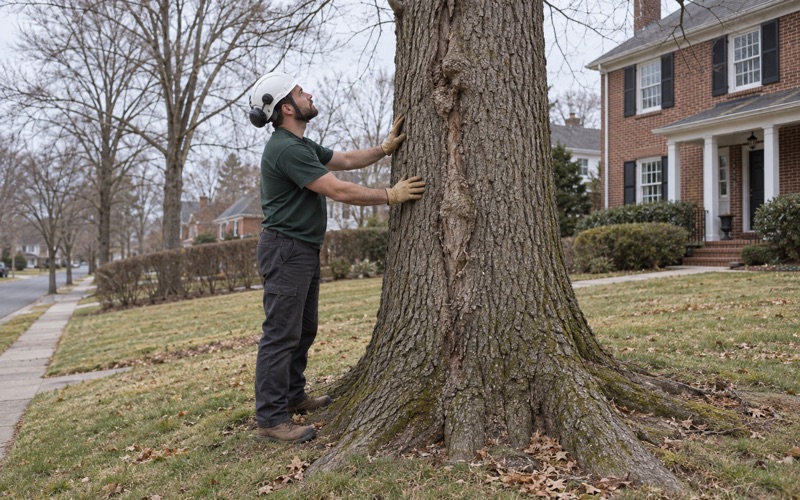
A heritage tree in the City of Greenville may not be cut, removed, trimmed, sprayed or destroyed without written approval on a Heritage Tree Disturbance Form, and the administrator may approve disturbance only on a finding that the tree is in a dangerous or deteriorating condition. A removed heritage tree is then assessed $45 per caliper inch on top of ordinary mitigation. The condition documentation that application rests on is exactly what our assessment produces.
Heritage and Specimen Tree Thresholds, Quoted Correctly
The City of Greenville defines a heritage tree as healthy and disease-free and either 20 inches diameter at breast height or greater inside a setback or buffer, or 40 inches or greater anywhere in the city, or determined by the administrator to be of cultural importance. Those are three separate triggers, not one number. A company quoting a single round threshold across the whole Upstate has read none of them.
Trees Inside the Airport Environs Area
The Greenville-Spartanburg Airport Environs Area Zoning Ordinance defines an airport hazard as any structure, tree or use of land exceeding the federal obstruction standards, and compliance with it is administered by Greenville County, Spartanburg County and the City of Greer. Where local zoning conflicts with the overlay, the overlay controls. We establish whether a parcel sits inside the Environs Area before quoting anything that grows.
Tree Service Licensing in South Carolina, Answered Plainly
South Carolina issues no arborist or tree-contractor license and requires none. The Contractors’ Licensing Board licenses construction above $10,000 in total cost with no tree, arborist or land-clearing classification, and the state registers foresters under an entirely separate program. What that means for you is that insurance certificates and demonstrated method are the checkable things, and a license claim is not.
Limbs Overhanging From a Neighbor’s Tree
The trunk decides ownership, so a limb reaching across the boundary is still part of your neighbor’s tree. What a property owner may generally do is cut back what crosses the line at their own cost; what they may not do is damage or kill the tree in the process. We measure the cut before we make it, and we put the plan in writing so the conversation next door has something to point at.
Pruning to the Property Line Without Killing the Tree
Taking every limb on one side of a trunk back to the boundary can remove enough live crown to push a tree into decline, and a dying tree on the far side of a line turns into an argument nobody wanted. We work the reduction to the objectives and cut types defined by the ANSI A300 pruning standard, removing what crosses the line in stages the tree can carry.
Written Notice on a Hazardous Neighboring Tree
South Carolina frames falling-tree liability around act of God and negligence, and a documented notice is what moves a known defect out of the first category. We write a tree condition report naming the defect, the target it threatens and the assessed risk, dated, so there is a record of when the owner was told. What the neighbor does with it is theirs; the record is yours.
Tree Value and the Registered Forester
South Carolina Code Section 16-11-615 provides treble damages for trees cut without the owner’s consent, with the value of the tree established by a registered forester. That is a specific state-registered professional, not a number a tree crew writes on an invoice. If a contractor or a neighbor has taken a tree that was not theirs, we will tell you plainly that the valuation is not ours to produce.