Greenville Tree Removal Team has worked as the arborist on Upstate trees for more than twenty years, across Greenville, SC and the surrounding cities including Gantt, Mauldin, Five Forks, Powdersville and Simpsonville. An arborist visit here is not a sales call with a chainsaw already in the truck. It is an assessment that ends in a written answer about one specific tree, with the alternatives priced next to the removal.
South Carolina issues no arborist license and requires none, which is why the word gets used loosely in this market. The City of Greenville’s own tree ordinance settles what it means for regulatory purposes by defining an arborist as a person certified by the International Society of Arboriculture and a member in good standing. That is the standard a tree condition report is written against, and it is the thing worth checking on a quote.
What two decades here buys is a sense of which defects actually go on to fail: the union that opens on a mature pear, the root plate that lifts in saturated Piedmont clay, the ash that has been dead considerably longer than the owner thinks. The report names the defect, the target underneath it, and what each course of action costs.
What an Arborist Reads Before Anyone Quotes a Removal
The Root Flare and Root Collar
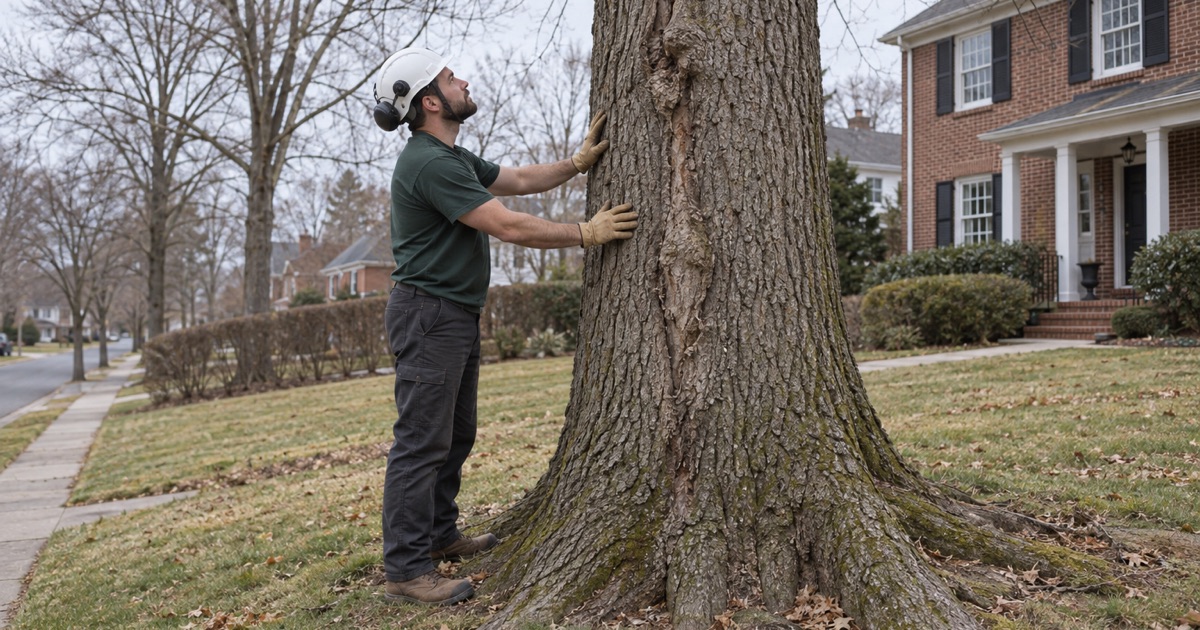
The base of a trunk says more about a tree’s future than the crown does, and on most residential lots it sits buried under years of mulch and settled soil. We perform a root collar excavation with an air spade, which moves soil using compressed air rather than a blade and leaves the roots themselves intact. What that exposes — girdling roots, decay at the buttress, a flare planted three inches too deep — is not visible any other way, and it is frequently the whole explanation for a decline nobody could account for.
Trunk Unions, Co-Dominant Stems and Included Bark
Two stems of similar diameter rising from one point form a union with little interlocking wood, and where bark has been drawn inward as they grew there is almost none at all. We sound the trunk, read the union geometry and the bark seam, and record whether the defect is progressing or static. Included bark is the most common structural finding on mature suburban hardwoods in this region, and it is also one of the most frequently correctable.
Decay Indicators and Fungal Conks
A conk on the buttress is the fruiting body of decay that has been working inside the structural roots for years before anything showed. We map where the fruiting sits against where the tree carries load, because decay on the tension side of a leaning stem is a different problem from the same decay on a buttress holding nothing up. Fruiting bodies in the lawn near a trunk are a reason to look properly rather than a conclusion.
Level 2 Basic Tree Risk Assessment
What a Level 2 Assessment Covers
A Level 2 basic tree risk assessment is a systematic ground inspection of the entire tree from every reachable side, using hand tools rather than a climb or diagnostic instrumentation. It answers the large majority of residential questions without the cost of an advanced assessment. Where something cannot be resolved from the ground, the report names the technique that would settle it instead of filling the gap with an opinion.
Targets, Occupancy and What Sits Underneath
Risk is never a property of the tree alone. It is the tree, the part likely to fail, and what happens to be under that part when it does. A hollow trunk over a back fence line and the identical trunk over a driveway where a car sits every night produce different ratings from the same defect. We record the target and how often it is occupied, because occupancy is usually what moves a finding from monitor to act.
Likelihood, Consequence and the Rating That Comes Out
A rating combines how likely the part is to fail, how likely it is to strike the target if it does, and how severe that strike would be. Stating those three separately is what makes a report useful to somebody else, because a committee or an adjuster can see which input drove the conclusion. A single adjective with no structure behind it is precisely what this replaces.
Consulting Arborist Reports You Can Hand to Someone Else
Reports Written for an Insurance Adjuster
An adjuster is deciding whether a failure was foreseeable and what the loss actually amounted to, and a dated description of the defect, its condition and the direction of failure is what that decision rests on. We photograph and describe rather than argue coverage on your behalf. Where a claim is not worth filing, we will say so, because a denied claim still sits on the policy history afterward.
Submissions for an HOA Architectural Review Committee
Committees approve tree work against covenants that are usually silent on arboriculture, so a submission naming the objective, the standard and the finished result moves faster than one asking for permission to cut. Our report states the pruning objective in the terms the ANSI A300 standard defines and describes what the tree will look like afterward. That is a document a committee can attach to its minutes and move on.
Documentation for a Conversation Over the Property Line
When the tree in question stands on the other side of a boundary, what helps is a dated, specific record of the defect and the target — not an opinion delivered at the fence. South Carolina’s approach to falling-tree liability turns on what the owner knew and when, so the date on a report carries weight alongside the finding. We write these to be handed over rather than filed.
When the Assessment Says Keep the Tree
Cabling, Bracing and Supported Unions
A union with included bark that has not yet failed can often be held rather than cut out, using extra high strength cable set high in the crown, or a brace rod through the union where a split has already begun. A dynamic cabling system is the choice where some sway should be preserved so the tree keeps building reaction wood. Any hardware installation commits you to an inspection interval, and the report names it up front.
Soil Decompaction and Radial Trenching
A tree declining in a yard that was graded, parked on or built around is usually losing to compacted soil rather than to a pest. Radial trenching with an air spade opens narrow channels running out from the trunk and backfills them with amended soil, while broader decompaction treats the whole root area at once. It shows results more slowly than a removal does, and it costs a great deal less.
Crown Reduction Rather Than Removal
Where the worry is one long overextended limb instead of the whole tree, reducing that limb back to a live lateral takes away the leverage without taking away the canopy. We quote the reduction and the removal together so the difference between them is a number rather than a sales argument. Plenty of trees that worry an owner do not need to come down, and saying so is part of what the assessment is for.
Our Step-by-Step Tree Risk Assessment
Step 1: Walk the Site and Map the Targets
We start away from the tree, identifying what sits within reach of a failure and how often anybody is there: the house, the drive, a shed, a play area, the sidewalk, the neighbor’s roof. That map is what every later finding gets rated against.
Step 2: Expose and Read the Root Collar
Mulch and settled soil come off the flare with an air spade so the buttress roots can actually be seen. Girdling roots, decay pockets and a buried flare are all found here, and all three are commonly missed by an inspection that starts at eye level.
Step 3: Sound the Trunk and Assess the Unions
The trunk is sounded from the base upward and every major union is read for geometry, bark inclusion and movement. Where the crown needs a closer look than the ground allows, we say so rather than reporting what could not be seen.
Step 4: Write the Report and Price the Options
You receive a dated written report naming the defect, the target, the assessed risk and every reasonable course of action with a price beside it. Removal appears on that list when it belongs there, alongside the pruning, support and soil work that might make it unnecessary.
- 20+ Years in the Upstate
- Free Estimates
- Written Tree Condition Reports