Greenville Tree Removal Team has handled tree removal in Williamston for more than twenty years, and on a job here the first question we settle is not how the tree comes down but where the wood goes. The Town of Williamston runs its own curbside collection, Anderson County runs a landfill gate at Starr, and the two authorities measure woody debris by different numbers. Which of those numbers a stump or a log falls between decides how the tree gets cut up.
That matters more here than it does in most of the places we work, because the town’s own collection list includes the two materials a removal produces that nothing else wants. We name the disposal route in the estimate rather than after the fact, and we put the inclusions in writing first: the trunk rounds, the stump, the grindings and the chips. The wood is a line item, not a surprise.
South Carolina issues no arborist license for this work and requires none, so we tell you what the state actually asks for instead of borrowing a word the state does not grant. What is checkable is an ISA Certified Arborist on the crew and current certificates of insurance, and we hand those over before anyone starts a saw.
What the Town of Williamston Will Actually Take From Your Curb
The vegetative pile, word for word
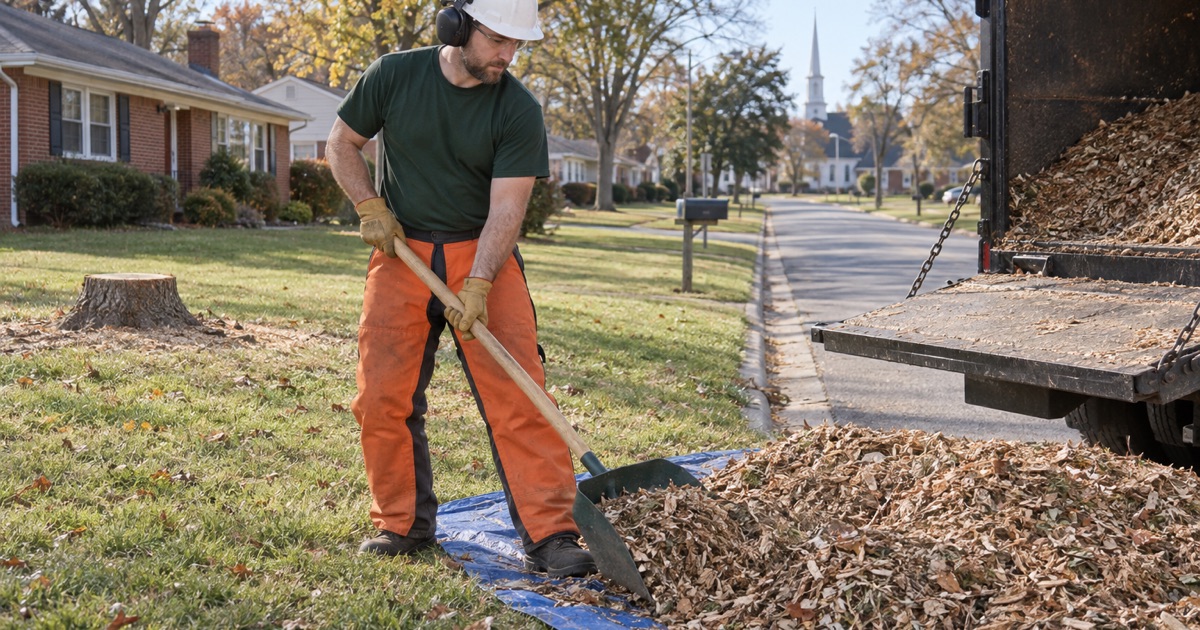
The Town of Williamston Waste Department, at 12 West Main Street, publishes a Separation Requirements For Trash Collection sheet, and the vegetative pile on it is listed item by item: stumps, no larger than 2’ x 2’; loose leaves; silt; logs 2’ or shorter; loose grass; roots; limbs. Two of those words carry this entire page. Stumps and roots sit on a municipal collection list, with a size rule attached rather than a refusal.
Those are the two materials a removal produces with no ordinary outlet: the stump because it is heavy, dirty and shaped wrong for any container, and the root plate because it lifts out of the ground with soil still on it. Plenty of towns write both out of the accepted pile entirely. This one writes them in and puts a dimension on them.
It is worth reading the sheet for what it leaves out as well. No diameter cap on limbs is published and no length cap on limbs either; the only dimensions given for woody material are the two-foot stump cap and the two-foot log cap. We read the collection rules for the jurisdiction a tree actually stands in, because this service area crosses Greenville, Spartanburg, Anderson, Pickens and Laurens counties and the answer changes at the line.
A pile gets left behind, and the truck does not leave a note
Separation is mandatory here and it is enforced by non-collection. In capitals over the vegetative list the sheet says: “These items, and only these items can be placed together for pickup. NOTHING ELSE CAN BE PLACED WITH THE FOLLOWING!” It adds that items which do not get picked up may reflect a failure to follow the separation guidelines.
There is no fine, no citation and no notice; the enforcement mechanism is simply that the truck goes past. On a removal that has a direct consequence: a vegetative pile with a scrap of tarp, a trash bag or a length of construction lumber mixed into it is not a partly collected pile, it is an uncollected pile. It sits at the curb until somebody separates it by hand.
Demolition material has its own separate pile in the same document, covering mirrors, untreated lumber, insulation, wall tile, wire, furniture, hardened concrete, plaster board, roofing materials, floor coverings, glass and bricks. A third group is refused from the roadside altogether: shingles, lead based paint, lumber containing lead based paint, pallets, asbestos and utility poles are the resident’s own trip to the landfill.
Looking for tree-removal closer to Lyman? See Tree-Removal in Lyman.
Two-Foot Rules on Both Sides of the Line, and They Do Not Agree
This is where a removal here actually gets priced, and it takes both authorities on the page at once. The town collects and the county accepts, and the two of them measure differently.
The town measures one way
The town’s rule is uniform and short. Stumps, no larger than 2’ x 2’, and logs 2’ or shorter, one two-foot standard for every piece of woody material, whatever its thickness.
The county publishes a ladder
Anderson County’s Starr C&D and LCD Landfill, at 390 Roy Arnold Road in Starr, sets its limits by thickness instead. Material 18 inches wide or smaller should be cut 6 feet long or shorter; material 19 inches wide or larger should be cut 2 feet long or shorter; and Starr does not accept stumps that are 2 feet high and 3 feet wide or larger.
Put the two side by side and three practical answers fall out. For ordinary limb wood under eighteen inches thick the county gate is three times more permissive, six-foot lengths against two-foot pieces, so a crew cutting for Starr and a homeowner cutting for the curb are cutting the same tree into different sizes. For heavy wood nineteen inches and thicker the two rules converge on two feet and there is nothing to save either way.
The third answer is the one that surprises people. A stump between two and three feet wide is refused by the town and accepted by the county, because the town caps at 2 feet by 2 feet while Starr only turns one away at 2 feet high and 3 feet wide. On exactly the material a homeowner most wants gone, the town’s own truck is the stricter of the two.
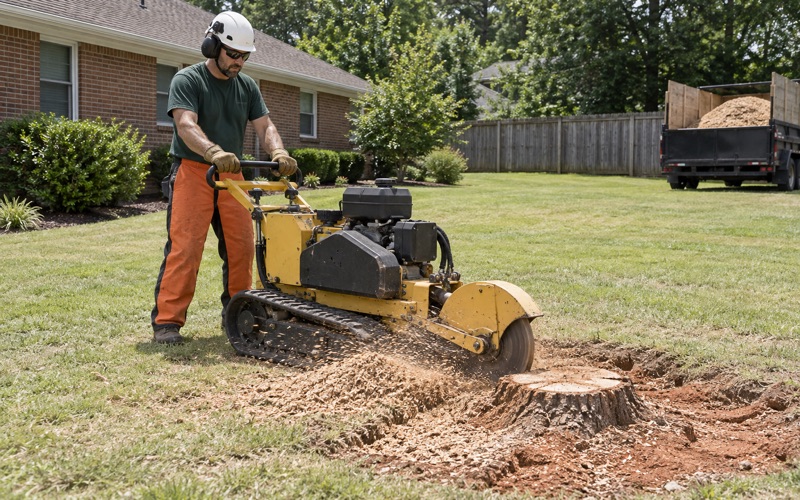
So we measure a stump before quoting it rather than after. Grinding in place with a tracked stump grinder leaves grindings and nothing to haul; pulling the root plate leaves a hole and a load that has to be legal at whichever gate it is headed for.
Three Ways One Tree Leaves a Williamston Yard
Between the curb and the landfill there are three genuinely different disposal routes for a single tree. Which one is cheapest depends on how the wood is cut and who is driving, and that is not our opinion: the numbers are published by the town and the county.
The town truck at the curb
The first route is the curb, inside the two-foot rule and separated the way the sheet requires. It costs nothing beyond the cutting, and on a small removal it quietly does most of the work, because stumps and roots are on the accepted list.
Your own vehicle to the Starr gate
The second is a trip to Starr in your own truck or trailer. The county publishes that Anderson County residents are not charged for C&D and LCD disposal or non-contaminated metal, and land-clearing debris is expressly accepted: vegetation, clay, soil, sand, gravel, logs, rocks, tree stumps, brush and limbs, and roots. Cut to the county’s ladder rather than the town’s and a pickup bed carries a surprising amount.
Our truck, and the sentence that changes the price
The third route is ours, and it is the one that carries a disposal charge. Anderson County publishes the sentence that changes the arithmetic of a hired job: if a resident pays someone to haul their material to the Starr Landfill, then the person hauling or the commercial business will be charged for disposal. That crossing is billed as commercial C&D and LCD at $33 per ton, on top of a two-year commercial permit at $20 for each truck.
We price disposal for the county a job is actually in, because one gate in this service area charges by the cubic yard, the next by the ton, and two of them are free only to their own residents. On a job here that means the estimate names the route before you sign it. If splitting the load is cheaper, some of it to the curb and the rest on our truck, we will tell you that.
A Town Built in the 1950s, With Trees That Are Aging Together
Housing here arrived in a wave, and the shade trees went in with it. Some 521 units, 27.1% of the entire stock, were built between 1950 and 1959; 58.1% of the stock predates 1980; and only 85 units have been added since 2010.
A cohort like that is a fact about trees more than about houses. The shade trees planted around a 1950s house are now roughly seventy years old, which for most Piedmont hardwoods, and certainly for the short-lived species people plant around a new house, is late middle age or past it. They decline on the same schedule and they fail in the same storms, so a street can go from comfortable to hazardous over a few seasons without any one owner having done a thing wrong.
Ground, slope and access
The stock is 78.3% one-unit detached at roughly 502 housing units per square mile, which means separate houses on their own lots rather than a dense core. Crane and rigging capacity matters more on that pattern than tight-access technique, though we bring compact tracked equipment when a back-yard gate is the real constraint.
The soils are Piedmont ultisols, the Cecil and Pacolet and Madison series and their relatives, running deeper than 60 inches to bedrock against a stump grinder that cuts roughly 12 to 25 inches below grade. The machine’s own stop binds first by several times over, so there is no shallow-rock warning to give and no bedrock story worth telling. What binds instead is wear from the quartz and rock fragments in the topsoil, and slope: the Pacolet series commonly runs 15 to 25 percent slopes, and a chipper, a grinder and a loaded truck are all slope-limited long before they are depth-limited.
The older part of the story
Williamston is an incorporated town in Anderson County, and its population was 4,043 at the 2020 census. Its origin is a spring: in the fall of 1842 a landowner named West Allen Williams dreamed of a clear spring with healing qualities, woke, followed a trickling sound and found a mineral spring on his property. The settlement was known as Mineral Springs until 1852, when it took his name.
After the railroads arrived in 1851 it became a resort the town’s own history calls the Saratoga of the South, and the Mammoth Hotel built for those visitors was the largest building in the state at the time, with 150 rooms plus bowling alleys and ballrooms, until fire destroyed it in 1860. Mineral Spring Park survives as the civic center and hosts the annual Spring Water Festival. The trees around that older core keep their own schedule, separate from the postwar streets.
We prune to the objectives, systems and cut types the ANSI A300 standard defines, and we do not top trees; rigging follows the ANSI Z133 safety requirements, including the weather limits that stop work near energized conductors. When a tree can be cabled, braced or crown-cleaned instead of removed, we will say so and price both options. Estimates are free, and we will write up a tree condition report you can hand to a neighbor, an insurance adjuster or an architectural review committee.
- 20+ Years in the Upstate
- Free Estimates
- Written Tree Condition Reports