Greenville Tree Removal Team has handled tree removal in Travelers Rest for more than twenty years, and the first thing we look at on a call here is rarely the gate. It is the ground. The lots on this end of the county pitch, and pitch is what decides whether a tree comes down in one piece, in rigged sections, or over a lowering line worked from an anchor uphill of the drop.
That is not something we settle from a map or a photograph. We walk the lot, read the fall lines, and price the work against how the machine can actually reach the stem, which is why two removals of the same species and the same trunk diameter can carry different numbers a mile apart.
Our crews work across the Upstate, and we have spent enough time on both sides of Greenville County to know that the two sides do not hand us the same job. Below is what changes here, what it does to the equipment, and who has a say in the tree before it comes down.
The trees on this side of Greenville County are not the same trees
Greenville County straddles two Level IV ecoregions, and Travelers Rest sits in 45a, the Southern Inner Piedmont. The identical query against the EPA layer returns 45b, the Southern Outer Piedmont, at other points tested in the county, so the difference is mapped rather than a local impression.
The published description of 45a carries oak-pine and oak-hickory forest with less loblolly-shortleaf pine than 45b. On a working lot that reads as more hardwood weight overhead, with pine mixed through the canopy rather than dominating it, and hardwood weight is what governs how a limb is rigged and lowered.
Escarpment view, Piedmont ground
The Blue Ridge Escarpment is close enough to be part of the view here, and the city’s own visitor material puts it beyond the low Piedmont hills rather than under the town. That distinction matters to the work: the ground under a removal in this city is Piedmont foothill, and the forest behaves like Piedmont forest.
The EPA describes the line between 45a and 45b as transitional, so the map is a regional statement and not an answer for one address. We use it to set expectations about species mix and then confirm what is actually standing when we get there.
What the mix changes about the work
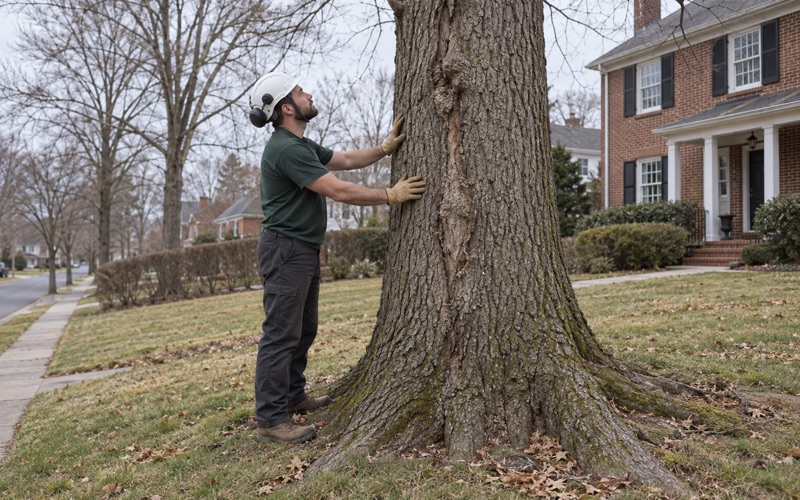
Species mix also decides what we look for before anyone climbs. Hardwood in this mix tends to fail at co-dominant stems with included bark, and a conk at the base of an oak tells us more about the removal plan than the crown does.
Emerald ash borer is confirmed present in Greenville County, so an ash in decline here gets looked at with that in mind rather than written off as drought stress. Where published state guidance is contradictory, we say so instead of inventing a rule, and we handle the wood the way the job and the county disposal gate require.
Looking for tree-removal closer to Greer? See Tree-Removal in Greer.
Slope, not driveway width, decides how a removal is rigged
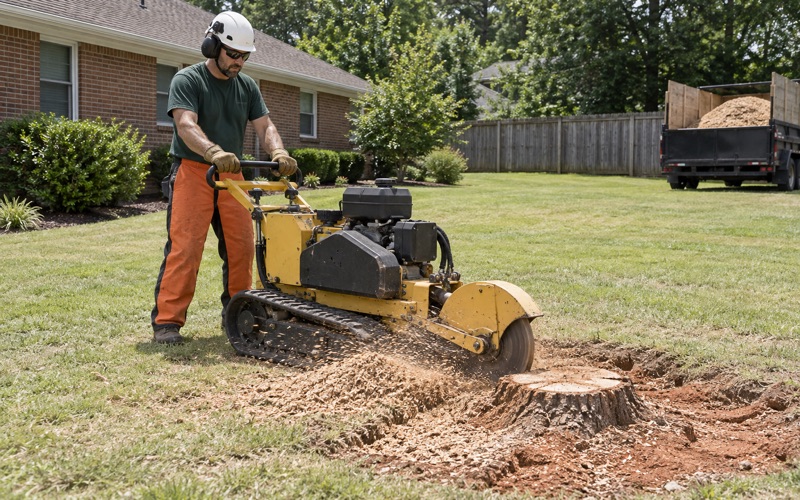
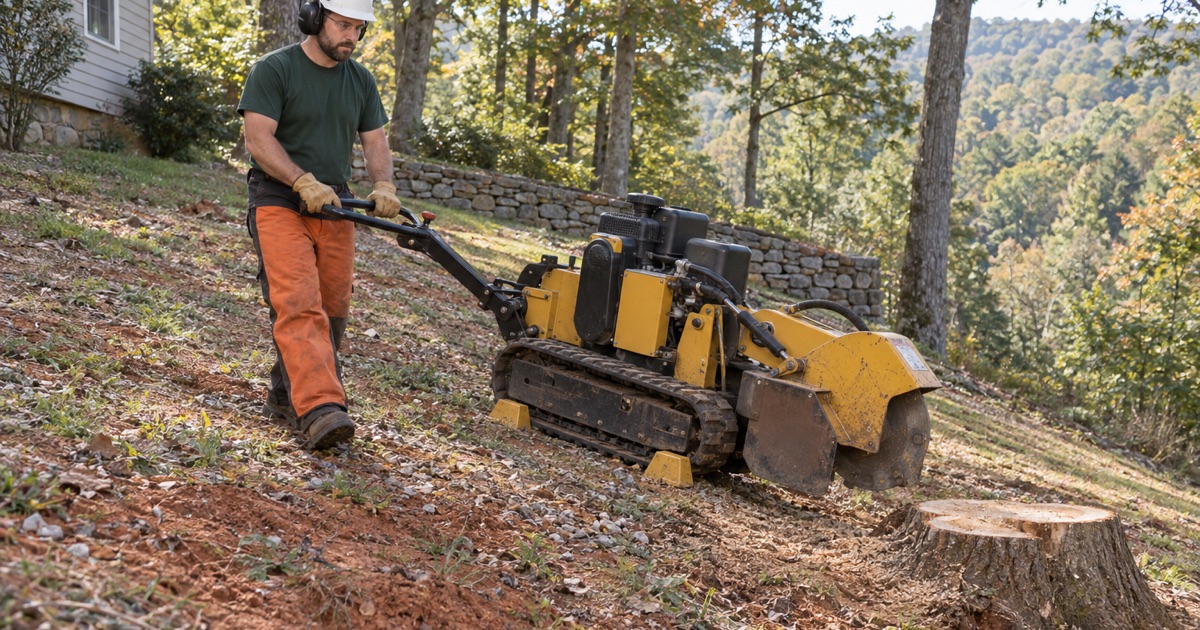
The soils here are Piedmont ultisols, and the published series descriptions put depth to bedrock at greater than 60 inches for Cecil and Pacolet and greater than 72 inches for Madison. A stump grinder is rated to cut roughly 12 to 25 inches below grade, so bedrock is not what stops a grind on these lots.
What does constrain the work is pitch. The Pacolet series is described with slopes commonly 15 to 25 percent, and a yard at that grade changes everything about how a machine is positioned, how a stem is tied off, and where the wood can be dropped without it running.
Grinder wear is a separate question from depth. The A horizon in these series carries 0 to 35 percent rock fragments, and quartz in that fraction is what takes the edge off grinding teeth, which is why a stump on a rocky shoulder can take longer than a bigger stump in clean soil.
Matching the machine to the grade
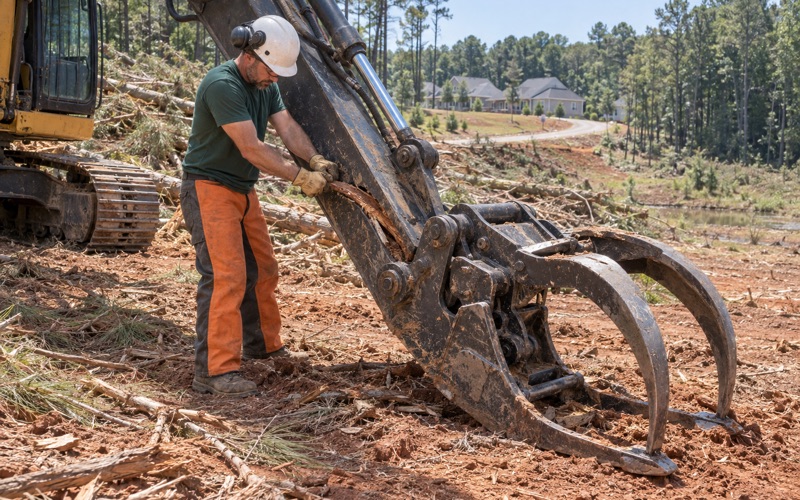
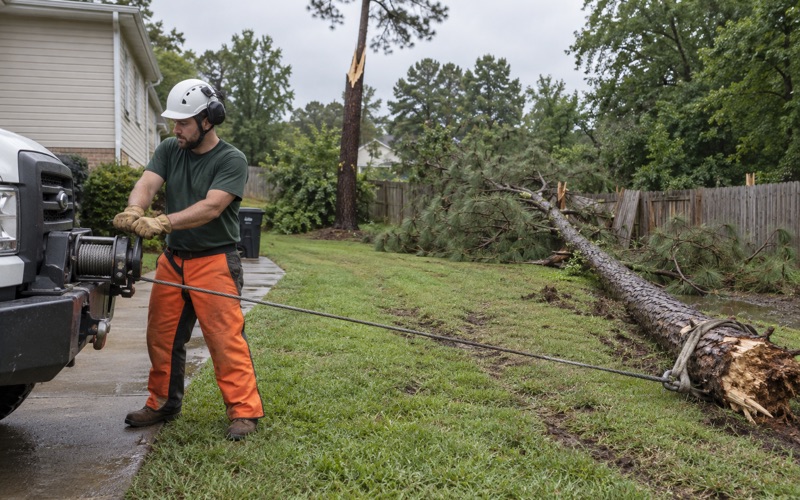
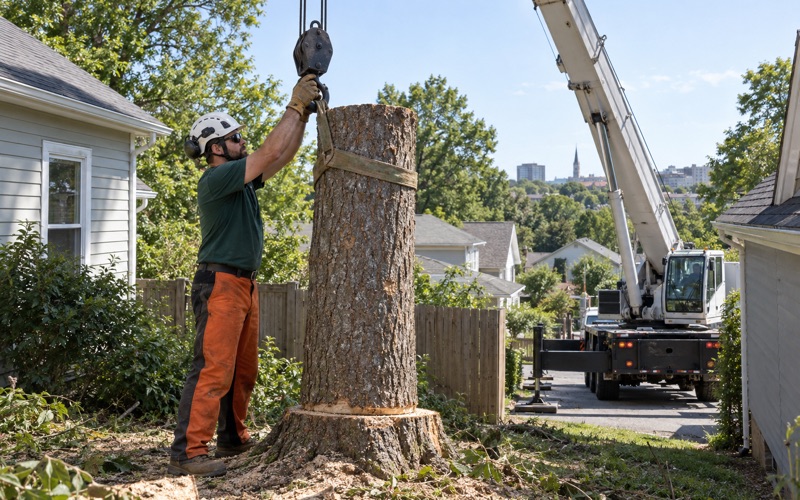
We carry compact tracked equipment that fits a backyard gate, which keeps a subdivision tree from becoming a crane job by default. On a steeper lot the same reach is often better served by a spider lift or a crane-assisted removal, because putting a machine where it cannot hold the slope is how a job turns into two.
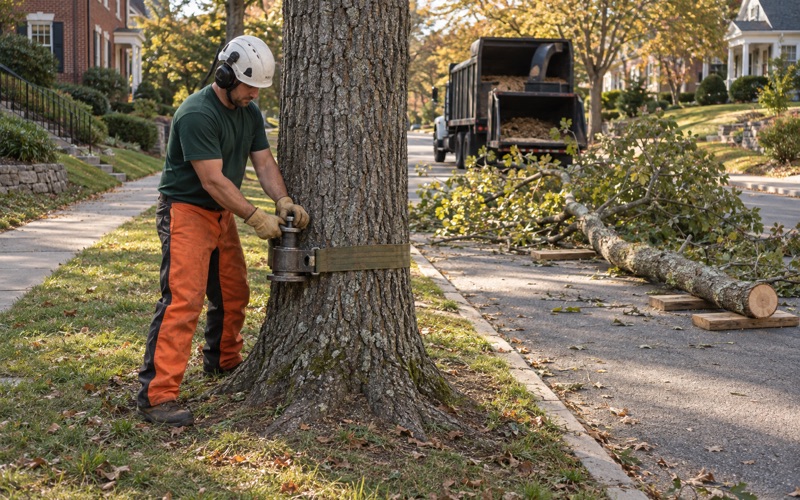
Where the slope rules out a machine under the tree, the work goes vertical and comes down on a line. Our rigging and line-clearance practice follows the ANSI Z133 safety requirements, including the weather limits that stop work near energized conductors, and the pieces are sized to the working load limit of the friction lowering device and the rigging block, not to what a rope looks like it can take.
What a straight quote on a sloped lot looks like
Estimates are free, and we would rather spend twenty minutes on the slope than send you a number off a photograph. We walk the drop zones, note where the tracks can sit, decide whether the stem comes down in sections or over a crane, and tell you what the stump grind will cost separately from the removal.
Sometimes the answer is that the tree does not have to come out. A Level 2 basic tree risk assessment on a leaning oak often ends in cabling and bracing or a crown reduction instead of a removal, and we will tell you what each option costs so the choice is yours rather than ours.
What Helene left in the northwest corner of the county
Hurricane Helene ran through the Upstate over an incident period of September 25 to October 7, 2024, and the National Weather Service office in Greenville-Spartanburg reported that many trees were uprooted or snapped across the region. A brief tornado occurred near Cleveland, in northwestern Greenville County, the same end of the county as this city.
Roughly 95 percent of Greenville County customers lost power, and the county recorded six deaths, several of them from falling trees. That is the storm our response planning is built around, rather than a generic coastal script written for a different kind of ground.
We will not tell you which species failed. No published record names a species that failed disproportionately in that storm, and a confident answer on that point would be invented rather than researched. What we can say is that windthrow on a slope lifts a root plate differently than it does on flat ground, and a leaning stem with a heaved root plate is a different removal from a snapped stem still rooted.
After a storm we write up what we found. A written tree condition report is something a homeowner can hand to a neighbor, an insurance adjuster or an architectural review committee, and we will give you a straight answer on whether a job is worth putting through a claim at all.
Two power companies, one address
Before we quote anything near a conductor we establish which utility owns the line, because more than one authority operates here. Duke Energy Carolinas serves most of the county, while Blue Ridge Electric Cooperative states that it serves northern Greenville County and keeps a district office on Highway 11 in this city.
A January 2026 winter storm outage report listed roughly 1,000 outages in Travelers Rest and named more than one electric authority at once, which is the plainest evidence that a town name does not tell you who owns the pole. We read it off the meter before a saw goes anywhere near a service drop.
Who verifies the tree, and where the wood goes
South Carolina issues no arborist license and requires none, so we do not present ourselves as holding one, and we would be suspicious of any company here that claims a state credential. What the state leaves open, the city’s code fills in a narrow way: Section 6:19.9 of the zoning ordinance conditions tree preservation on trees being in good health and free of damage or disease as verified by a certified arborist, which makes a private trade certification the verifier.
Those rules are a development standard. They apply when land is being developed, and they do not require a homeowner to obtain a permit before removing a tree on an existing lot, which is the single most common misunderstanding we correct on a quote here.
On the development side the numbers are specific: a minimum of 20 percent of the mature tree canopy has to be preserved, replacement runs one-to-one on the diameter at breast height of what came out with a minimum replacement size of three caliper inches, and Exhibit B of that ordinance sets a fee-in-lieu of $50 per caliper-inch for each tree removed. If you are clearing for a build rather than taking one tree off a yard, those figures are the ones to price against.
Frontage, the trail, and the public works director
Two other pieces of the code come up on frontage work. Chapter 3.08 covers trees on or affecting public property and is administered by the public works director, who can order a nuisance tree removed from private property with a 15-day compliance period, and the city keeps a separate chapter governing public use of the Swamp Rabbit Trail. If a tree sits over a right-of-way or the trail corridor, we sort out who has authority over it before we bid the work.
The city’s code also makes it unlawful for any person, firm or city department to top a street tree, and we do not top trees anywhere, on public frontage or in a backyard. Our pruning is worked to the objectives, systems and cut types the ANSI A300 standard defines, which is what crown cleaning, crown raising or a crown reduction actually means on a work order.
Six inches is where the city’s brush stream ends
City brush collection caps tree waste at 6 feet in length and six inches in diameter, and contractors doing tree or brush work for compensation are required to remove the resulting debris from the premises and provide for lawful disposal of it. No trunk section off a removal clears a cap that size, so the municipal stream is closed to removal wood by design.
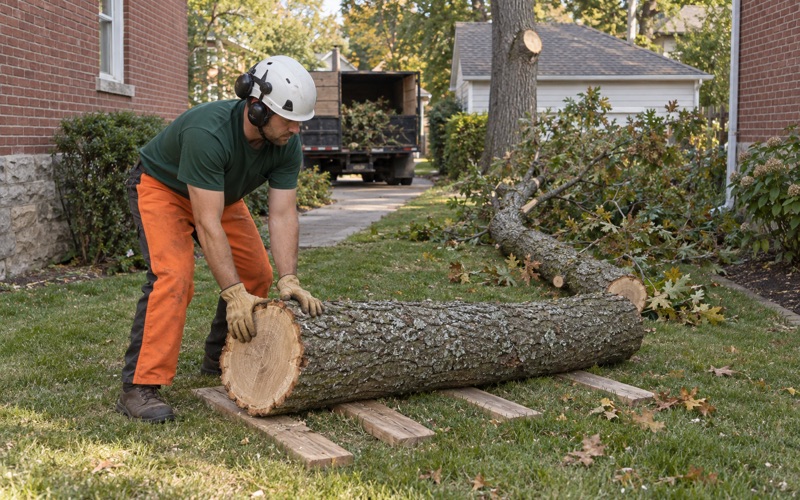
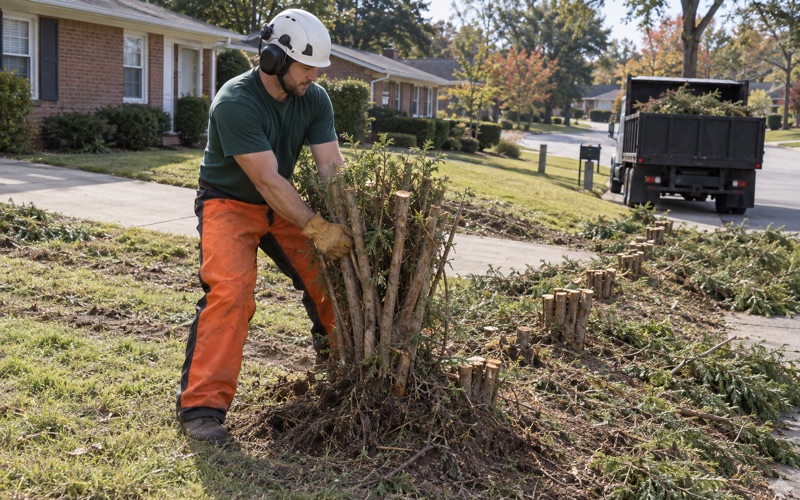
So the pile is ours to haul, and we say so before we start. We put the inclusions in writing, the trunk rounds, the stump, the grindings and the chips, and we price disposal for the county the job is actually in, because one gate charges by the cubic yard and the next by the ton.
- 20+ Years in the Upstate
- Free Estimates
- Written Tree Condition Reports