Greenville Tree Removal Team has handled tree-removal in Spartanburg for more than twenty years, and the question we answer most often here is not how a tree comes down but who carries the risk while it is still standing. A storm that a tree survives is not the end of the story. It is the beginning of a duty to look at that tree.
That is not our opinion. It is what the South Carolina Supreme Court told this city in a case that carries its name, and it is the frame an adjuster, a neighbor or a lawyer will use when a limb lands on something that matters.
We work the whole South Carolina Upstate, and we quote a Spartanburg address against Spartanburg rules rather than the ones that apply a county line away. Before any climber leaves the ground we establish which electric provider serves the address, what the city will and will not haul away, and whether the tree can be cabled, braced or pruned instead of removed.
The case that carries this city’s name turned a record storm into notice
In Correll v. City of Spartanburg (1933), the City answered a pedestrian’s death by pleading act of God after 6.93 inches of rain fell in a single day. The Palmetto Street sidewalk washout he fell into was roughly twenty feet long and five to six feet deep, and it had been there at least three to five days.
The court rejected the defense and affirmed the verdict against the City. Extraordinary rain, it held, was ‘sufficient to put them on guard’ and ‘should have made them especially diligent in the inspection of streets and bridges.’ The storm did not excuse the failure to inspect. It raised the duty to look.
No tree appears anywhere in that opinion, and we do not present it as a tree case. What it settles is the doctrine, and the doctrine reaches any owner whose property was put on notice by weather everybody watched. Correll also holds that a defendant’s negligence need not be the sole cause of the harm.
The trees that survived Hurricane Helene are the ones we are called to now
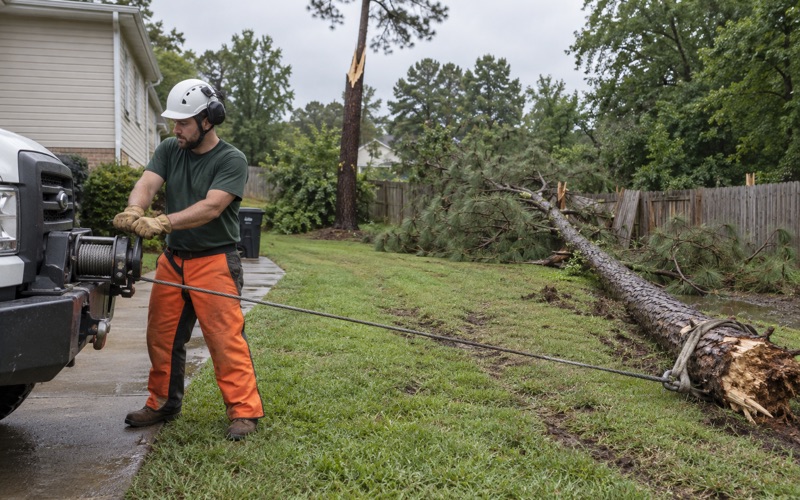
Hurricane Helene left roughly 99% of Spartanburg County without power in late September 2024, and the National Weather Service summary for this area repeats one phrase: many trees were uprooted or snapped. No published source names a species that failed. What we see now is delayed failure in stems that took the wind loading and stayed up, which is exactly the population the storm put on notice.
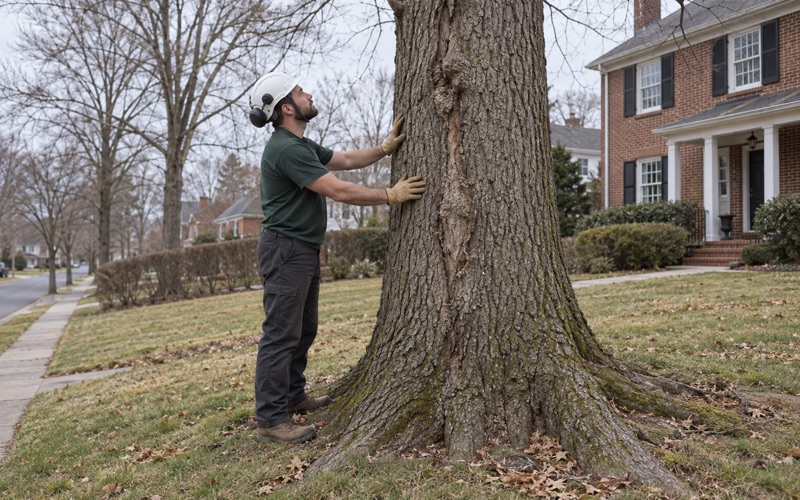
That is why our first visit to a storm-hit property is an inspection rather than a quote. We look at root plate movement, cracked soil at the root flare, hanging deadwood, and the co-dominant stems with included bark that open up under load. A Level 2 basic tree risk assessment gives you something dated and written, which is what turns a hunch into notice you can act on.
Looking for tree-removal closer to Boiling Springs? See Boiling Springs Tree-Removal.
What South Carolina asks after a tree falls on someone else’s property
South Carolina does not follow the Massachusetts or Hawaii rule. The frame here is act of God against negligence: a healthy tree blown over by a storm creates no liability, while a tree that was decayed, diseased, dead or otherwise dangerous before the storm can. Notice is the mechanism that separates the two.
Self-help over a property line is bounded twice. You may cut the limbs that grow onto your property, but you cannot kill the tree, and the cuts stop at the boundary line. We work those cuts to the objectives and cut types the ANSI A300 pruning standard defines, and we do not top trees.
The written report is the part that travels
A conversation with a neighbor is not notice. A dated condition report, with the defect described and the diameter at breast height recorded, is something a homeowner can hand to a neighbor or to an insurance adjuster. We write those reports whether or not the job ends in a removal, because half the time the honest answer is cabling and bracing, crown reduction or deadwooding rather than a stump.
What the state actually asks of the crew you hire
South Carolina issues no arborist license and requires none to cut trees for money, so we tell homeowners that plainly instead of calling ourselves licensed. The Contractors’ Licensing Board carries no tree, arborist or land-clearing classification at all. What the South Carolina Forestry Commission points homeowners to instead is the ISA Certified Arborist credential and verifying a certificate of insurance directly with the insurer.
Our rigging and line-clearance practice follows the ANSI Z133 safety requirements, including the weather limits that stop work near energized conductors. That matters here because the electric provider is address-specific: Duke Energy Carolinas serves the city, and the county’s own utility listing names other providers across the county. We confirm which one owns the line before we quote work near it.
Emerald ash borer has been confirmed in Spartanburg County since 2017, which makes ash in this stock a declining-species question rather than a hypothetical one. We will tell you what condition a tree is in, what the realistic options are, and what each one costs, in writing, before anything is cut. That is the same document that becomes your record if the tree is ever the subject of an argument.
The line in the city tree ordinance that excludes a house
The City of Spartanburg Zoning Ordinance section 505, Tree Protection and Landscaping Requirements, exists to discourage the unnecessary destruction of trees inside the city. Homeowners often assume it governs their yard. Subsection A of section 505.3 says otherwise: the single family dwelling or duplex exemption puts those parcels outside the section entirely, so the City requires no permit to take a tree off one.
The same exemption clause also carves out the approaches, called clear zones, to the Spartanburg Downtown Memorial Airport and the rights-of-way of utility companies. So the two regimes that most often govern a tree near a conductor or a flight path sit outside the city’s tree ordinance rather than inside it. That is worth knowing before anyone assumes one office can answer for all of them.
On the parcels the section does reach
Commercial, institutional, industrial, business and multi-family sites are a different matter. A landscaping plan there needs a twelve inch D.B.H. tree survey locating existing trees at or above that size, and the plan has to be prepared by a horticultural or landscape authority who puts a name and address on it.
Native yellow pines are held to a different bar in that survey. Shortleaf, longleaf, loblolly and Virginia pine are not required to be shown below 24 inches in diameter at breast height, so the code measures a pine differently from an oak.
Removing a protected tree on one of those parcels without approval is treated as a misdemeanor under the Zoning Ordinance, and replacement is measured in caliper: a minimum of two inches per tree, and a cumulative caliper at least equal to what came out. Where a site has no room left, the replacements can go on City property, and the City of Spartanburg Tree Board approves those plantings.
Old housing stock, mature stems, tight access
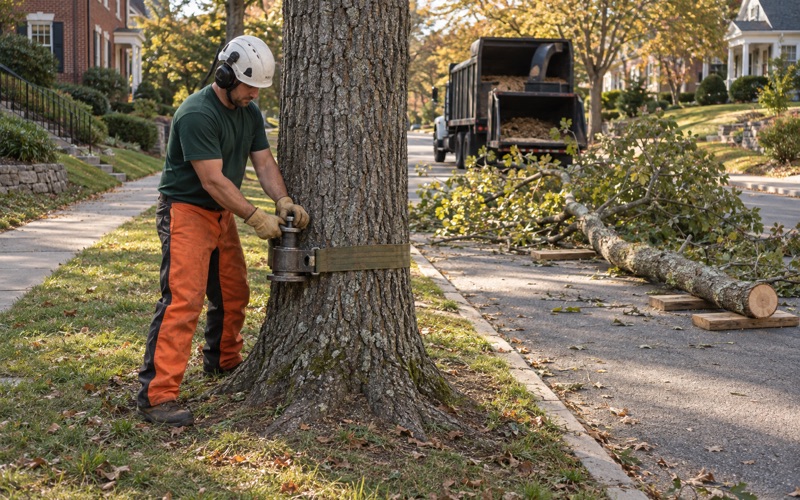
Of the city’s 17,458 housing units, 11,806 were built before 1980 and 2,081 predate 1940. That is a canopy that went in with the houses and is reaching the end together, over roofs, over service drops and inside fenced back lots. On the pre-war streets the first question is usually whether equipment reaches the tree at all, which is why we run compact tracked machines that fit a back-yard gate and keep crane and rigging capacity for the stems that need it.
Where the wood goes, and what a claim actually pays
City of Spartanburg Public Works runs green waste collection with two hard limits: no limbs longer than 6 feet in length or 6 inches in diameter, with brush, grass and leaves in three separate piles set at least 3 feet from obstacles. The rule then excludes us by name. Green waste is limited to residential yard clippings from routine pruning, and it does not include debris generated by commercial tree cutting or landscaping services, nor stumps, dirt or land-clearing debris.
During Helene recovery the City temporarily collected vegetative debris including contractor-cut material. That waiver has ended, and the standing rule is what applies now. So the pile from a removal is ours to haul, and we say so before we quote rather than after.
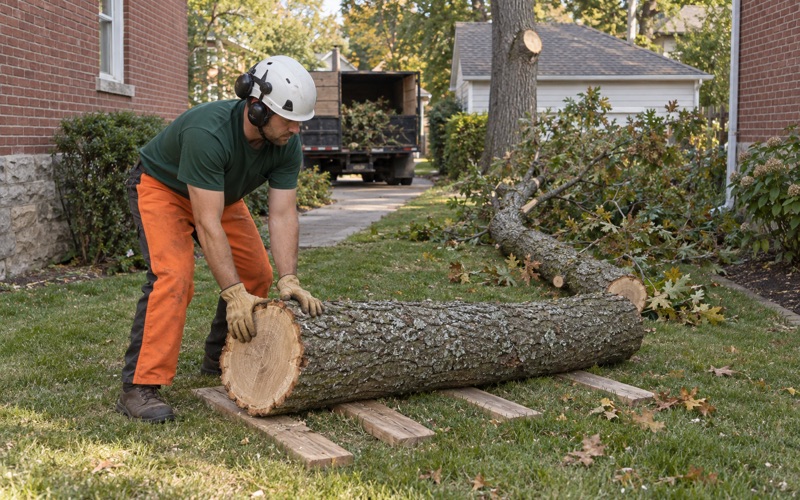
Spartanburg County accepts yard debris at exactly one site, the Wellford Landfill, and it caps limbs at 6 feet as well. Disposal here is therefore a haul plus a tipping fee rather than a curb set-out, and the FY26 schedule prices yard waste debris at $30.00 per ton. We put the inclusions in writing first: the trunk rounds, the stump, the grindings and the chips.
Stumps in Cecil and Pacolet soil
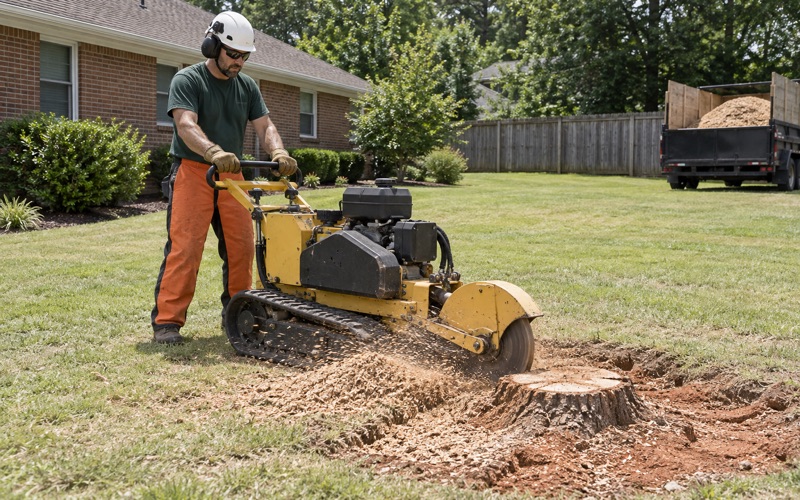
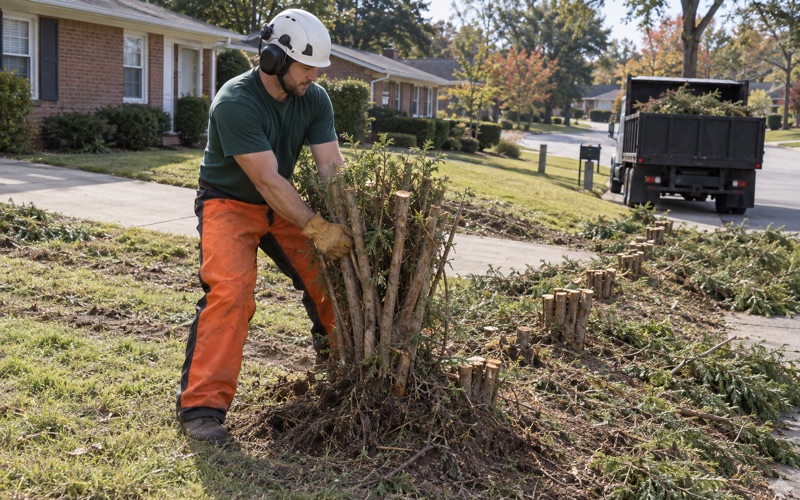
Depth to bedrock in these Piedmont ultisols runs past 60 inches, several times any stump grinder’s rated cut, so soil depth never binds the job. Abrasion does. Quartz and rock fragments in the upper horizon wear teeth, and Pacolet is mapped commonly on slopes of 15 to 25 percent, which decides how a tracked stump grinder gets set up more often than the stump diameter does.
What insurance covers, and what a tree is worth
South Carolina’s insurance regulator publishes the figure homeowners are usually surprised by: some homeowner’s policies provide up to $500 coverage for tree removal, and that limit applies to all of the downed trees per loss rather than per tree. Removing a tree off a damaged structure is paid under the dwelling portion of the policy instead, and storm damage to a car is covered only where the auto policy carries comprehensive coverage. We will give you a straight answer on whether a job is worth a claim at all.
A neighbor’s tree cut or destroyed without permission is a different calculation. South Carolina Code section 16-11-615 allows up to exactly three times the fair market value for timber trespass, and the value must be established by a registered forester, so a registered forester valuation under section 16-11-615 is a purchased professional opinion rather than an estimate. We can point you toward that; it is not a number we invent.
Every one of those decisions is easier before the wind than after it. We give free estimates, and on a tree that can still be saved we would rather sell you a cable and a reduction cut than a stump.
- 20+ Years in the Upstate
- Free Estimates
- Written Tree Condition Reports