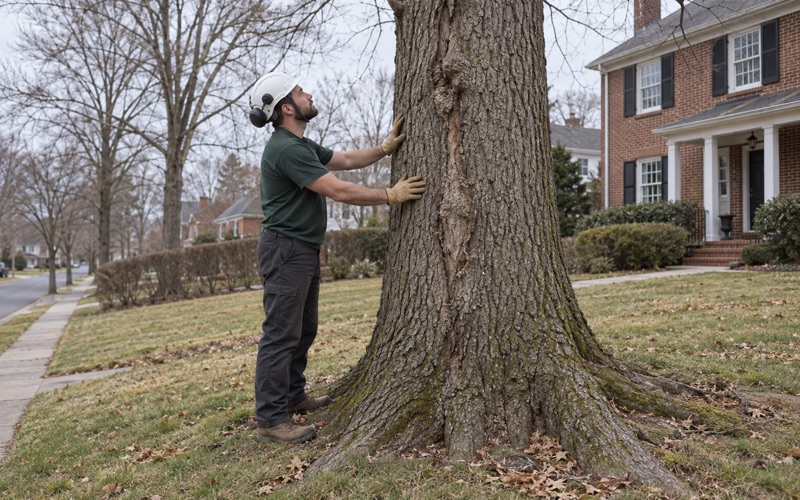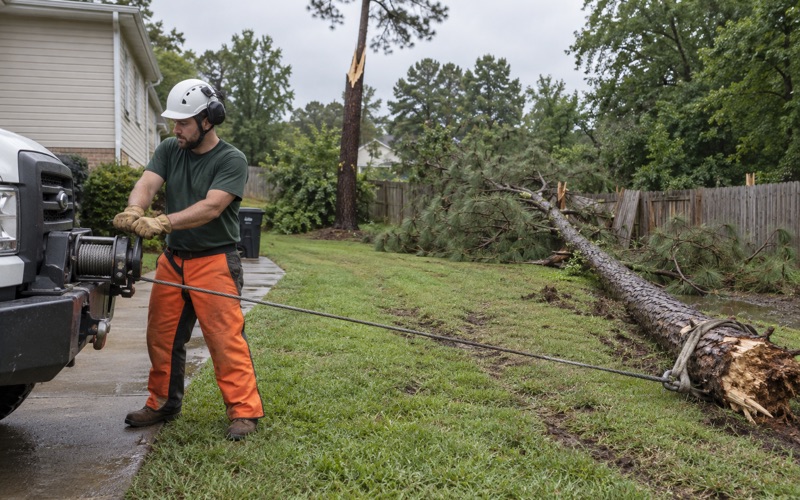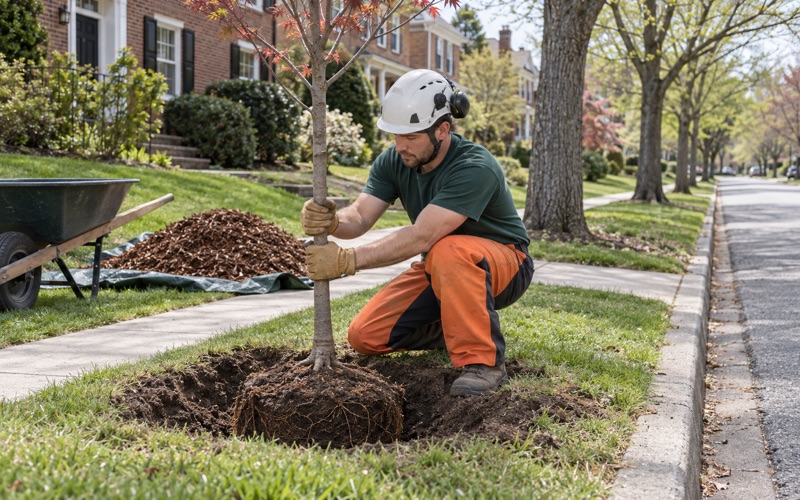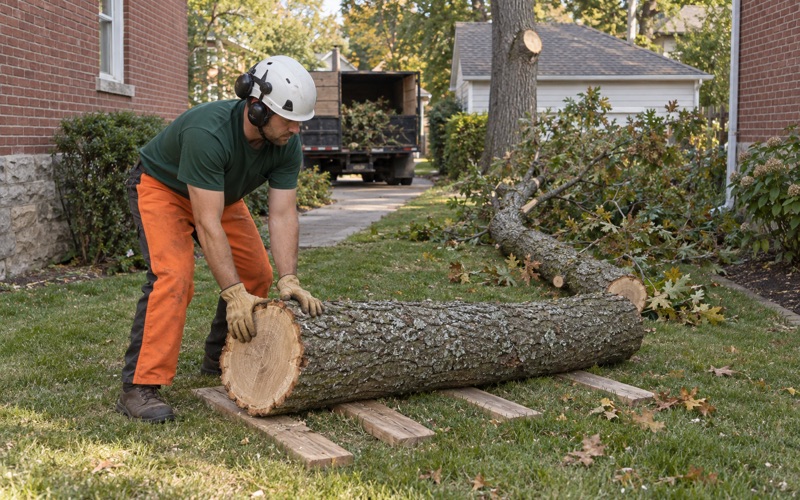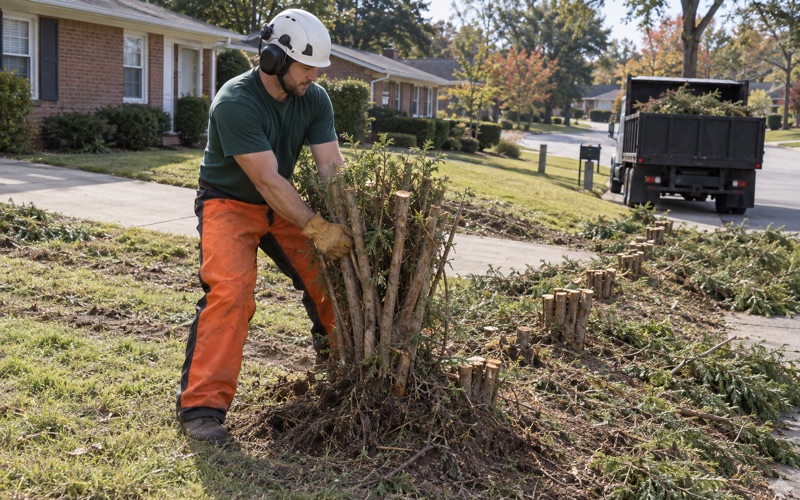
Greenville Tree Removal Team handles tree removal in Powdersville as part of more than twenty years of tree work across the South Carolina Upstate. Before we price anything here, we settle a question most crews skip entirely: which authority the tree actually answers to.
That question carries more weight in Powdersville than almost anywhere else we work. Our service area crosses Greenville, Spartanburg, Anderson, Pickens and Laurens counties, and the answer changes at the line, so we read the code for the county the tree stands in rather than repeating whatever applied to last week’s job. Estimates are free, and the inclusions go in writing before we start: the trunk rounds, the stump, the grindings and the chips.
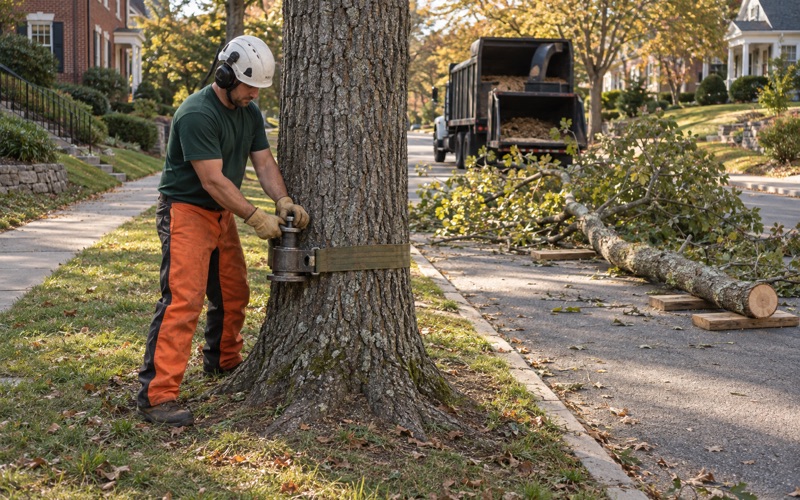
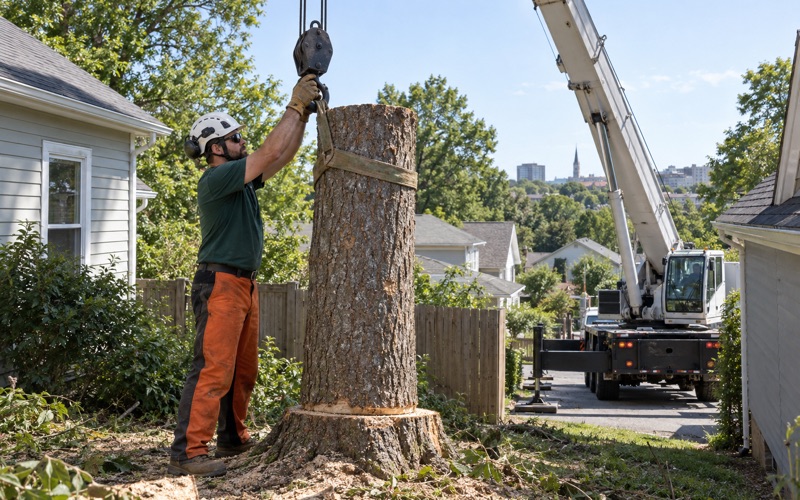
We run compact tracked equipment that fits a back-yard gate, so a subdivision tree does not automatically become a crane job, and we keep crane and rigging capacity for the canopies that genuinely need it. We will also tell you when a tree can be cabled, braced or pruned instead of removed, and what each of those costs.
There is no Town of Powdersville, and that changes who you call
Powdersville is an unincorporated census-designated place in Anderson County, with a population of 10,025 at the 2020 census. There is no city council, no mayor, no city ordinance, no municipal building department and no city public works department.
That absence quietly reorganizes the questions homeowners ask us. There is no city permit counter to visit, no municipal brush day to plan around, and no local tree ordinance to look up before we quote.
Every rule that reaches a tree on this ground comes from Anderson County or from a district chartered by the state. A regional newspaper caught the geography of it neatly, describing the meeting of Highway 81 and Highway 153 as the point “which would be the center of town if Powdersville were a town.”
The one body carrying the name is a water district
Powdersville Water describes itself, in its own words, as “a special purpose district of South Carolina that has been chartered by the Secretary of State” serving drinking water to portions of Anderson and Pickens counties, operating “as a non-profit community water system under the direction of a nine member board.” It has been reported of the same district that it holds no taxing authority and is not part of any county or city government.
So the one institution whose sign reads Powdersville is a chartered water district rather than a town. That is why the mail address, the school attendance area, the water bill and the governing county can all point at different bodies for the same house, and why the obvious answer to who you call about a tree is usually the wrong one.
Two electric utilities, sorted out by service address
Electric service here is split rather than single-provider. Blue Ridge Electric Cooperative states it has powered Anderson, Greenville, Oconee, Pickens and Spartanburg counties since 1940, and Duke Energy Carolinas is present in the community as well. We confirm which one serves your address before quoting any work near a conductor instead of assuming every pole belongs to the same company, and line work follows the ANSI Z133 safety requirements, including the weather limits that stop work near energized conductors.
Looking for tree-removal closer to Simpsonville? See Tree-Removal Services in Simpsonville.
What Anderson County wrote in December: Ordinance 2025-057
The newest binding document on this ground is a county one. Anderson County Council adopted Ordinance 2025-057 on third reading and public hearing December 30, 2025, after first reading November 18 and second reading December 2. The title runs “AN ORDINANCE TO AMEND THE ANDERSON COUNTY LAND DEVELOPMENT STANDARDS TO INCORPORATE PROVISIONS FOR MINIMIZING MASS GRADING, PRESERVING NATURAL TOPOGRAPHY, REQUIRING TREE PRESERVATION, AND ESTABLISHING DEVELOPMENT INCENTIVES FOR RESIDENTIAL SUBDIVISIONS,” and the recitals give the reason plainly: “mass grading practices and indiscriminate tree removal degrade the natural environment and local aesthetics.” It adds a division headed MINIMAL SITE DISTURBANCE AND TREE PRESERVATION, printed at sections 24-540 through 24-544.
Read it as a land-development instrument, because that is what it is. Nothing in it requires a homeowner to obtain a permit to take one tree off a finished private lot.
Where it bites is on ground being cleared and graded: mass grading is prohibited outright, and so is lot mass grading, which the ordinance defines as clearing and grading more than fifteen lots concurrently to create artificially uniform and flat homesites. Section 24-543(a) sets the intent as preventing clear-cutting where possible and preserving mature and specimen trees.
A specimen tree is twelve inches, and the root zone has a formula
The ordinance defines a specimen tree as any broad-leaved large canopy tree with a diameter at breast height of twelve inches or greater, or any understory tree at six inches or greater, and awards those trees double density credits. The critical root zone is defined as “[a] more or less circular area on the ground equivalent to a circle around the trunk with a radius equivalent to 1 foot for every 1 inch in DBH” — a twenty-inch trunk carries a twenty-foot radius.
On a development site that circle is a physical boundary, not a drawing: protective fencing goes up at the outer limits of the critical root zone before construction activity, and no grading, material storage or vehicle traffic happens inside it. The same division sets a minimum ten-foot undisturbed natural buffer from subdivision side and rear property lines and a one-tree-per-lot minimum.
The plan a certified arborist signs, in a state that licenses none
A Tree Preservation Plan is defined as a formal plan prepared by a certified arborist, landscape architect, surveyor or engineer, and Section 24-543 requires it be approved by the Planning Department before any land disturbance — clearing, grading or grubbing — can commence. The body approving subdivisions on this ground is the Anderson County Planning Commission; there is no municipal planning commission here to appeal to.
That is a more interesting requirement than it looks. South Carolina issues no arborist or tree-contractor license and requires none, so the credential the county names is the voluntary ISA certification, and Anderson County has turned a voluntary credential into a gate a project cannot pass without. We tell you plainly what the state actually asks for rather than calling ourselves licensed, because it does not ask for that.
Nobody comes for the brush pile
This is unincorporated ground, and there is no municipality here to run a brush program, so what happens to a pile at a given address depends on who is hauling it rather than on a published city schedule. Anderson County’s residential model is drive-in convenience centers, and it publishes fifteen of them.
Exactly one carries the note ACCEPTS YARD DEBRIS on the county’s own list, and it is the Slabtown Convenience Center at 728 Pickens Drive in Pendleton. The Powdersville Recycling Center at 151 Spearman Circle carries no such designation, and neither does the Wren Recycling Center on Roper Road. What that establishes is the absence of the marking rather than a published refusal, but the practical effect is the same: the two closest sites are not listed for the category, and the one that is listed is a drive to Pendleton.
The county gate for land-clearing debris, and the stump it will not take
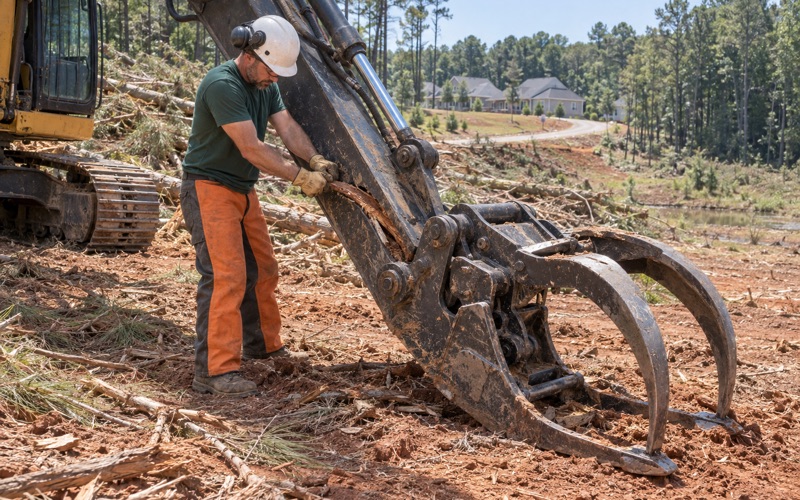
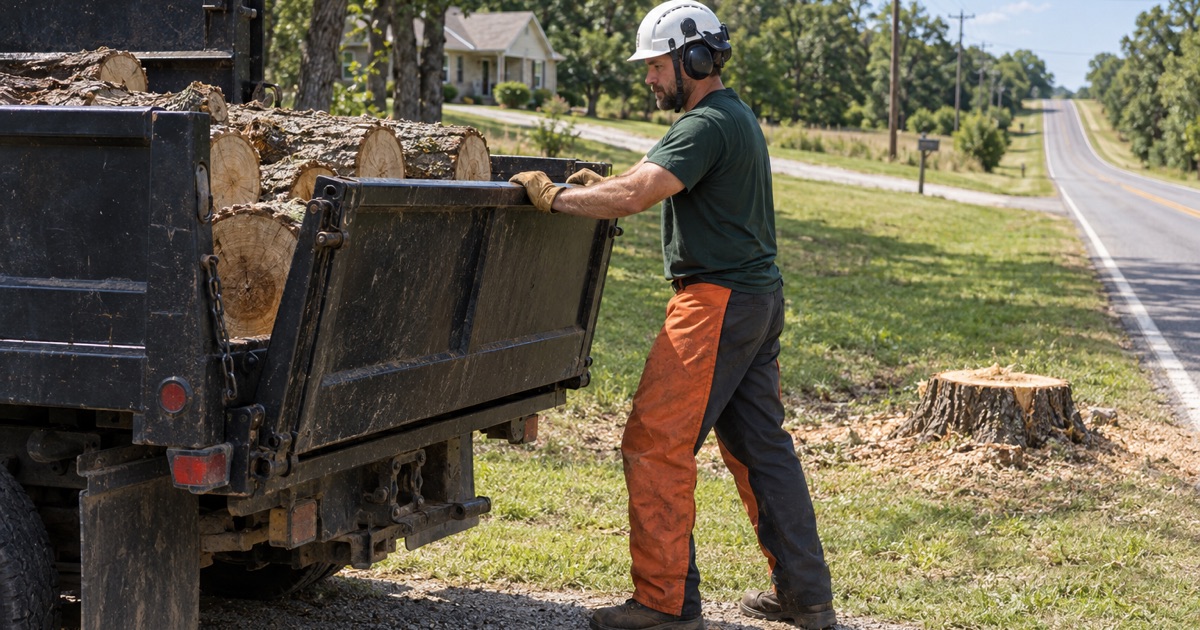
Anderson County’s Starr C&D Landfill at 390 Roy Arnold Road, Starr, accepts land-clearing debris including vegetation, logs, rocks, tree stumps, brush, limbs and roots. Its size rule is conditional rather than absolute: material 18 inches wide or smaller should be cut 6 feet long or shorter, and material 19 inches wide or larger should be cut 2 feet long or shorter. Bucked short, oversize wood still goes through the gate.
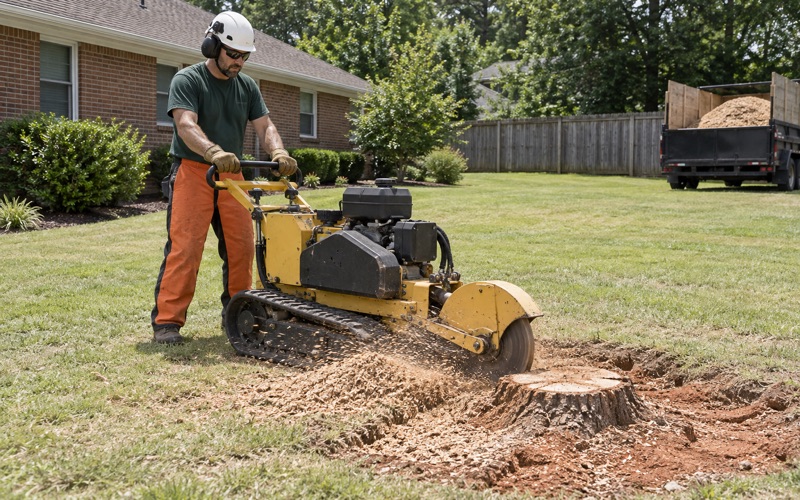
One refusal is flat. Starr does not accept stumps that are 2 feet high and 3 feet wide or larger, which means a stump over that dimension has no county outlet at all. That is the strongest practical argument we know for grinding a large stump in place rather than pulling it and then owning a piece of wood nobody will take.
The economics are worth stating before the work rather than after. Anderson County residents are not charged for construction, demolition and land-clearing disposal, but the county says that if a resident pays someone to haul their material to the Starr landfill, the hauler or commercial business will be charged for it, at $33 per ton commercial. We price disposal for the county the job is actually in and put the number in the estimate instead of discovering it at the scale.
Grinding depth is set by the machine, not by the soil
Where the native Piedmont profile survives here, it runs deep. Cecil and Pacolet publish depths to bedrock greater than 60 inches and Madison greater than 72, against a tracked stump grinder rated to roughly 12 to 25 inches below grade, so the machine’s own stop binds first by three to six times and depth becomes a decision rather than a limit. What costs time instead is wear from quartz and rock fragments, and slope, with Pacolet commonly mapped at 15 to 25 percent.
Newer streets add a wrinkle the soil survey does not describe: a third of the housing here was built since 2010, on engineered fill and compacted subgrade. And if the stump is a Callery pear, the lateral roots come out with it or the tree comes back, because that species resprouts from them.
Burning, insurance, and what you can actually verify
The sharpest incorporated-versus-unincorporated asymmetry in this state falls on Powdersville’s side of the line. The South Carolina Forestry Commission says state law requires citizens to notify the Commission before burning outdoors, and that “[t]his requirement applies only to UNINCORPORATED AREAS of the state.” It covers leaves, limbs and branches, and expressly reaches land-clearing burns.
Two cautions go with that every time it comes up. Notification is not permission, and county and state air rules still apply, so a burn restriction can be in force whether or not anyone has been notified. We confirm the current county notification line and any active restriction before anything is lit, rather than working from a number someone copied down a season ago.
The $500 line in a homeowners policy
The South Carolina Department of Insurance stated in an October 5, 2015 media release that generally, some homeowner’s insurance policies will provide up to $500 coverage for tree removal, and that “[t]his limit applies to ALL of the downed trees per loss and is not paid on a per tree basis.” It is one limit for the event, not a payment for each tree on the ground.
Removal of a tree off a damaged structure is paid under the dwelling portion of the policy, and a tree on a car is covered only where the auto policy carries comprehensive coverage. We give you a straight answer on whether a job is worth a claim before you file one, and we write tree condition reports you can hand to an adjuster, a neighbor or an HOA architectural review committee.
What to check when there is no license to check
Because the state issues no arborist license, and because there is no municipality here running a business license counter to create a second impression of one, insurance is the thing a homeowner can genuinely verify. The Forestry Commission’s own advice is the right advice: ask for certificates of insurance covering liability and workers’ compensation, then telephone the carrier and confirm the policy is current.
The rest is standards work and honest options. Pruning is worked to the objectives, systems and cut types the ANSI A300 standard defines, and we do not top trees. Where a tree can be kept, a Level 2 basic tree risk assessment followed by crown reduction, deadwooding or a cabling system is often the cheaper answer, and we would rather tell you that than sell you a removal.
- 20+ Years in the Upstate
- Free Estimates
- Written Tree Condition Reports