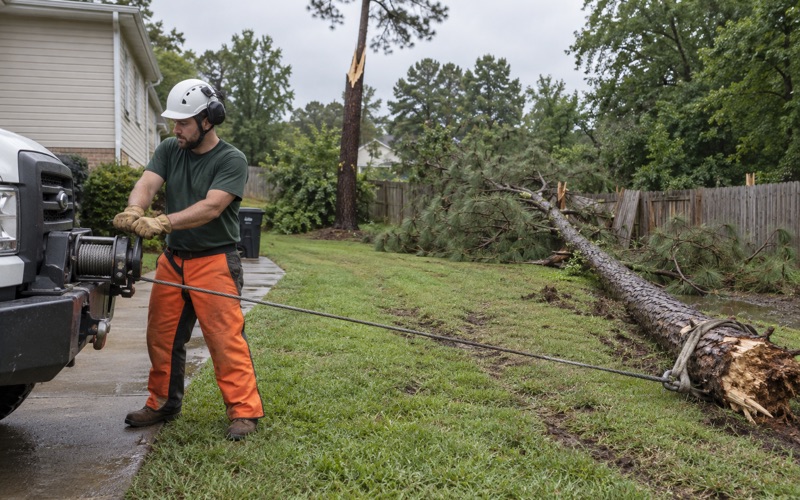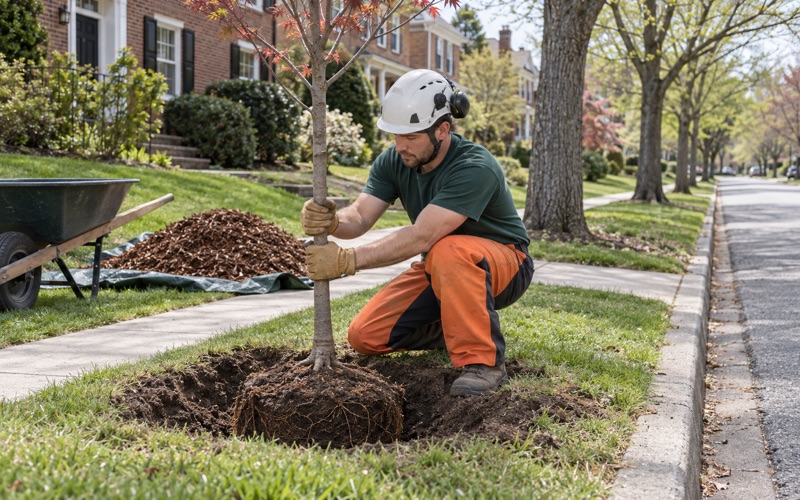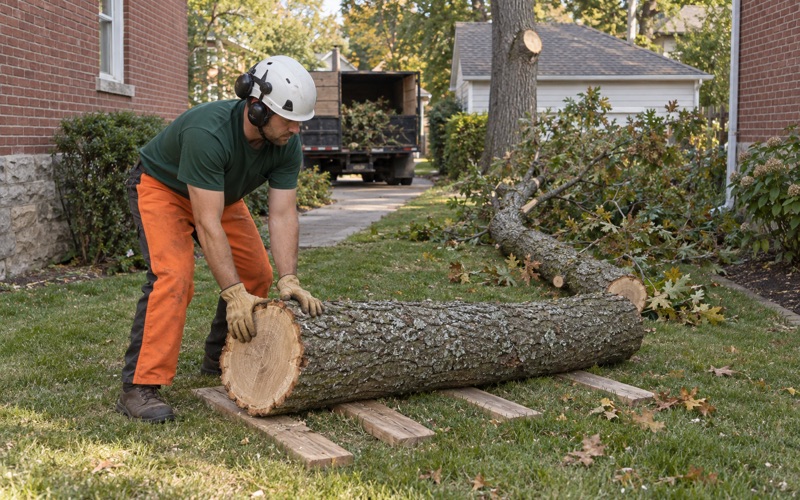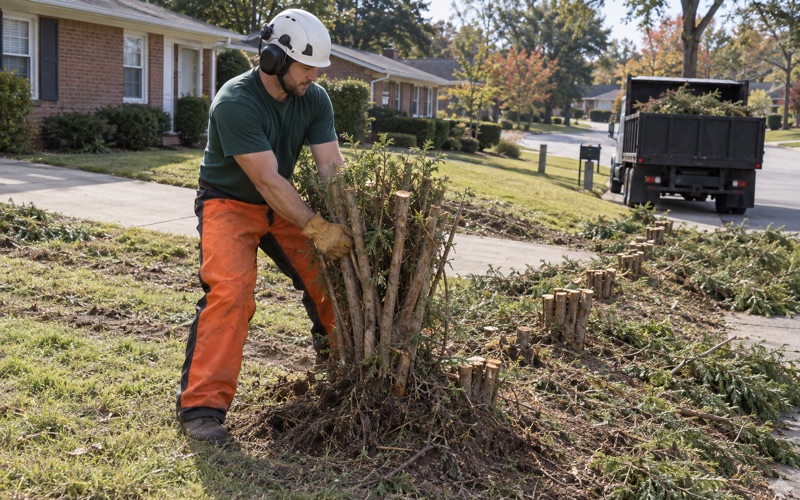
Greenville Tree Removal Team has been taking trees down in Mauldin for more than twenty years, and tree removal in Mauldin starts with a document most crews never open: the city’s own tree ordinance. Mauldin does not hand this question to county land development rules. It writes its own thresholds, names its own officer, and draws its own line between the trees it protects and the ones it leaves entirely to the property owner.
That line matters more than the ordinance’s length suggests. For the large majority of Mauldin addresses the honest answer to “do I need permission for this?” is no, and we would rather establish that in writing at the estimate than watch a homeowner spend two weeks chasing an approval the code never asked them for.
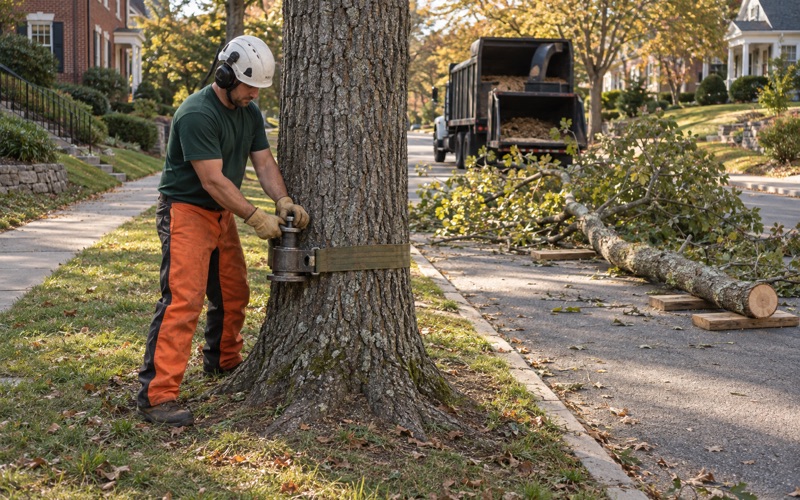
What we quote is the whole job — the felling or the sectional dismantle, the trunk rounds, the stump, the grindings and the chips — with disposal priced for where the wood actually has to go. Estimates are free. If the tree can be cabled, braced or pruned instead of removed, we will say so, and tell you what each option costs.
Ordinance No. 822 and the Thirty-Inch Heritage Tree
Mauldin’s tree rules live in Ordinance No. 822, which amends the Mauldin Zoning Ordinance at Article 6, Section 2 and replaces the previous landscape ordinance in its entirety with Sec. 6:2, Landscape and Design Standards. The Mauldin Planning Commission voted unanimously to recommend approval on February 28, 2017, and the enacting clause is the council’s own: “BE IT ORDAINED BY THE CITY COUNCIL OF THE CITY OF MAULDIN, SOUTH CAROLINA.” The tree protection provisions sit at Section 6:2.11.
What makes a tree a heritage tree
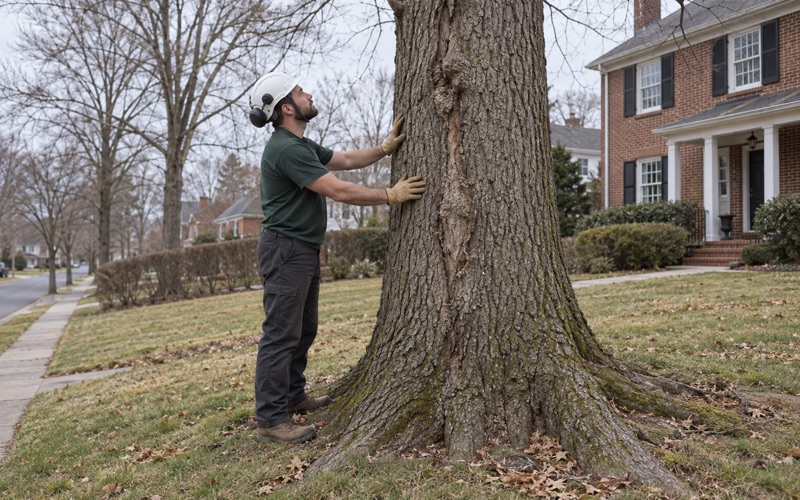
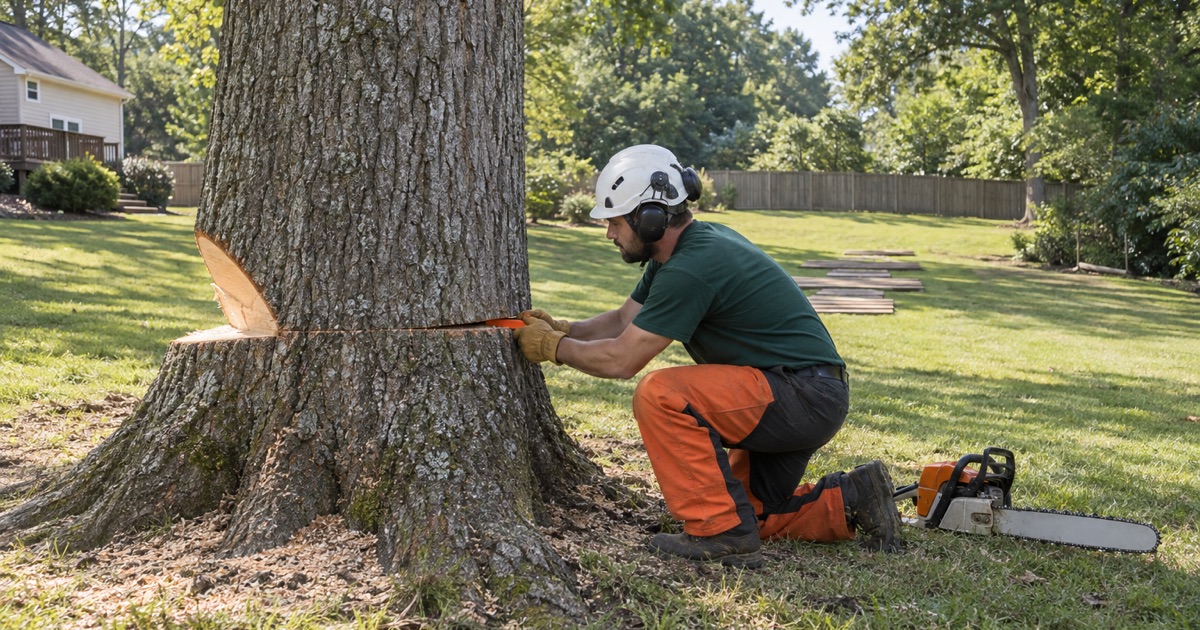
Section 6:2.11(E)(1) sets the threshold in a single line: “A Heritage tree is any tree greater than thirty inches (30") in diameter.” The ordinance adds that such a tree is further defined as one free of major damage that exhibits the growth habit and superior qualities to be considered a specimen of its species. Thirty inches is Mauldin’s own figure and no neighbor’s, which is one reason we take diameter at breast height with a tape on site instead of eyeballing a trunk from the driveway.
The city’s tree preservation credit table meets the same number from the other direction. A trunk of 2 to 6 inches earns one credit, 25 to 29 inches earns five, and anything 30 inches and over jumps to seven. The code is treating that last step as a different class of tree rather than a slightly larger one.
Written approval, and how far it reaches
Section 6:2.11(E) is broader than most property owners expect. Heritage trees “shall not be cut, removed, pushed over, harmed, trimmed, sprayed, or destroyed without written approval of the Business and Development Services Director.” Trimming and spraying are named right alongside removal, so on a regulated site a pruning visit can need the same signature a takedown does.
Where a healthy heritage tree does come out, Section 6:2.11(E)(3) makes a professional finding the operative document: the first listed standard is that the tree “is certified by an arborist or other qualified professional as being severely diseased, high risk, or dying,” and a tree certified that way is exempt from replacement. That is what our written tree condition reports are built for — a Level 2 basic tree risk assessment set down so it can be handed to the Director, to an insurance adjuster, or to an HOA architectural review committee without anyone having to translate it first.
Before the first machine moves
On land the section reaches, Section 6:2.4(A) wants a tree inventory “prior to beginning any tree clearing, development work, or land disturbance,” identifying every canopy tree two inches or larger at breast height. Protection follows the same logic once work starts: fencing at the critical root zone and drip line before grading, at least four feet high, signed on all sides with the words “TREE PROTECTION ZONE: KEEP OUT,” and nothing parked, stored or graded inside it.
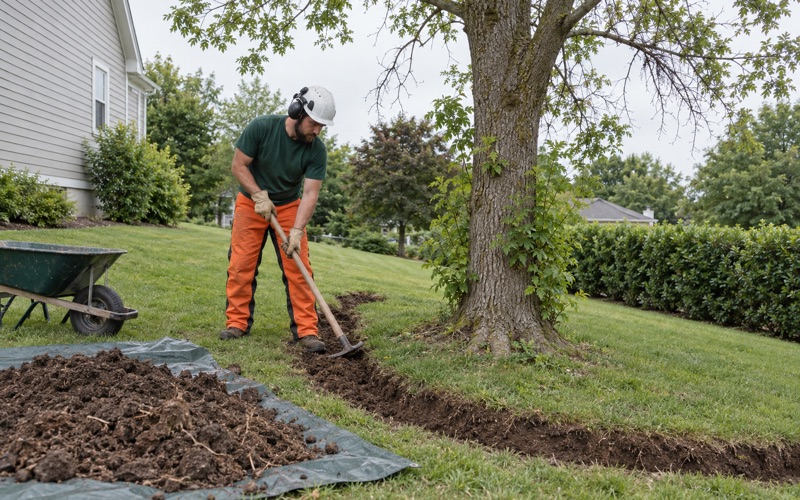
Where clearing runs up against that boundary the ordinance asks for minimum two-foot trenches along the limit of disturbance “so as to cut, rather than tear, roots.” It is a small detail with a long tail — a root plate torn rather than cut is a tree that dies three summers later, and on a preserved tree the credits come back as a replacement obligation.
Looking for tree-removal closer to Five Forks? See Five Forks Tree-Removal.
Where the Ordinance Stops: Individual Single-Family Lots
Section 6:2.11(B)(1) exempts one category outright: “The removal of trees located on individual lots containing single-family detached dwellings.” The exemption is unconditional. It carries no date-of-title test, no lot-size floor and no zoning district qualifier, which is unusual enough in this state that it is worth reading twice.
Mauldin’s housing stock makes that a wide exemption in practice. The city has 11,656 occupied housing units, 68.0% of them owner-occupied and 61.5% single-unit detached, including 6,589 owner-occupied single-unit detached homes. At those addresses the thirty-inch heritage rule and the Director’s written approval do not attach to a removal at all.
The replacement rule stops at the same line
The contrast is sharpest in Section 6:2.11(E)(3)(e): “Except on lots containing single-family detached dwellings, each healthy Heritage tree removed or destroyed shall be replaced with three (3) replacement trees, measuring at least six (6) inches in diameter by American Nurseryman Standards,” replanted within twelve months of the removal. Three six-inch caliper trees is a genuine line item on a commercial or multi-family site. On a detached lot it is not a line item at all.
The other exemptions worth knowing
Section 6:2.11(B) also exempts dead or naturally fallen trees, and trees the Director finds to be a threat to public health, safety or welfare; selective and limited removal for clear visibility at a driveway or an intersection, or for authorized field survey work; and selective and limited clearing of a utility easement to keep it doing its job. Forestry activity is exempt as well, with a condition attached — where a site is substantially cleared under legitimate forestry activities, no development applications are accepted for thirty-six months from the date the clearing is completed.
We work out which of these an address sits under before the number goes on paper. Our service area crosses Greenville, Spartanburg, Anderson, Pickens and Laurens counties, and the answer to the same question really does change at the line, so we read the code for the place the tree actually stands in rather than the one we were in last week.
Four Cubic Feet: What Mauldin Public Works Will Collect
City of Mauldin Public Works runs curbside collection with the city’s own sanitation crews, and its limits are stated plainly: “Limbs are to be no larger than 6 feet in length and 6 inches in diameter,” and “Limited amounts of tree limbs and bush trimmings (4 cubic ft.) will be collected by the city.”
Four cubic feet is roughly an armful. A single mature removal produces debris in a different order of magnitude, so municipal collection is not an outlet for it at any stage of the job. Leaf pick-up, which runs from October 1 to May 1, does not change that arithmetic either.
Contractor debris belongs to the contractor
Public Works is equally direct on the second point: “Yard waste produced and collected by contractors who work for city residents must be disposed of by the contractor.” There is no version of a Mauldin removal in which the pile waits at the curb for the city to deal with. It leaves on our trucks, and it is priced into the estimate rather than discovered afterward.
Two drop-off gates, two different sets of rules
The city names two disposal points and they are not interchangeable. Simpsonville Residential Waste at 517 Hipps Road mirrors the same 6-foot length and 6-inch diameter cap and allows one truck-load per household. Twin Chimney Landfill at 11075 Augusta Road accepts limbs that exceed those dimensions and allows multiple truck-loads.
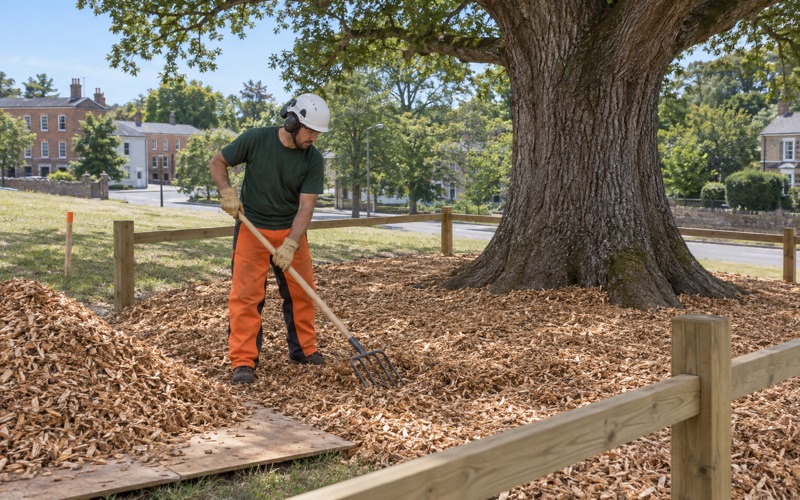
For an actual removal that usually settles it in favor of Twin Chimney Landfill: a thirty-inch trunk cut into rounds is not going through a gate written around six-inch material, and a full canopy is not one truck-load. We price disposal for the county the job is really in, because one gate charges by the cubic yard, the next by the ton, and a couple of them are free only to their own residents. Where a homeowner wants the rounds split and stacked, or the grindings left in the hole, we put that in the inclusions before the saws start.
Topping Is a Violation, Not a Pruning Style
Section 6:2.13(D) of the same ordinance, headed Maintain Shape, is the provision most likely to catch a property manager off guard. Required trees and shrubs “shall be maintained in their characteristic natural shape, and shall not be severely pruned, sheared, topped, or shaped as shrubs.” A tree that has been topped and no longer serves its intended landscape function is “considered a violation as damaged vegetation in need of replacement,” to be replaced during the current or next available growing season.
Crape myrtles are named in the text by way of example, which tells you the city has watched the problem happen. We do not top trees — not on regulated landscaping, and not on a detached lot where nothing in the code would stop us. Our pruning is worked to the objectives, systems and cut types the ANSI A300 standard defines: crown cleaning, crown raising, crown reduction, crown thinning, deadwooding. A reduction cut back to a live lateral of adequate size is a different operation from a heading cut through a trunk, and the tree spends the next decade telling you which one it got.
When the tree does not have to come out
Co-dominant stems with included bark are the most common reason a healthy-looking tree gets condemned in a hurry. Frequently that union can be supported instead — a dynamic cabling system, or extra high strength cable with brace rods where the defect calls for it — and we quote that beside a removal rather than in place of quoting one. A conk at the root flare is a different conversation with a different ending, and we will tell you which of the two you are having.
Lines, gates and what the soil does to a stump
Mauldin is served by two electric providers, Duke Energy Carolinas and Laurens Electric Cooperative, whose drive-through office sits at 1201 East Butler Road. The right vegetation-management contact for a line-adjacent tree is therefore decided by the service address rather than by the city limits, and we check which one it is before quoting any work near a conductor. Rigging and line-clearance work follows the ANSI Z133 safety requirements, including the weather limits that stop work near energized conductors whether or not the schedule likes it.
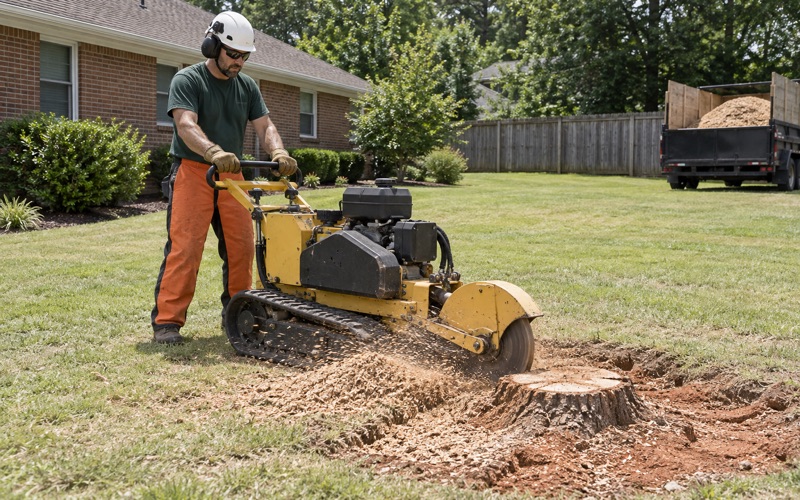
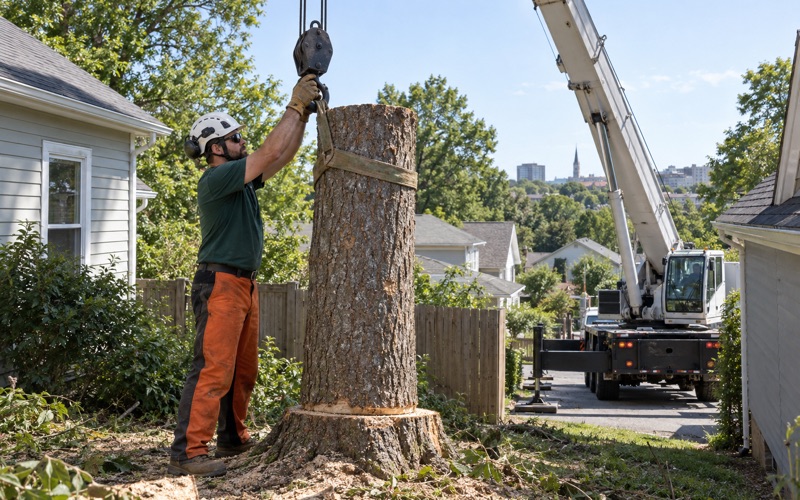
On the ground, compact tracked equipment goes through a back-yard gate, so a subdivision tree does not have to become a crane job to come down cleanly. Stump work here is bound by the soil rather than by depth — quartz gravel in the A horizon of these Piedmont ultisols wears grinder teeth steadily, and slope finishes the argument on the steeper lots. One last thing worth saying out loud: South Carolina issues no arborist license and requires none, so no crew working in Mauldin holds one, ours included. We would rather tell you that plainly than let the word do work it has not earned.
- 20+ Years in the Upstate
- Free Estimates
- Written Tree Condition Reports