Greenville Tree Removal Team handles tree removal in Lyman with more than twenty years of Upstate work behind it, and we quote a job here by starting with access rather than with the tree. Whether a crew can reach the trunk decides more about the method and the price than the species or the height does.
Two very different kinds of residential ground sit inside one small town limit, and a single day of routing can touch both. One half is tight, platted and built for walking, with short setbacks and shared drives. The other is open subdivision ground with young stock and room to work.
Before we quote, we tell you which utility owns the line over the tree, what the Town will not collect once the wood is on the ground, and whether the trunk can be cabled or pruned instead of taken out. Estimates are free, the inclusions are written down before the first cut, and you get a straight answer on whether a job is worth an insurance claim.
Two neighborhoods a century apart on one town roster
The census counts 2,425 housing units inside the town, and they fall into two clear cohorts. Of those, 303 were built in 1939 or earlier, while 1,214 units, half the entire stock, have gone up since 2010. Very little separates those two populations on a map, and almost everything separates them as working conditions.
The older cohort is the mill village. Pacific Mills bought more than 700 acres from the Groce family and built the Lyman Printing and Finishing Mill in 1924, and in 1927 the company built a village of 375 homes to house the workers of the plant. The 303 surviving units from before 1940 match that build in scale, which makes the village a cohort still visible in the census rather than a line on a historical marker.
The settlement predates the mill. In the mid 1870s August Belton Groce opened a general store in the center of what would become the town, and the place was known as Groce’s Stop. The community was later renamed for a past president of Pacific Mills, and residents voted to incorporate the town in 1954.
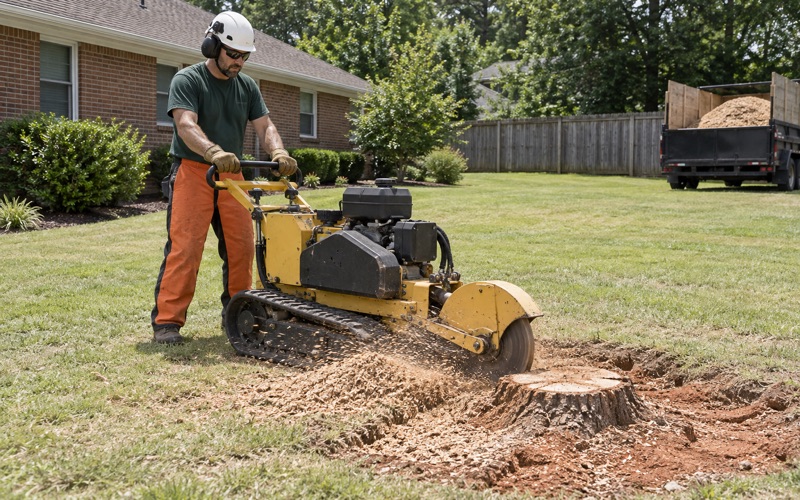
Those houses sit on a platted grid of small, uniform lots with alleys and shared drives behind them. A removal on that ground is usually decided by whether a chipper, a lift or a tracked grinder can reach the back yard at all. Compact tracked equipment that fits through a gate keeps a fair number of these jobs from becoming crane work.
The newer half of the housing stock
The newer cohort is subdivision ground, with 865 units built between 2010 and 2019 and another 349 since 2020. Trees there were planted one at a time, they are young, and access is rarely the problem. What is under the stump matters more, because a grinder on that ground is often working imported fill rather than the native profile.
Ownership is the other thing that stays constant between the two halves. The town is 91.7% owner-occupied and 91.7% single-unit detached, with 2,065 owner-occupied single-unit detached homes on the roster. The person who calls us is almost always the person who owns the tree and signs for the work, so we quote the whole job once, in writing, instead of routing it through a manager.
Looking for tree-removal closer to Woodruff? See Tree-Removal Services in Woodruff.
The trees the mill planted went in together and are aging together
Street trees planted at one time, on a grid, at uniform spacing reach the end of their service life on roughly the same schedule. In the village that means a century-old canopy over a narrow street, hung on the same poles the village was wired with, failing as a cluster along one block rather than one tree at a time. We still assess each of them individually, even when a neighbor’s removal on the same block looks like an obvious precedent.
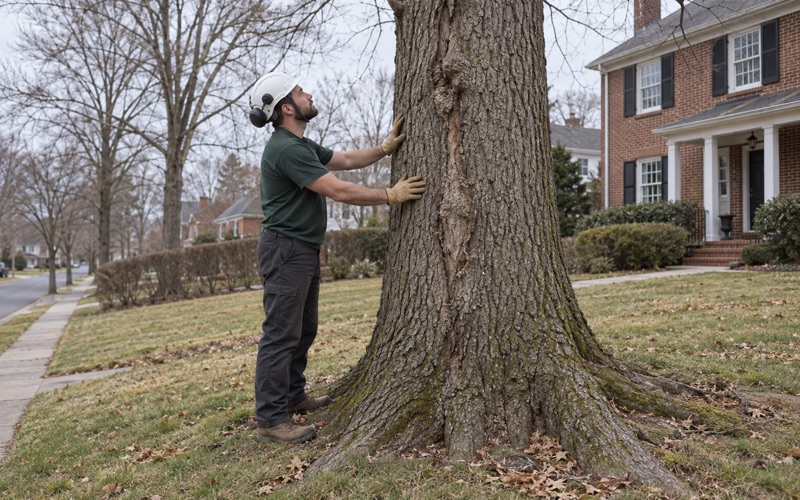
A Level 2 basic tree risk assessment settles most of these calls. We look at the root flare and the root collar for decay, at co-dominant stems with included bark, at conks at the base, and at how much of the crown has gone to deadwood. Where the finding supports it we say so, and quote crown cleaning, crown reduction or a cabling and bracing job instead of a removal.
Hurricane Helene left roughly 99% of Spartanburg County without power during an incident period running from September 25 to October 7, 2024, and the South Carolina Forestry Commission assessed about 3 million cubic yards of urban wood waste statewide. Trees loaded by that wind are the population presenting delayed failures now. No published source names a species that came apart in that storm, so we read the individual root plate, the lean and the soil around it rather than working from a list.
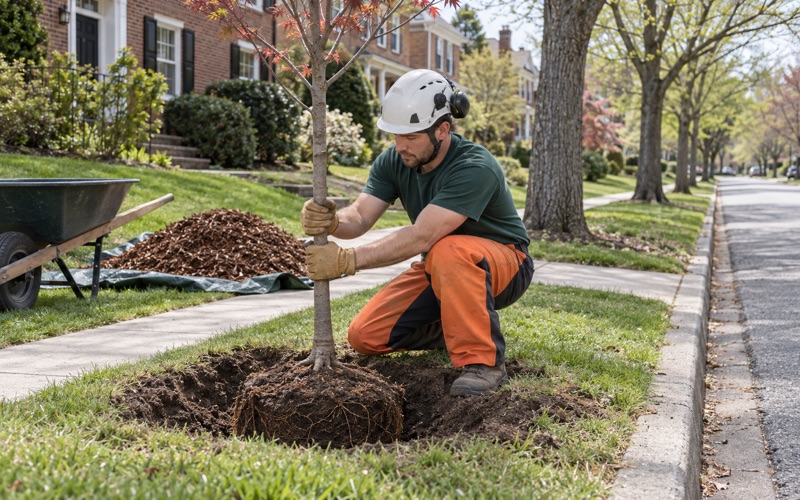
The young stock on the newer streets is a different job on the same route. Structural pruning while a tree is small, crown raising over a driveway, and a look at co-dominant stems before they carry real weight are worth more there than anything a removal crew can do later. We would rather schedule that than remove the same tree once it has grown into the wires.
Rigging above a narrow village street
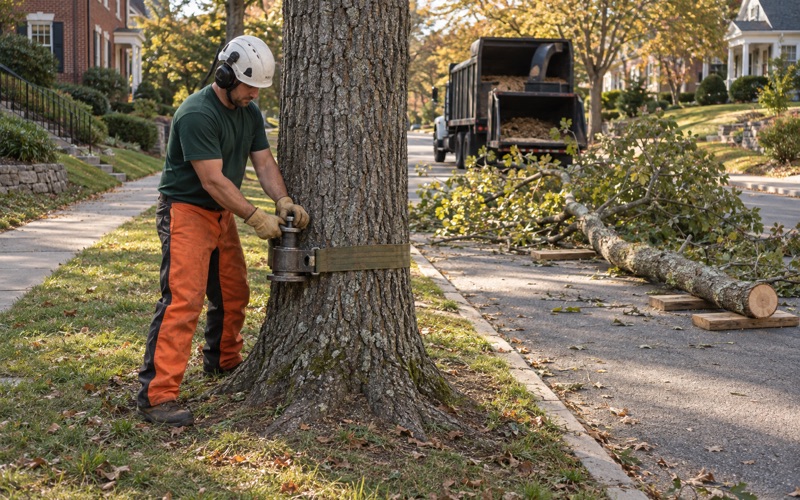
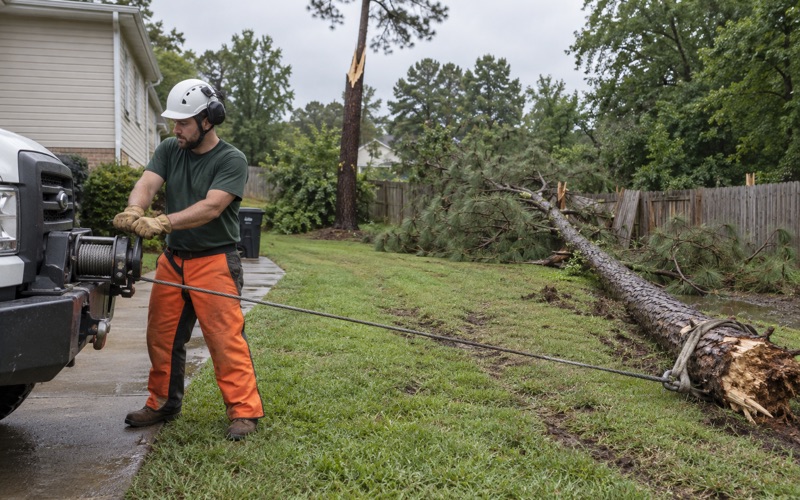
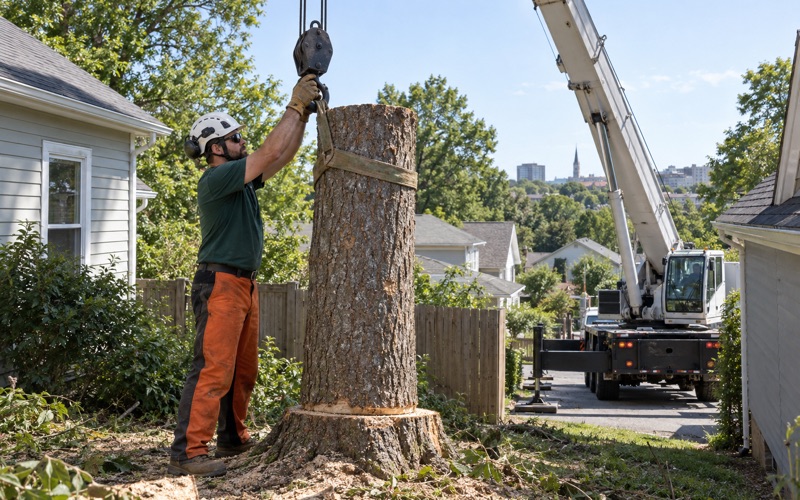
Those streets are where crane and rigging capacity earns its keep. A friction lowering device, a rigging block and a bull rope sized to a real working load limit bring a large trunk down in controlled pieces over a roof line and a sidewalk. We work rigging and line clearance to the ANSI Z133 safety requirements, including the weather limits that stop work near energized conductors.
Pruning follows the ANSI A300 standard, worked to stated objectives and defined cut types, and we do not top trees. Topping a century-old street tree buys a couple of seasons and builds a worse removal into the future. Emerald ash borer has been confirmed in Spartanburg County since 2017, and an infested ash on one of these streets is a removal we would rather schedule than wait on.
What the Town collects, and the categories it refuses
The Town of Lyman runs residential garbage pickup and lawn debris and bulk pickup through its own Public Works department. That is convenient for ordinary yard work and stops being convenient the moment a tree comes down. The published rule is a refusal by category, stated in terms: ‘Whole trees, stumps, and land-clearing debris will not be collected by the Town, but shall be removed and disposed of properly by the property owner or contractor.’
Read that a second time, because it does not turn on who did the cutting. Whole trees, stumps and land-clearing debris are out by category, and that is most of what a real removal produces. The town states a length limit separately, and it is a length limit rather than a diameter one: ‘The Town cannot pick up limbs larger than six feet in length.’
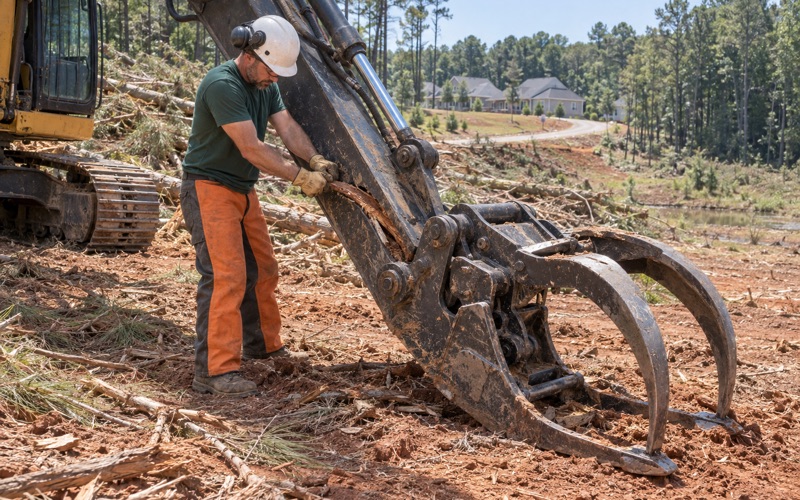
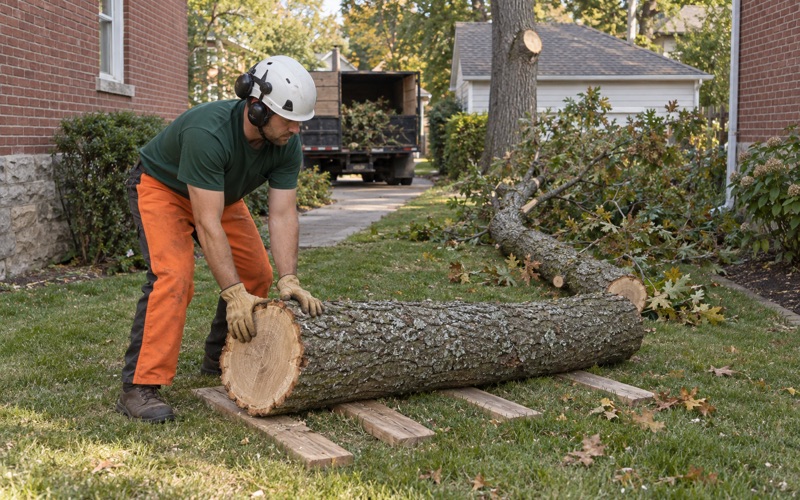
So the pile is ours, and we tell you that before the quote rather than after the crew leaves. The wood leaves as a haul, and Spartanburg County accepts yard debris at exactly one site, the Wellford Landfill, which caps limbs at six feet as well and prices yard waste debris at $30.00 per ton. Disposal is priced for the gate the job actually goes to, and the inclusions go in writing before we start: the trunk rounds, the stump, the grindings and the chips.
Stump grinding on two kinds of ground
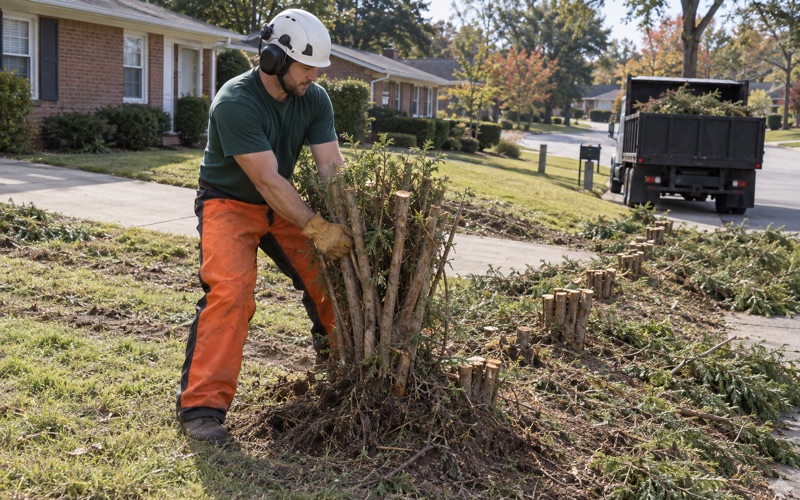
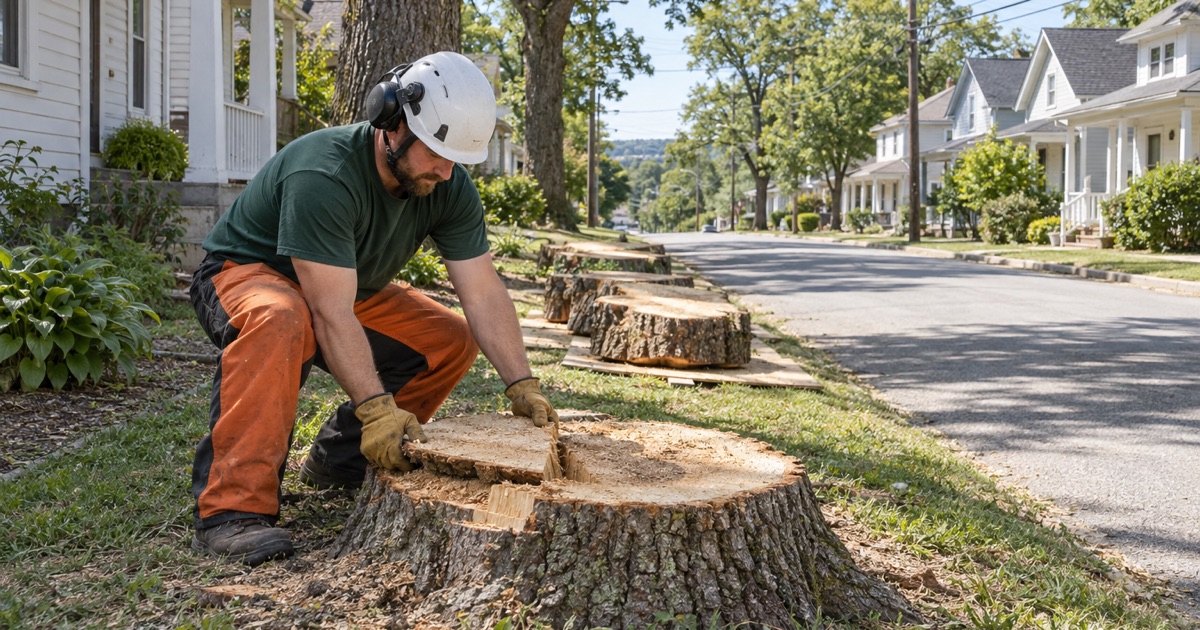
Grinding here is a wear problem more than a depth problem. The native soils are Piedmont ultisols of the Cecil, Pacolet and Madison series, and depth to bedrock runs well past anything a stump grinder’s rated cut reaches, so the binding constraint is the quartz and rock fragments in the upper horizon working on the teeth. Pacolet is mapped commonly on slopes of 15 to 25 percent, which changes how a grinder and a chip truck are staged as much as it changes the grind itself.
Where the town limit changes the answer
The town limit is a working regulatory edge, not just a line on a map. Inside it, the Town of Lyman administers its own zoning across thirteen districts, with its own Planning and Zoning Administrator, its own Board of Zoning Appeals and its own Land Development Regulations. Immediately outside it, an address falls under Spartanburg County’s Performance Zoning Ordinance in the Southwest Planning Area, which took effect there in January 2020.
That edge has a practical consequence for debris. State law requires notification to the South Carolina Forestry Commission before an outdoor burn of leaves, limbs and branches, and that requirement applies only to unincorporated areas of the state. A property on the county side of the line is covered by it, and a property inside the incorporated town is not.
The county amended that ordinance with approval on June 15, 2026, effective July 15, 2026, adding tree planting requirements for new residential subdivisions in the Southwest Planning Area. Existing homeowners were given no new requirements for their current property, which is worth knowing before a rumor about it reaches your street. We read the code for the city and the county a tree actually stands in, because this service area crosses five Upstate counties and the answer changes at the line.
Three utilities meeting inside one small town
The Town’s own utility page names three different providers, so a question about a line near a tree has a different owner depending on which line it is. Duke Energy supplies power, the SJWD Water District supplies water, and the Greer Commission of Public Works supplies natural gas. We confirm which company serves the address before quoting anything close to a conductor, rather than assuming every pole on a street belongs to one company.
Underground service gets a South Carolina 811 locate before a grinder touches the ground, whichever half of the housing stock the address sits in. On a village lot there is not much distance between a stump and the services feeding the house.
One last thing, said plainly: South Carolina issues no arborist license and requires none, so no tree service in this state can honestly present itself as licensed. We tell you what the state actually asks for instead, and we write up a tree condition report you can hand to a neighbor, an insurance adjuster or a review committee. If an insurer is involved, South Carolina’s insurance regulator states that some homeowner’s policies provide up to $500 coverage for tree removal, that the limit applies to all of the downed trees per loss and is not paid on a per tree basis, and that removing a tree from a damaged structure is paid under the dwelling portion of the policy.
- 20+ Years in the Upstate
- Free Estimates
- Written Tree Condition Reports