Greenville Tree Removal Team has been doing tree removal in Greer for more than twenty years, and we start every quote in this city with two questions that have nothing to do with the saw. Which county does the trunk actually stand in? And does the tree sit inside the Greenville-Spartanburg Airport Environs Area?
The second question is what makes this address different from most of the Upstate. Zoning ordinances usually regulate buildings. The one that governs the land around the airfield regulates a tree by name, and where it conflicts with local zoning, it is the one that controls.
That does not make the work exotic, but it does change the order of operations: we establish the rules that apply to the tree before we quote it, not after a crew is already on site. South Carolina issues no arborist license and requires none, so we tell you plainly what the state and the local documents actually ask for instead of dressing the answer up.
A zoning ordinance that names a tree as a hazard
The Greenville-Spartanburg Airport Environs Area Zoning Ordinance was adopted March 29, 1996 and amended in 1997 and 1999 under South Carolina Code Sections 55-11-100 through 55-11-230. Section II.D defines an airport hazard as ‘any structure, tree or use of land which would exceed the Federal obstruction standards as contained in Part 77, Subpart C of the Code of Federal Regulations.’ The tree is written into the definition itself, not read into it afterward.
Part 77 works as a set of imaginary surfaces sloping up and out from the runway ends rather than as a line on a map, and Section IV.B.2.a provides that any structure, tree or use of land whose height would exceed those standards is prohibited. Prohibited is strong language to find aimed at something that gets taller on its own schedule.
Where the area actually is
The Environs Area geometry set by South Carolina Code Section 55-11-230 runs 1,000 feet to each side of the runway centerlines, with a corridor extending along the runway extensions. That corridor is why the question is worth asking on a residential lot at all, and why the answer is a mapping question rather than a guess from the driveway.
Two counties and one city administer it
The Greenville-Spartanburg Airport Environs Planning Commission, created by state statute in 1995 and constituted separately from the Airport Commission, monitors administration and compliance with the plan by Greenville County, Spartanburg County, and the City of Greer. Those three are the only administering jurisdictions, and the city is the only municipality among them. Overlay maps are on file with the Registrar of Mesne Conveyances in both counties.
It also matters that the airfield itself is not inside the city limits: the terminal and runways sit in unincorporated Spartanburg County under a Greer mailing address. Proximity to the airport and municipal boundaries are two different things here, and the overlay follows the runway surfaces rather than the city line.
Section I.E is the piece that decides ties. Where the local zoning authority’s rules are inconsistent, the uses permissible for that parcel under the Environs Zoning Ordinance apply, so a tree that clears the city’s own ordinance can still be a problem under the overlay.
Looking for tree-removal closer to Piedmont? See Tree-Removal Services in Piedmont.
What the rules can require of a tree’s owner
Most homeowners assume the worst case is being told to take a tree down. Under this ordinance the range is wider than that, and some of it lands on the owner rather than on the contractor.
Markers and lights on a tree
Section IV.B.1.c provides that a permit or variance may be so conditioned as to require the owner of the structure or growth in question to abide by the commission’s requirements for the installation, operation and maintenance of such markers and lights as may be necessary to indicate to pilots the existence of an airport hazard. Read plainly, that is a homeowner being made responsible for marking and lighting a tree. It is not the usual outcome, but it is a real one, and it belongs in the conversation before a variance is sought rather than after.
An object of natural growth does not stay grandfathered
Section II.L defines a nonconforming use to include any pre-existing structure, object of natural growth or use of land inconsistent with the ordinance’s provisions. A tree that predates the rules is therefore recognized, but recognition is not immunity.
The growth trigger sits in the state code rather than in the overlay itself. South Carolina Code Section 55-9-330(D) provides that regulations may require that a preexisting nonconforming structure, tree or use not be replaced, rebuilt, altered, allowed to grow higher, or replanted so as to constitute a greater airport hazard, and the same section addresses cost recovery for removal or abatement, liens and notice to the owner. In practice that turns a canopy near the flight path into something with a maintenance calendar attached, and crown reduction worked to the ANSI A300 standard is often the difference between managing a tree and losing it.
A stop order can reach the crew
Section VIII.A.2.a(1) provides that a temporary stop order may be personally served on the owner or delivered to the foreman or director of workers on the site where the violation is occurring. That is a rule worth knowing before a saw starts, because the person holding it is the one who gets handed the paper.
The commission also asks a property owner inside the Airport Environs Area to submit a Proposed Development and Land Use Application before beginning construction, or before any change of tenant or use of a parcel, so that the work is consistent with the Environs ordinance. We raise that during the estimate when the address warrants it; it is not our filing to make, but it is a bad thing to learn about late.
Greer CPW is the utility, and what it does not publish
Electric service inside the city limits is municipal, not investor-owned. Greer Commission of Public Works provides electricity, natural gas, wastewater and water, serves roughly 26,000 electric customers primarily within the city limits and certain nearby unincorporated areas, and obtains all of its power through the Piedmont Municipal Power Agency, a joint action agency of ten municipal electric utilities in the northern part of the state.
That matters on a quote because we check which provider serves the address before pricing work near a conductor, rather than assuming a pole belongs to whoever owns the poles a mile away. The utility’s own published material on vegetation is thinner than most, and we would rather say so than invent a policy for it.
What is published, and what is not
A Greer CPW post states that trees or vegetation in the right of way that may pose a danger to the lines and public safety will be pruned or cut down, and that actual clearance and widths will vary depending on the applicable right of way. Its vegetation work runs year-round through two contractors: Condor Environmental handles ground-level vegetation management including sewer line right-of-way, and Wright Tree Service performs the aerial work.
What we did not find anywhere on the utility’s website is a vegetation-management policy: no clearance width, no trim cycle, no rule about who owns the tree, no wood or chip handling rule, no offer to take a hazard tree down at no charge, and no service-drop de-energize procedure. We treat that absence as an absence. Line-clearance and rigging work near energized conductors is planned to the ANSI Z133 safety requirements, including the weather limits that stop work, and we do not build a quote around an assumption that a service drop will be de-energized for us at no charge.
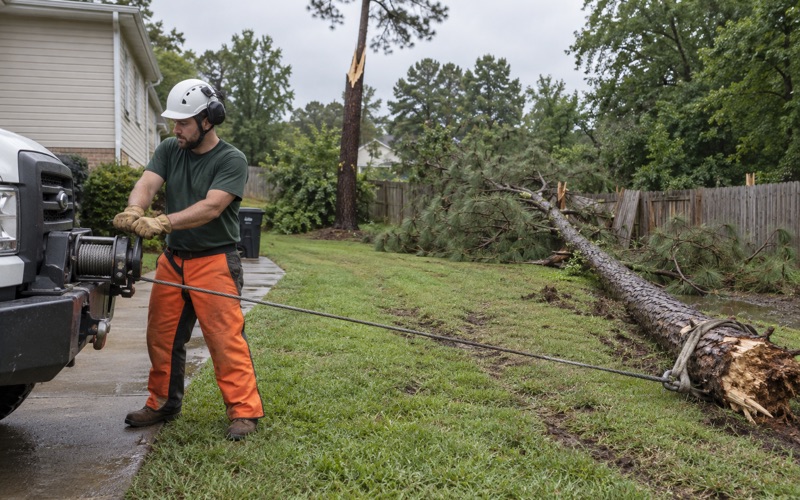
Storms here are not hypothetical. When Hurricane Helene came through in late September 2024, the National Weather Service office in Greenville-Spartanburg recorded that many trees were uprooted or snapped, and outages ran to roughly 99 percent of Spartanburg County and roughly 95 percent of Greenville County. Windthrow of that kind lifts a root plate rather than breaking a stem, which is a different removal problem and a different conversation with an adjuster.
Ground conditions, county gates and the curbside cap
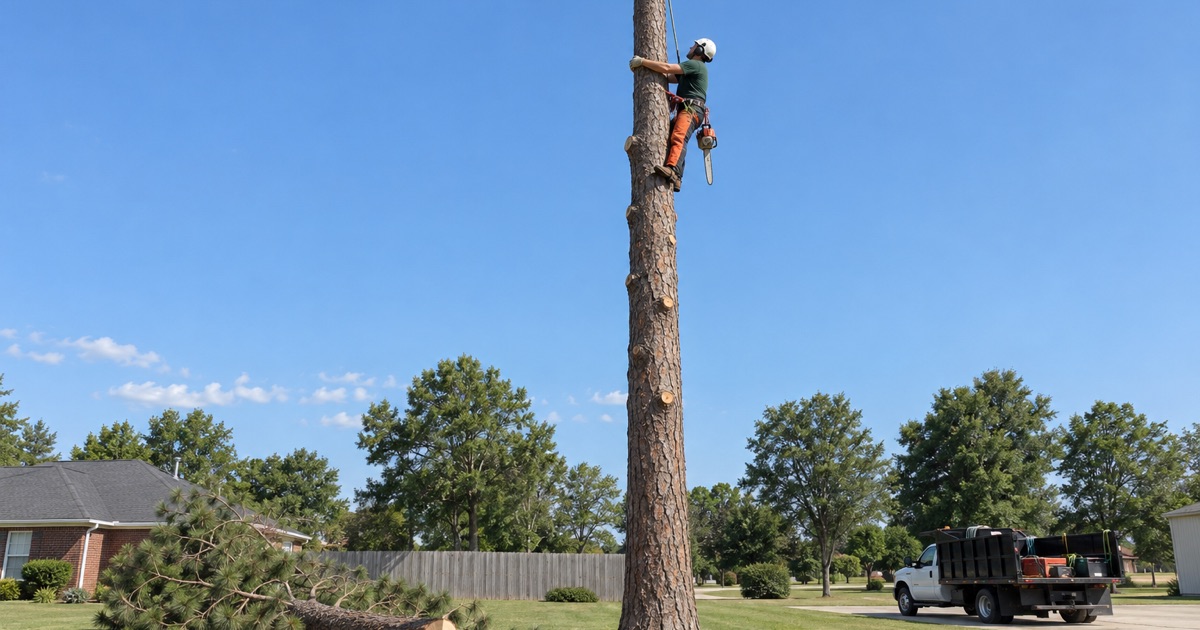
The city resolves to the Southern Outer Piedmont, EPA Level IV ecoregion 45b, whose published description names the Greenville-Spartanburg and Interstate 85 corridor explicitly. That band carries more loblolly and shortleaf pine than the inner Piedmont does, which shows up in how a lot is rigged: pine tops break differently from oak, and a bull rope and rigging block sized for one is not sized for the other.
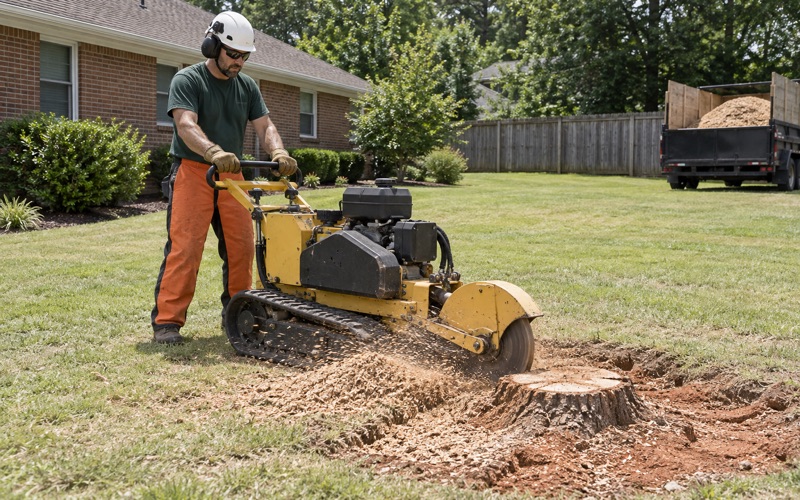
Piedmont ultisols here run deeper than 60 inches before bedrock, well past what a stump grinder is rated to cut, so the machine’s own limit is what stops the job rather than the ground. The wear item is the quartz and rock fragments in the upper horizon, which is a teeth-and-time question we price honestly instead of discovering halfway through.
One city, two county disposal systems
The city spans two counties, and Census geocoding confirms it: one point in the incorporated place returns Greenville County, Census Tract 25.04, and another returns Spartanburg County, Census Tract 232.02. That means one municipality is served by two disposal systems that do not even price in the same unit.
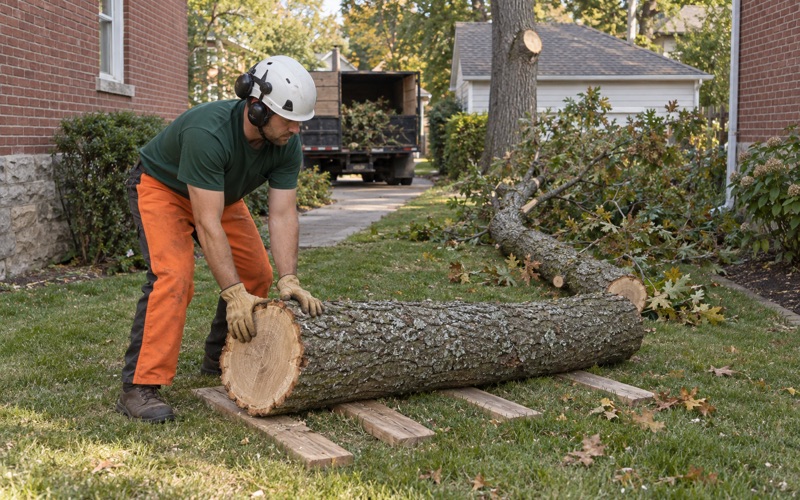
Greenville County charges $32.50 per ton at the tipper and $5.00 per cubic yard for a small vehicle, and it reclassifies yard and brush waste by geometry: past a set diameter, or past six feet in length, the material is handled as construction and demolition waste at $15 per cubic yard for dense material, with a $150 per ton penalty on an unseparated load. Spartanburg County charges $30.00 per ton. A trunk section is priced as demolition debris rather than yard waste, which is why we quote disposal for the gate a job actually goes to and separate the load before it gets there.
The curbside cap is volume, not stem size
The city’s brush rule is written as a quantity rather than as a diameter: a limited amount, up to one truckload or approximately eight cubic yards, of neatly stacked tree limbs and bush trimmings is taken on the weekly curbside collection, with a yard waste cart available for a one-time fee. Weekly residential trash and recycling run through Meridian Waste under contract with the city.
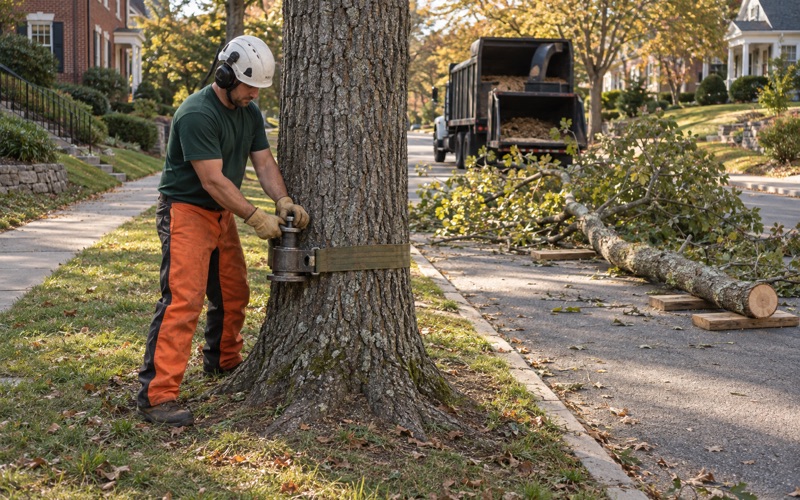
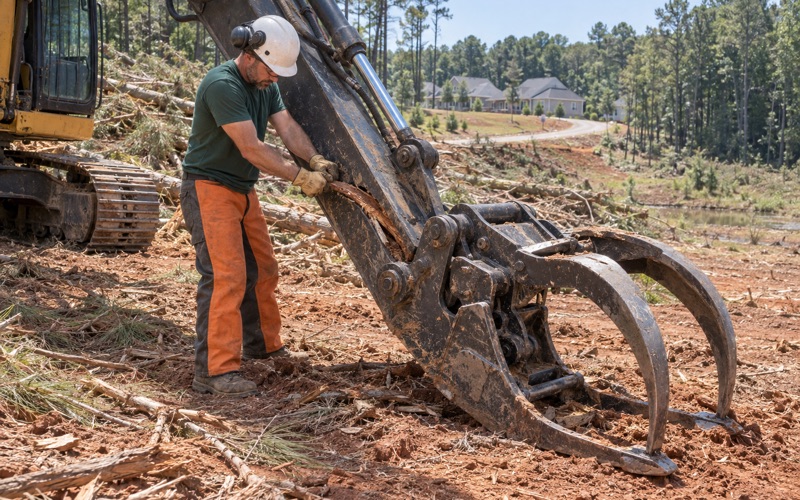
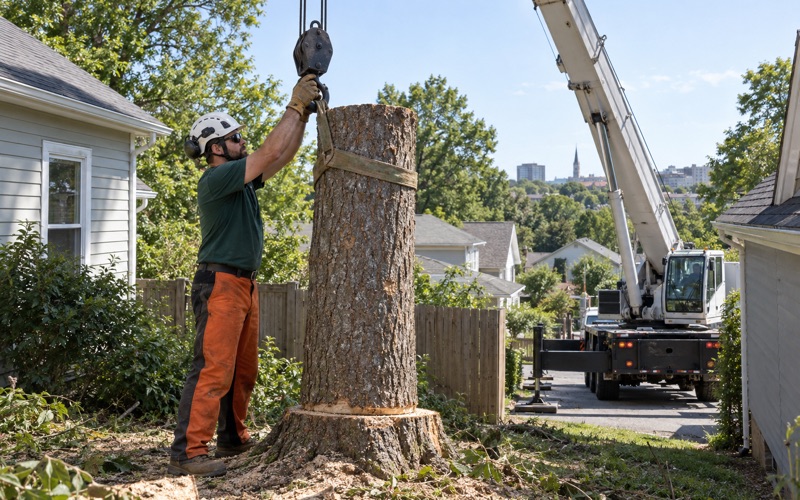
A mature removal produces many times eight cubic yards, so the debris is ours, and we say what is included in writing before the first cut: the trunk rounds, the stump, the grindings and the chips. Compact tracked equipment gets us through a back-yard gate on a subdivision lot without turning the job into a crane setup, and where the canopy genuinely needs one, we have the crane and rigging capacity for it.
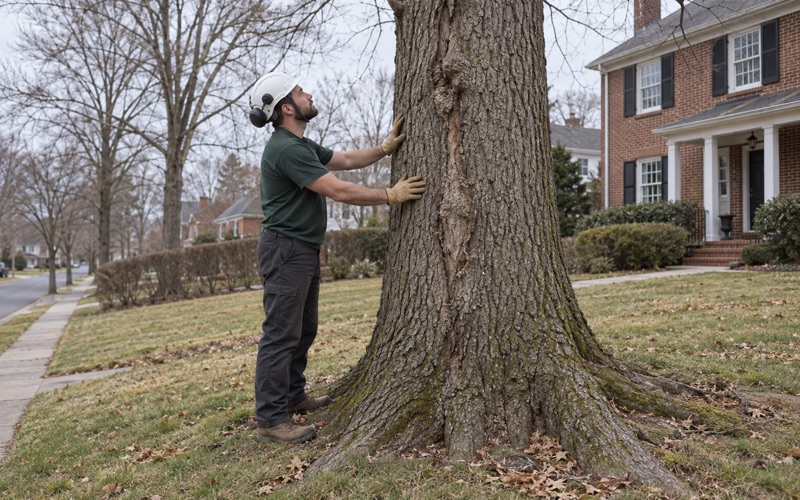
Before anything gets cut near the flight path, we establish which side of the county line the tree stands on, whether it falls inside the Environs Area, and who serves the address with power. Estimates are free, we will tell you when cabling, bracing or pruning is the better answer than removal, and we will give you a written tree condition report you can hand to a neighbor, an adjuster or an architectural review committee.
- 20+ Years in the Upstate
- Free Estimates
- Written Tree Condition Reports