Greenville Tree Removal Team has been taking down trees across the South Carolina Upstate for more than twenty years, and tree removal in Fountain Inn starts with a question most crews never ask. Before we price the wood, we work out which county the address actually sits in, because the answer changes where the trunk can go.
Fountain Inn is one city with two county solid waste systems behind it, and the two do not agree about what a felled tree is. One side measures a load by the cubic yard and reclassifies the oversize pieces. The other publishes a diameter ceiling that no fee will clear, and sends the same log back down the road.
That is why our estimate names the disposal route before it names a price. We tell you which gate the debris is headed for, what the inclusions are, and where the county line puts your particular driveway. Estimates are free, and so is a straight answer about whether a tree needs to come down at all.
Which county the driveway sits in, answered twice in one city
The southern part of the city is in Laurens County, while the bulk of Fountain Inn is in Greenville County. Neither county holds the whole city, and the line runs through neighborhoods rather than around them. For a homeowner that is trivia; for the crew hauling the wood away it decides the afternoon.
The city itself confirms the split in the most practical way possible. Its Trash and Yard Waste Collection page names two destinations for material the city will not take: the Simpsonville Residential Waste and Recycling Center at 517 Hipps Road, and Laurens County Solid Waste at 100 Landfill Road, the second flagged in the city’s own words as Laurens County Residents Only.
Two gates stand behind one job in one city, and residency decides which of them a given address may use. We check that before we quote, the same way we check which utility owns the pole nearest the drop zone rather than assuming every line belongs to the same company. Twenty years of Upstate work has taught us that the answer changes at the county line, not at the city limit.
What the city collects at the curb, and what it hands back
Fountain Inn runs weekly yard debris collection on the regular service day, with no scheduling required. The city takes tree limbs, branches, shrubbery and other natural yard debris, loose at the curb rather than bagged, in separate piles for limbs and branches versus grass and leaves, set at the front corner of the property near the street or public alley.
Two lines on the not-accepted list matter to anyone hiring us. The first is explicit: if work is completed by a tree service or contractor, removal is the responsibility of the property owner or contractor, and yard debris generated by commercial contractors is not collected. The second is quieter, because excessive yard waste sits on that same list, and a removal produces excessive yard waste whether or not anybody was hired to do it.
So the pile is ours to haul, and we say so in writing before the first cut. What we put on paper covers the trunk rounds, the stump, the grindings and the chips, so nobody discovers a windrow of wood in the yard after the trucks leave.
Looking for tree-removal closer to Duncan? See Tree-Removal Services in Duncan.
The eighteen-inch ceiling on the Laurens side, and the door behind it
Laurens County’s Recycling Center at 202 Landfill Road, Gate 1, publishes one line that governs a great deal of what we do on the southern half of the city. Limbs and logs must be shorter than 5 feet and no larger than 18 inches in diameter. Residents of Laurens County drop material there at no charge; commercial loads are priced at $42.00 per ton, and leaves are billed at the same rate.
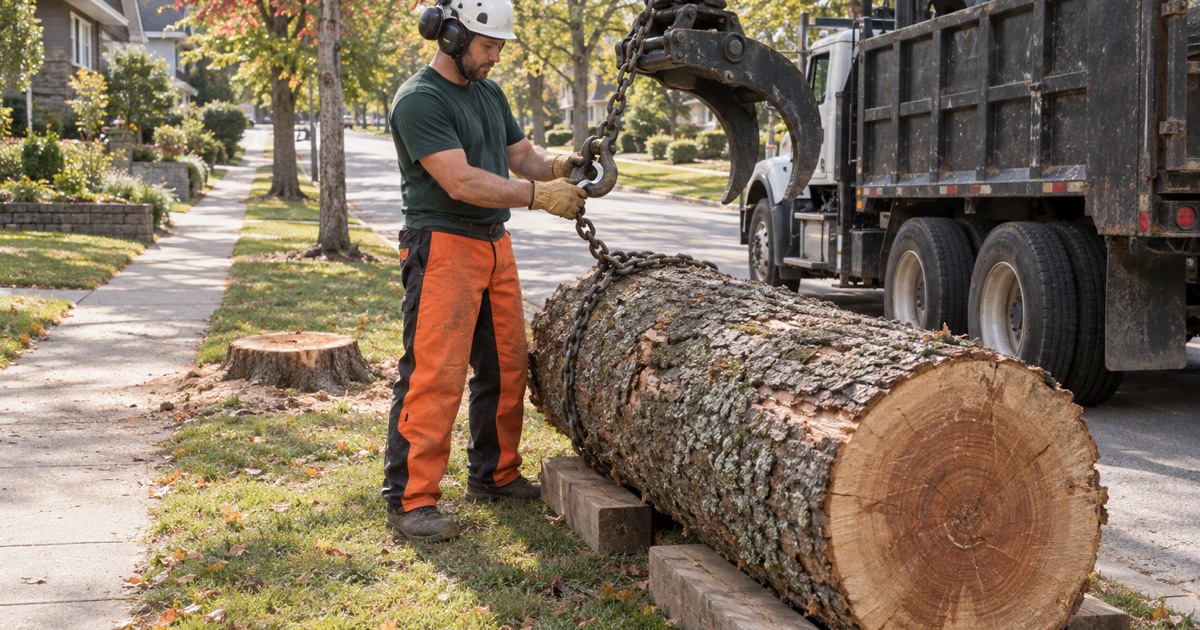
Read that cap carefully, because it is written as a property of the material rather than of the payer. There is no published fee that buys a twenty-inch butt log through that gate, which means a piece of wood that is perfectly ordinary on a mature oak has no residential outlet on the Laurens side. That is the constraint we plan the day around, not a surprise we discover at the scale house.
The second door, and the category that closes it
The obvious next thought is the county’s other facility, and it is a reasonable one. The Laurens County Transfer Station at 350 Landfill Road takes construction and demolition material, commercial waste, bulk residential loads and building clean-outs, with a $55.00 minimum on bulk and commercial loads, cards and checks only. Its published prohibited list, however, reads rock, brick, concrete, wet paint, metal, tires, yard debris.
Yard debris is prohibited there as a category, not as a size. Put the two published lists side by side and a trunk section over 18 inches in diameter off a Laurens-side removal is refused at one gate on its dimensions and at the other on what it is. That reading is ours, drawn from the two documents rather than from a county officer, but both lists are the counties’ own.
What that means for a quote is simple enough. On a Laurens-side job we plan the trunk down to sections the gate will actually accept, or we route the oversize wood somewhere else entirely, and we tell you which of those we are doing before you sign anything.
The same trunk repriced instead of refused on the Greenville side
Cross the line and the same wood stops being a problem and becomes a line item. Greenville County’s waste disposal rates, effective July 01, 2025, price yard and brush waste at $5.00 per cubic yard, defining it by geometry: loose leaves, grass clippings and tree or branch trimmings under six inches in diameter and less than six feet long.
The county then adds the sentence that matters here. Yard and brush waste exceeding those dimensions, or containing bags or other contaminants, is classified as construction and demolition waste, which is priced at $5 light or 15.00 per cubic yard if it is dense. Nothing is turned away; it is simply moved into a different column on the same sheet.
Bigger wood has its own category on the Greenville side as well. Acceptable waste at $32.50 per ton expressly includes logs greater than six inches in diameter or six feet in length, tree stumps, root mats and vegetation. The identical butt log that the Laurens gate sends home is, on this side of the city, a weight and a price.
Weight against volume, and why an estimate does not convert
One county bills by the ton and the other bills mostly by the cubic yard, so the arithmetic behind a disposal figure does not carry across the city. A homeowner comparing two numbers for identical work on opposite sides of Fountain Inn is often comparing two pricing systems rather than two companies. We price disposal for the county the job is actually in, and we show that line separately.
There is one more routing rule on the Greenville side worth knowing before a truck leaves the driveway. Greenville County requires that all commercial haulers disposing at a county facility use the Twin Chimneys Landfill on Augusta Road, so the loaded route on that side runs to the landfill rather than to the residential drop-off on Hipps Road. That is a longer haul than most quotes assume, and pretending otherwise is how a disposal line gets revised after the work is done.
The zoning code changed in February, and the code host has not caught up
Fountain Inn adopted a Unified Development Ordinance on February 12, 2026, the project the city branded INNtheZONE. It consolidates what were Appendix A, Zoning, and Appendix B, Land Development Regulations, of the Code of Ordinances into a single document, the first significant rewrite since 2006. The city’s own executive summary says the new ordinance incorporates development standards related to landscape buffers, tree preservation, open space and transportation improvements, and names street tree requirements among the notable changes.
Here is the part that catches people out. The Municode library still presents the Fountain Inn code as codified through Ordinance TX 2025-01, adopted October 9, 2025, which predates the February adoption, so anyone reading the tree rules on the code host is reading a superseded scheme. We have not quoted a threshold, a buffer width or a caliper figure from the adopted ordinance anywhere on this page, because the adopted text is the only place those numbers live and we will read it against your specific parcel rather than paraphrase it.
The cooperative that owns the corridor
Electric service here comes from Laurens Electric Cooperative, a member-owned utility organized in May 1939 that serves more than 65,000 member-customers across seven Upstate counties. Its published right-of-way clearance is 20 feet on each side of the line, and the cooperative reports spending roughly $1 million a year keeping that corridor open. Knowing whose corridor a tree stands in changes the plan, because work near energized conductors follows the ANSI Z133 safety requirements, including the weather limits that stop a climb rather than delay it.
Ground the soil survey never described
More than a third of this city’s housing, 37.4 percent, went up after 2010, which means a large share of addresses stand on imported fill and compacted subgrade rather than on the Cecil, Pacolet and Madison profiles the survey maps. Depth to bedrock is rarely the binding constraint in either case, since those series run past 60 inches while a stump grinder works roughly 12 to 25 inches below grade. What binds instead is wear from quartz and rock fragments, slope on the Pacolet ground, and on the newer lots the buried construction debris and utility runs no survey sheet can warn you about.
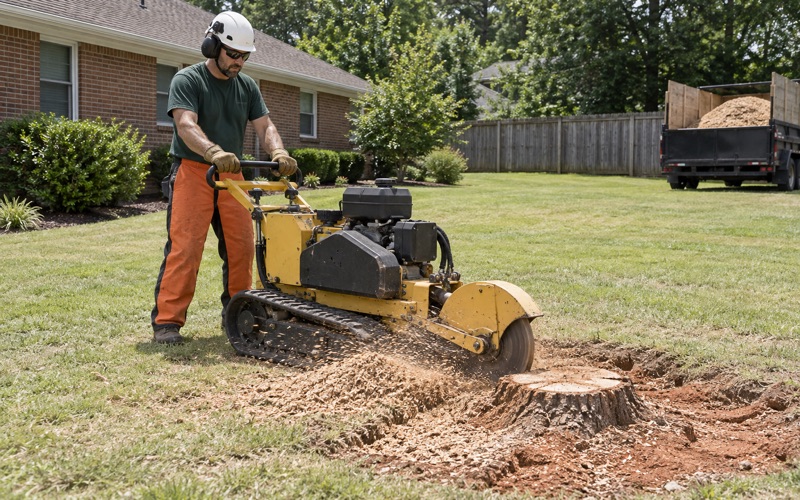
That mix is also why we bring compact tracked equipment to subdivision work, so a back-yard tree does not automatically become a crane job. Where a covenant is involved, it is worth remembering that South Carolina Code Section 27-30-130 makes homeowners association documents unenforceable unless they are recorded with the county register of deeds, and in a two-county city that means checking the correct one.
Two last things we say plainly, because competitors here do not. South Carolina issues no arborist or tree contractor license and requires none, so we describe what the state actually asks for instead of borrowing a word that does not exist; the Forestry Commission points homeowners at the ISA Certified Arborist credential and at telephoning the carrier to verify a certificate of insurance. And on the money side, the South Carolina Department of Insurance said in an October 5, 2015 release that some homeowner’s policies provide up to $500 coverage for tree removal, with that limit applying to all downed trees per loss rather than to each tree.
If the tree can be kept, we will say so, and price the cabling, bracing or crown work against the removal so the choice is yours. Our pruning follows the objectives and cut types the ANSI A300 standard defines, and we do not top trees. When you need something to hand a neighbor, an adjuster or an architectural review committee, we put the tree’s condition in writing.
- 20+ Years in the Upstate
- Free Estimates
- Written Tree Condition Reports