Greenville Tree Removal Team has been doing tree removal in Five Forks for more than twenty years, and the job here has a shape to it. Most of what we take down is a single large specimen on a platted subdivision lot, behind a fenced rear yard, on a property whose owner already knows the tree has to go.
What varies is who else has to agree. A removal in this area is usually a committee decision before it is a crew decision, so the paperwork half of the job carries as much weight as the rigging half. We write our findings up so they can be read by someone who never stood in the yard.
Estimates are free. We put the inclusions in writing before anyone starts — the trunk rounds, the stump, the grindings and the chips — and we will tell you when a tree can be cabled, braced or pruned instead of removed, and what each of those costs. South Carolina issues no arborist license and requires none of a tree contractor, so we tell you plainly what the state does ask for rather than leaning on a credential that does not exist.
The Trees Here Went In With the Houses
Five Forks was built fast and built recently. Of its 6,605 housing units, 4,421 — 66.9% — went up between 1980 and 2009, and the single largest decade is 2000 through 2009 at 2,005 units, or 30.4%. Only 309 units, 4.7%, predate 1980, and just 99 were built before 1960.
That distribution tells us something before we arrive. A tree on one of these lots is almost never a remnant of the forest the subdivision was cut out of. It is a landscape specimen that a builder or a first owner put in the ground with the house, in a spot chosen for how it would look in year five.
It is also not small. Stock from 1980 through 2009 puts those plantings at roughly twenty to forty-five years old, well past the point where drop-zone geometry and lifting capacity stop being optional considerations. We size the removal to the tree standing there now, not to the one on the original landscape plan.
The species that era chose, and how they come apart
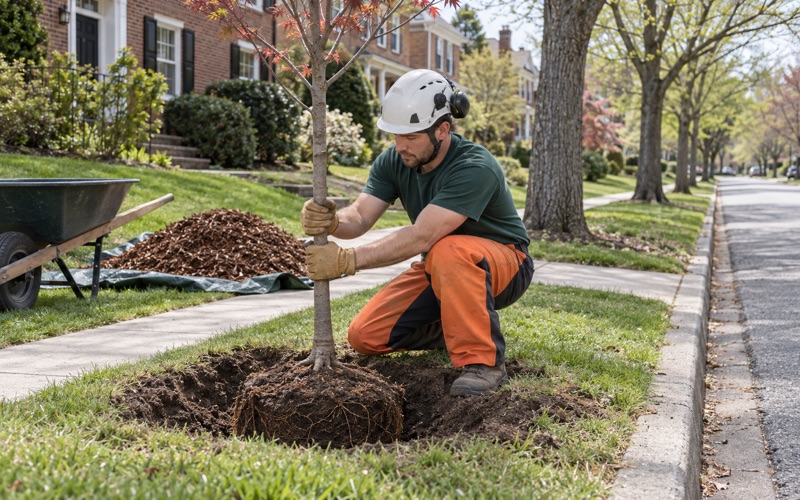
Callery pear, sold for years under the Bradford name, splits at exactly the tight branch unions the cultivar was selected for. It also has to have its lateral roots taken out along with the stump or it resprouts from the root system, which turns a straightforward grind into a root excavation and changes both the equipment on the truck and the number on the estimate. We tell you which of the two a job is before we quote it.
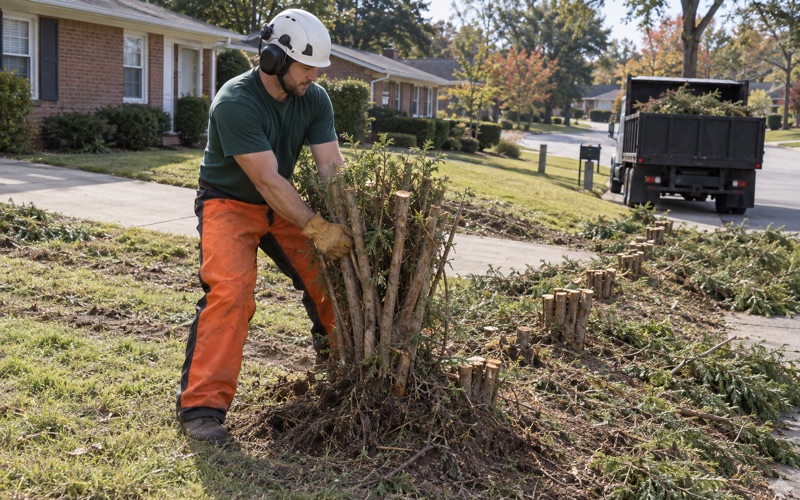
Leyland cypress is the other signature of the period. Planted on close centers as a privacy screen, it goes on to reach sixty and seventy feet against a spacing that assumed a hedge, and a run of them comes down as a rigging problem rather than a trimming one.
Neither species is unlawful to own. South Carolina ended nursery sale of Pyrus calleryana and its cultivars on October 1, 2024, but that instrument bans the sale, not the tree already in your yard. If you are taking one out anyway, Clemson Extension’s Bradford Pear Bounty trades free native replacement trees for removed Callery pears, with events scheduled into 2026.
Gates, easements and which pole belongs to whom
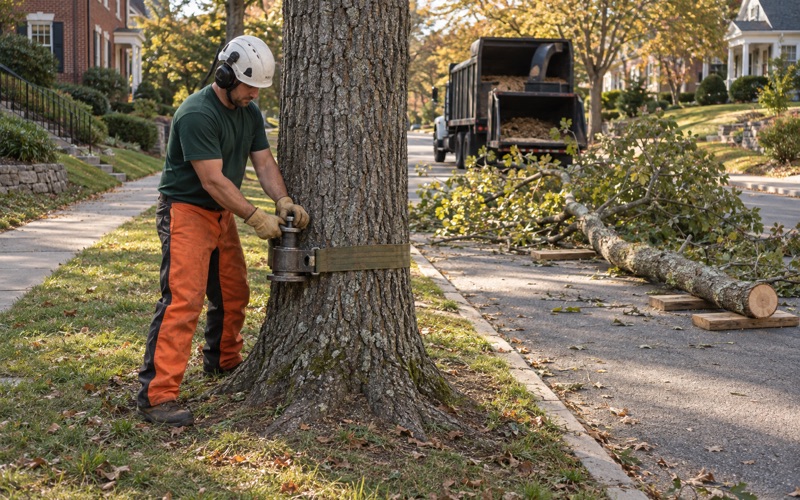
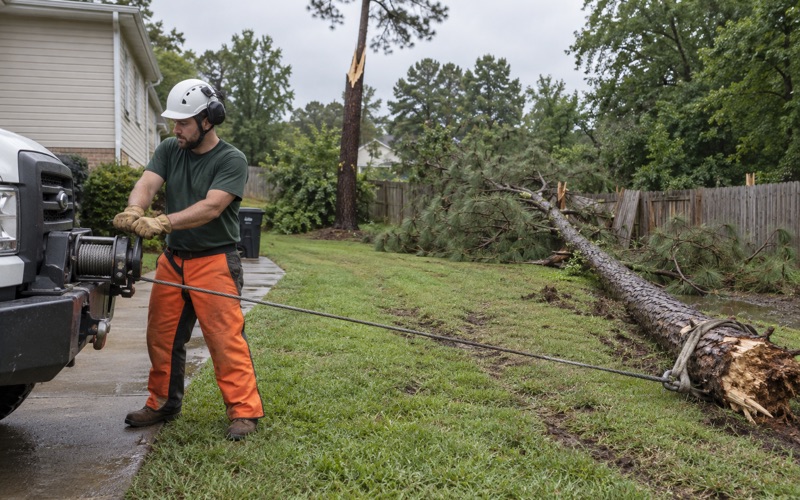
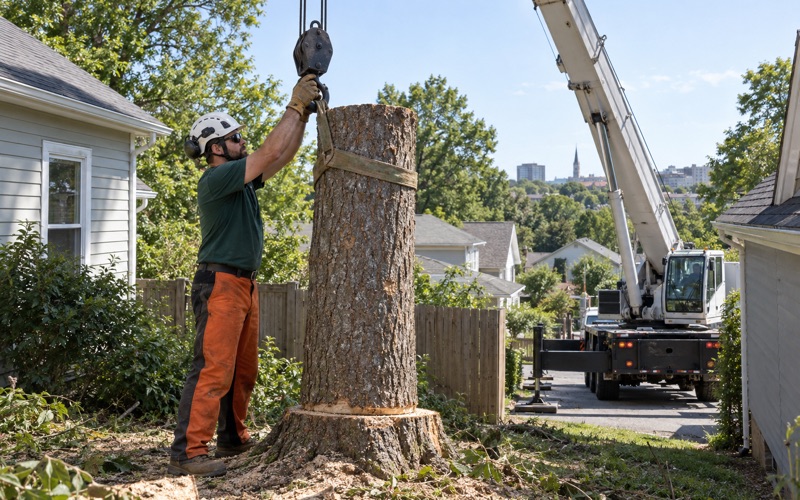
Subdivision geometry is its own constraint. Detached houses on platted lots — 90.7% of the stock here is single-unit detached — usually mean workable drop access at the street and a much tighter picture behind the house, with utility easements running the rear lines. Our compact tracked equipment fits a back-yard gate, so a back-lot tree does not automatically become a crane job, and we bring the crane when the geometry genuinely calls for it rather than by default.
Before we quote anything near a conductor we establish which utility serves the address. Both Duke Energy Carolinas and Laurens Electric Cooperative serve parts of Greenville County — Laurens Electric alone serves more than 64,000 consumers across seven counties — so the right vegetation-management contact is decided by the service address rather than by the look of the pole. Our rigging and line-clearance work follows the ANSI Z133 safety requirements, weather limits included.
Looking for tree-removal closer to Powdersville? See Tree-Removal in Powdersville.
Your Architectural Review Committee Approves It First
There is no city hall here to issue a tree permit and no municipal code setting a removal threshold. Five Forks is an unincorporated census-designated place in Greenville County with no municipal government of its own. South Carolina has no statewide tree-removal permit either; the state-level trigger most homeowners never reach is land disturbance, where SCDES requires NPDES general permit coverage for clearing, excavating or grubbing at or above one acre, with the Greenville County Land Development Division as the county authority on that side.
What does govern the tree is private. Subdivisions in this area are run by homeowners associations whose covenants restrict removal, replacement and species, and whose architectural review committee approves the work separately from anything a government agency would ask for. In practice the sequence is approval first and crew second, and a removal that starts before the committee has signed off is one the homeowner may have to answer for afterward.
What we hand the committee
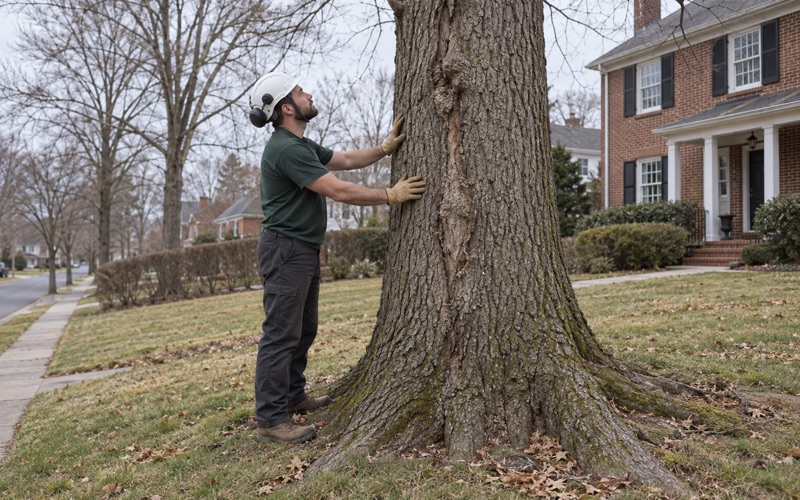
We write a tree condition report a homeowner can pass to an architectural review committee, a neighbor or an insurance adjuster: the defects we found, where they sit on the tree, and what we recommend. A Level 2 basic tree risk assessment gives that report a defensible structure — diameter at breast height, root flare and root collar condition, co-dominant stems with included bark, conks and deadwood, and how each of those bears on whatever sits underneath.
That document is also how a refusal gets reconsidered. A committee is usually being asked to approve an aesthetic change; a described structural defect is a different question than a preference, and it gives the committee something to file.
When the answer is prune, not remove
Not every approvable removal should be one. If a tree can be held with cabling and bracing, or brought back inside its bounds by crown cleaning, crown raising or crown reduction, we will say so and price it that way. Our pruning is worked to the objectives, systems and cut types the ANSI A300 standard defines, and we do not top trees — a topped tree on a covenant street becomes the neighborhood’s problem twice, once for how it looks and again when the regrowth fails.
Recorded by January Tenth: When a Covenant Actually Binds
Homeowners sometimes assume a covenant binds because it is printed in a handbook. Under the South Carolina Homeowners Association Act it does not. S.C. Code Section 27-30-130(A)(1) provides that in order to be enforceable, a homeowners association’s governing documents must be recorded in the clerk of court’s, Register of Mesne Conveyance or register of deeds office in the county where the property is located, which for Five Forks is Greenville County.
The rules layer carries a second, separate requirement. Section 27-30-130(B)(2) is where the annual deadline lives: rules, regulations and amendments to rules and regulations must be recorded by January tenth of each year following their adoption or amendment in order to remain enforceable. The two subsections are often quoted as one, and they are not the same rule — the January tenth date belongs to (B)(2).
We are a tree service and not your attorney, so we will not tell you whether a particular covenant holds. What we will tell you is that the answer is a records question with an office, an address and a date attached rather than something to be assumed from a handbook, and we will schedule the work around whatever answer comes back.
No Curbside Outlet: Where the Debris Goes
The community takes its name from a conflux of five roads — Woodruff, Batesville, Scuffletown, Bennetts Bridge and Five Forks — across 7.61 square miles that stayed rural into the early 1990s before the residential and retail growth arrived. It never picked up a municipal government along the way, and that is what decides where your wood ends up.
No public collection was established for this area, and with no municipal government there is no city crew to fall back on either. Residents here handle household waste through private subscription and compare notes among themselves about which hauler serves which street, which is what an area without an established public service looks like from the inside. Whatever arrangement a household has, it is a household arrangement: a subscription sized for what fits in a cart is not an outlet for trunk wood.
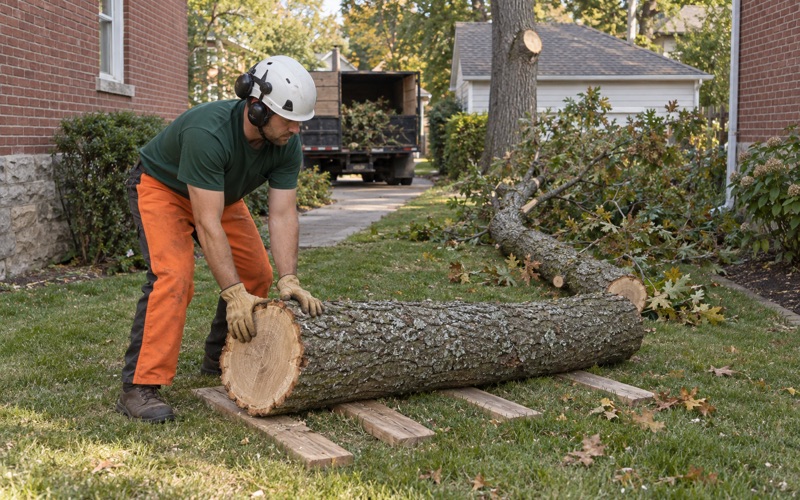
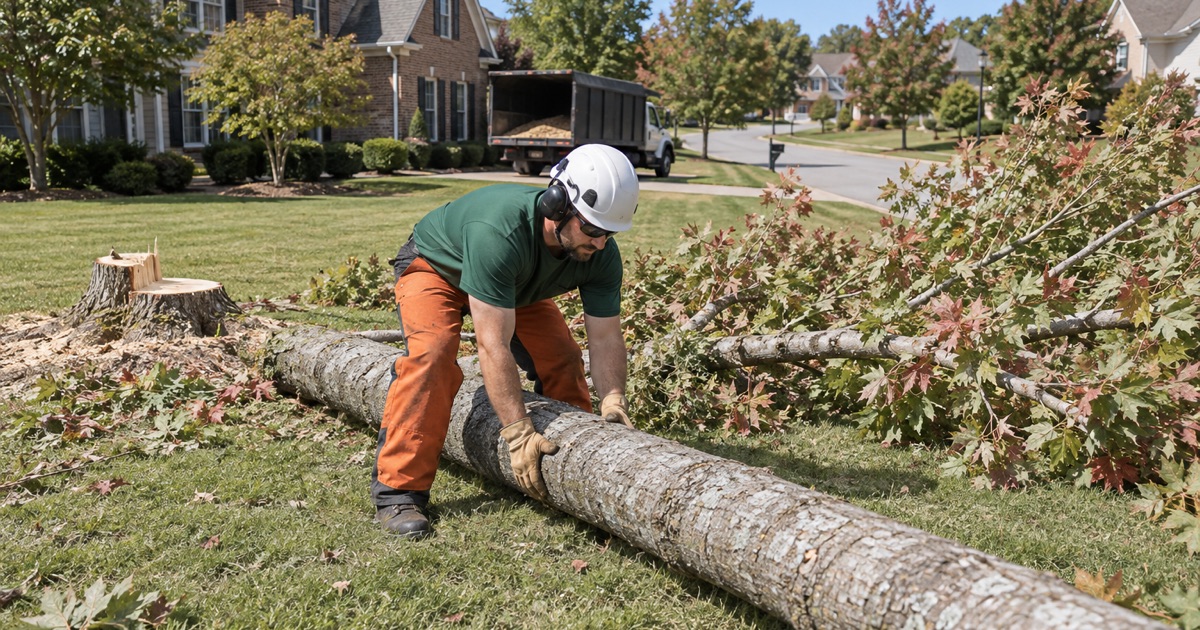
So the disposal side of a Five Forks removal is entirely ours to arrange. Every round, limb and chip leaves on our truck, and that haul is a priced line in the estimate rather than something assumed away — there is no curb outlet to fall back on here, and no public crew to blame if a pile stays put. It is worth asking any bidder where the wood is going, because a quote that is quiet about disposal is a quote with a gap in it.
Burning is a notification, not a free option
Because this is unincorporated ground, South Carolina’s requirement to notify the Forestry Commission before an outdoor burn reaches it — that requirement applies only in unincorporated areas of the state, and it covers leaves, limbs and branches as well as land-clearing burns. Where a burn is part of the plan, that call gets made before anything is lit.
Stumps in Southern Outer Piedmont soil
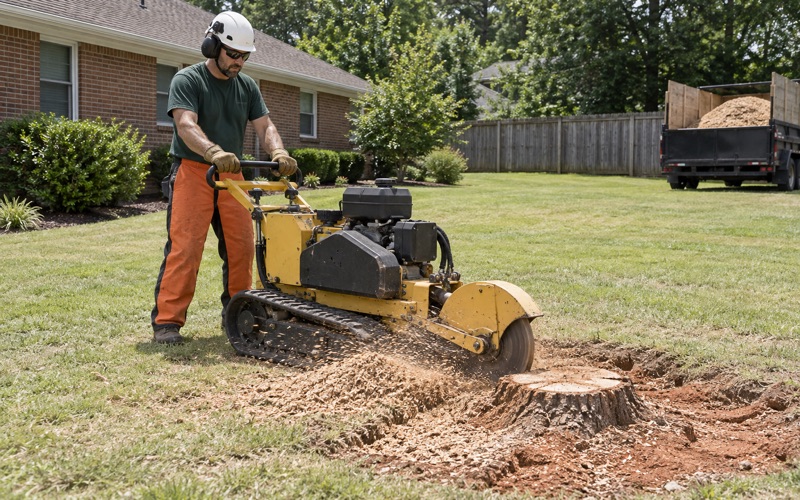
Five Forks sits in the Southern Outer Piedmont, and the soils under these lots are Piedmont ultisols carrying quartz gravel up in the A horizon. For stump work the practical constraint is not depth but teeth: grinder wear is what that gravel costs, and on the sloped rear lots the slope limits the machine before the depth does. Our tracked stump grinder gets through a gate to reach the stump, and we settle before we start whether the grindings stay on site or leave with the chips.
- 20+ Years in the Upstate
- Free Estimates
- Written Tree Condition Reports