Greenville Tree Removal Team has handled tree removal in Easley for more than twenty years, and on a city address the first thing we settle is who owns the wire the limb is lying on. The span from the pole to your meter belongs to you rather than to the power company, which makes it your contractor’s problem to work around. Easley Combined Utilities will take that span down and put it back at no charge, and knowing to book it ahead is most of the difference between a safe morning and a refused job.
We check which electric provider serves an address before quoting any work near a conductor, because the poles on this side of Pickens County do not all belong to one company. We read the ordinance for the city and the county a tree actually stands in, and we put the inclusions in writing before a saw leaves the truck: the trunk rounds, the stump, the grindings and the chips.
Estimates are free, and so is a straight answer about whether a job is worth an insurance claim. When a tree can be cabled, braced or pruned instead of taken down, we will say so and price both.
The service drop is yours, and Easley Combined Utilities will unhook it at no cost
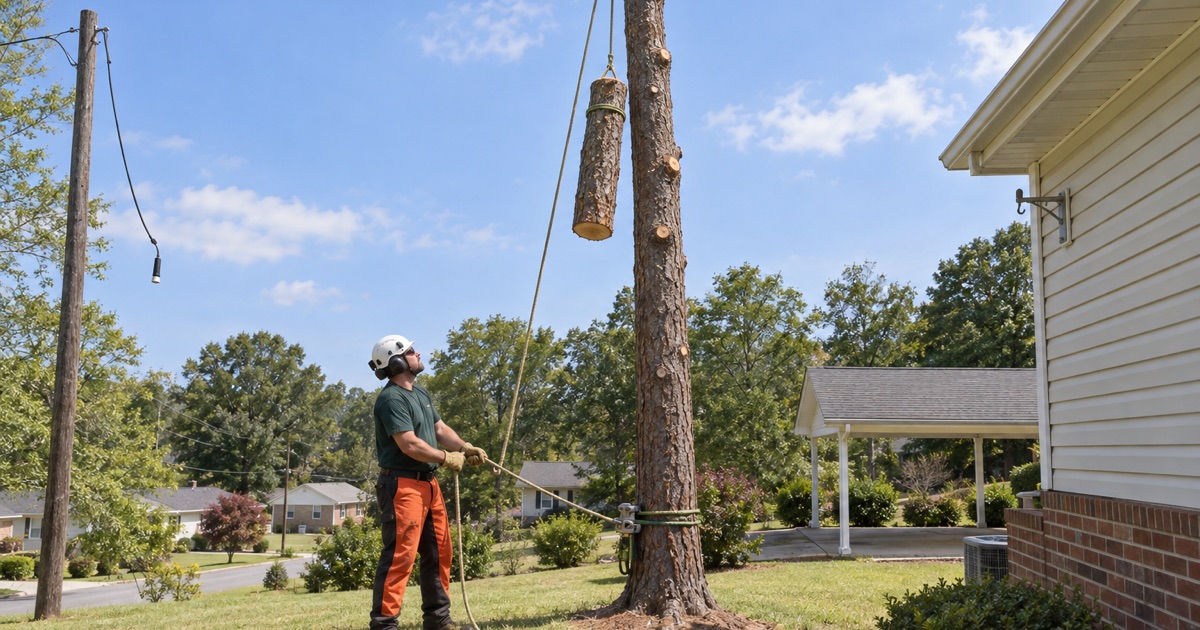
Easley Combined Utilities is municipally owned, providing electric, water and sewer from one office, so it writes its own vegetation rules instead of inheriting an investor-owned company’s. Its published Tree Trimming Policy states that trimming for services to residences and private lights is the responsibility of the customer, and that the utility will drop the service wire and re-connect it after a qualified contractor has completed the tree work. Then comes the clause that decides scheduling: there is no charge for this service, but it must be scheduled.
Read that as four separate facts. The span from the pole to the meter belongs to the customer, the utility de-energizes and physically drops it, the work costs nothing, and it is arranged in advance at (864) 859-4013 rather than called in on the morning of the job. A crew that does not know this either works alive beside an energized drop or turns the job down.
What the utility trims, and where its own numbers stop
The same policy covers the utility’s own lines, around energized power lines, fiber optic cables, utility poles and pad mount transformers, and it commits to attempting a five-year trim cycle. Any limb within 15 feet of an electrical line is cut back, at a main branching point or at the trunk, leaving no stub. Trees of 10 inches or less at chest height standing less than 10 feet from the nearest line may be removed outright.
Directly under the conductor the rule turns on mature size: a species whose maturity height exceeds 15 feet is removed at ground level, while slower growers such as oak, cedar, fir and hemlock may be left if the trunk exceeds 10 inches, pruned to hold 12 feet of clearance to the nearest primary conductor. That is thorough coverage on the primary line, and it stops there. The seam it leaves is the drop to your house, which is exactly what the free disconnect exists to cover.
We work rigging and line clearance to the ANSI Z133 safety requirements, including the weather limits that stop work near energized conductors. Booking the drop with the utility is part of that sequence rather than an extra step tacked onto it.
Looking for tree-removal closer to Fountain Inn? See Tree-Removal in Fountain Inn.
Where Easley wood goes after the saw stops
The city sanitation route carries two limits, and removal wood fails both. The published spec is that the Sanitation department picks up tree branches cut by the homeowner, no longer than 6 feet long and 8 inches in diameter, placed at the roadway behind the curb line. The same page assigns contractor debris to the contractor: a private lawn service collecting leaves or cutting trees is responsible for hauling off all debris.
Those are two different mechanisms. The 8-inch diameter cap is a material limit, and it sits below the diameter of most trunk sections and most primary scaffolds on a mature tree, so the wood off a removal is out regardless of who handled the saw. The phrase cut by the homeowner is an origin limit written into the spec itself, so hiring anyone forfeits the curbside route entirely.
Leaves run on a separate unbagged collection from early October through April, and grass clippings have their own paid cart at $45 a year. Neither route reaches a removal pile, which is ours to load and haul.
The county gate prices a railroad tie and never prices a tree
The Pickens County Landfill sits at 2043 Old Liberty Road in Liberty, with a weekday brush intake window and free mulch available to the public. Its admittance rule catches every truck at the entrance: a decal is required for admittance to the county solid waste facilities, obtained at the county administration facility or at the recycling stations. The published fee list names large tires at $80 per ton, and cross ties and creosote-treated lumber at $47 per ton.
What that list does not name is brush. The county publishes no rate for limbs, stumps or land-clearing debris on its solid waste pages, and no published distinction between a resident and a commercial hauler for that material. Figures circulate locally that do not reconcile with one another and appear on no county page, so we do not quote one; the disposal line on an estimate comes from a call to Solid Waste at (864) 859-3492, priced for the county the job is actually in.
Orange fencing and a Tree Save Area sign change where a crew can park
Easley’s tree provisions live in Article Five of the 2023 Zoning Ordinance, inside the buffer yard regulations, and they attach to landscape plans, buffer yards, parking lot planting and development sites. Section 5.13, Preservation of Wooded Areas and Trees, opens by stating that the preservation of existing vegetation shall be encouraged, and the practice of clear-cutting shall be prevented. Its mechanism is a fenced root protection zone installed outside the dripline before grading or building begins, four feet or taller, orange polyethylene web or silt fencing, with Tree Save Area signs secured to it.
The prohibition inside that fence is broader than most crews expect. The ordinance bars clearing, grading and other land disturbing activity within the fencing, and it also bars storage of materials, dumping of waste or fill, parking of equipment or vehicles, and trespassing inside the root protection zone. A chipper set down inside an orange fence on an active site is a violation on its face, which is why we walk the tree protection fencing with the site superintendent before anything rolls in.
Section 5.14, the credit table, prices what is preserved against what would otherwise be planted: a tree of 2 to 6 inches caliper at breast height counts as one planted tree, 6 to 10 inches as two, 10 to 15 inches as three, and anything larger than 15 inches as four. On a covered site that turns a single mature removal into four replacement trees, which is a budget conversation and not a field decision. For a finished single-family lot we have located no city requirement that a homeowner get approval before taking a tree down, because those provisions bite on grading and building permits instead.
What South Carolina asks of whoever you hire
South Carolina issues no arborist license and requires none to cut trees for money, so we tell homeowners that plainly instead of dressing it up. South Carolina’s Contractors’ Licensing Board covers construction above $10,000 in total cost and carries no tree, arborist or land-clearing classification at all. What South Carolina does register is foresters, which is a different profession from the one standing in your yard.
The South Carolina Forestry Commission’s homeowner guidance points instead at the ISA Certified Arborist credential and at verifying coverage directly: ask for certificates of insurance covering liability for personal and property damage and workers’ compensation, then telephone the carrier to confirm the policy is current. That is a better filter than anything a company can paint on a truck. We prune to the objectives, systems and cut types the ANSI A300 standard defines, and we do not top trees.
Insurance, neighbors and the association record
The South Carolina Department of Insurance said in an October 2015 release that some homeowner policies provide up to $500 of coverage for tree removal, and that the limit applies to all of the downed trees per loss rather than to each tree. Removal of a tree off a damaged structure is paid under the dwelling portion instead, and a tree on a car is comprehensive auto coverage rather than homeowners. We will tell you which of those a job falls under, and whether it is worth opening a claim at all.
Neighbor tree disputes here run on negligence rather than a bright-line rule: a healthy tree that fails in a storm generally carries no liability, while one that was decayed, dead or otherwise dangerous beforehand can, and written notice of that condition is what moves the risk. That is what our written tree condition reports are for, a document a homeowner can hand to a neighbor, an adjuster or an architectural review committee. If the committee is the obstacle, South Carolina Code Section 27-30-130 makes association governing documents unenforceable unless they are recorded with the county register of deeds, and requires rules and regulations to be re-recorded by January tenth each year.
Ground conditions that govern the machines
Easley sits in the Southern Outer Piedmont, EPA Level Four ecoregion 45b, which carries more loblolly and shortleaf pine than the inner Piedmont subregion to the west, though the EPA calls that boundary transitional rather than a fence. The practical read is a mixed pine-hardwood suburban canopy, which is why southern pine beetle evidence, crown fade and popped-corn pitch tubes on the bole, belongs in the conversation on this side of the county. The soils under it are Piedmont ultisols, and the Cecil, Pacolet and Madison series all publish depth to bedrock far beyond a stump grinder’s rated cut of roughly 12 to 25 inches below grade.
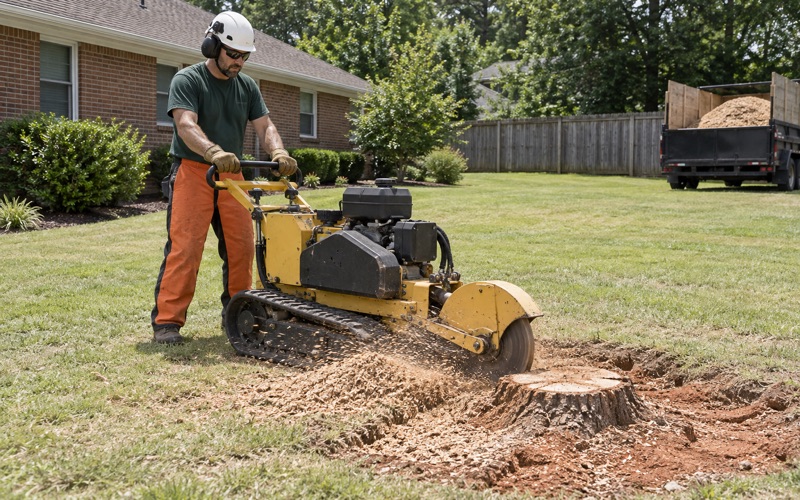
So depth is not the constraint worth quoting around. The two that bind are wear, since these profiles carry quartz and rock fragments in the surface horizon that cost teeth and cutting wheels, and slope, since the Pacolet series commonly runs 15 to 25 percent. We do not promise a below-grade grinding depth sight unseen, and we bring compact tracked equipment through a back-yard gate where the alternative would be making a subdivision tree into a crane job.
Hurricane Helene is this county’s event: the incident period ran from September 25 to October 7, 2024, and the South Carolina Forestry Commission named Pickens among the five heaviest-loss counties inside a statewide timber loss of roughly $83 million. The National Weather Service summary for the Upstate repeats one phrase, that many trees were uprooted or snapped, and no published source names a species that failed, so we will not name one either. With 40.7 percent of the housing stock built before 1980 and 71.3 percent of it one-unit detached, the mature back-yard canopy here is crane-and-rigging ground, and our storm planning is built on what the Upstate actually recorded.
- 20+ Years in the Upstate
- Free Estimates
- Written Tree Condition Reports