Greenville Tree Removal Team has been doing tree removal in Duncan for more than twenty years, and the first thing we look at here is not the tree. It is what the tree is standing in. Part of this town sits on Piedmont soil that has been in place since long before the railroad arrived, and part of it sits on ground that was hauled in, spread and rolled flat inside the last few years.
That difference decides how a root plate is actually holding, how far a stump grinder gets before it stops earning its fuel, and who has to be called before a saw goes anywhere near a service drop. We price the work off what is under the tree rather than off the address alone. Estimates are free, and if a removal is worth an insurance claim we will say so plainly.
We also read the rules for the jurisdiction the tree actually stands in, because our work crosses several Upstate counties and the answer changes at the line. Here that means a town brush policy with one hard limit in it, a county ordinance that governs anything resembling grading, and four outside utility authorities the town does not run.
Trees rooted in made ground beside the distribution corridor
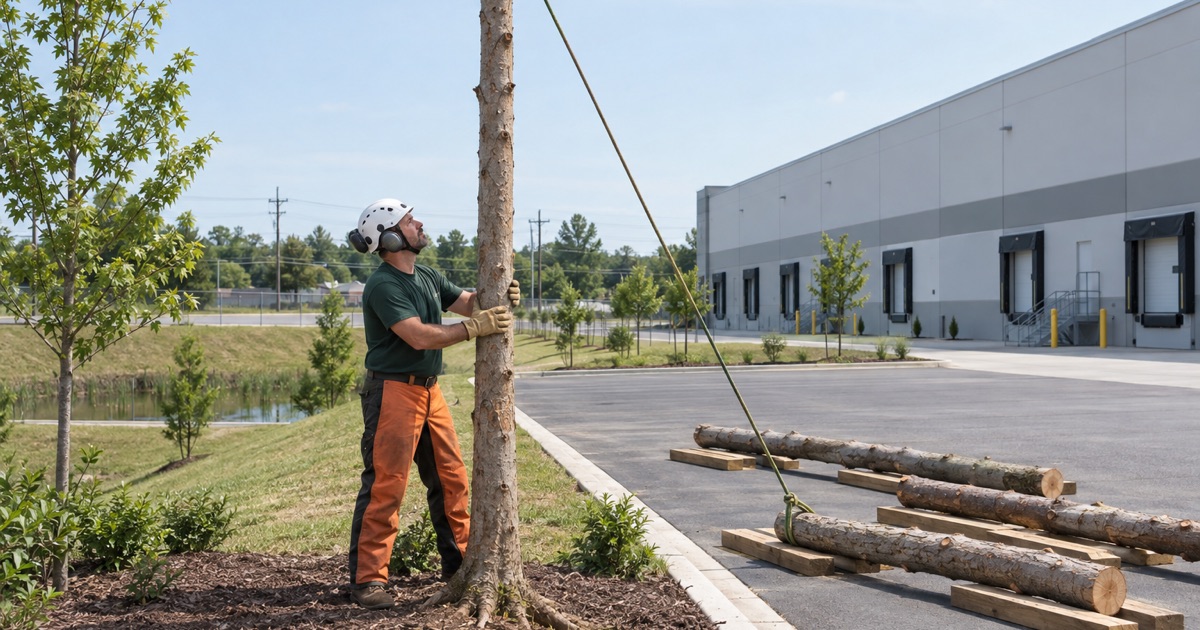
Duncan’s town limit covers 5.42 square miles of land, and two logistics developments carrying Duncan addresses press right up against Interstate 85 at the edge of it. Rockefeller Group completed Duncan Logistics Center, 827,000 square feet on 98 acres, with immediate Interstate 85 access. The Cubes at Inland 85 is a 324-acre industrial project developed by CRG with Lamar Johnson Collaborative and Clayco.
That puts hundreds of acres of graded and filled pad next to a street grid whose lines were set when the Atlanta and Richmond Railroad laid a line through in 1873 and the town took its charter in 1889. Engineered ground is not a soil type. It is a construction record, and it describes material placed to carry a slab and a truck court rather than to grow a canopy.
How a root plate behaves in imported fill
Imported fill and compacted subgrade change the shape of a root system rather than its size. Roots follow air and water, and in that ground both are near the surface, so the root plate develops shallow and wide instead of deep. A tree like that can look sound for years and still fail as a whole plate in saturated soil under wind, which is why we assess windthrow potential separately from crown condition on corridor properties.
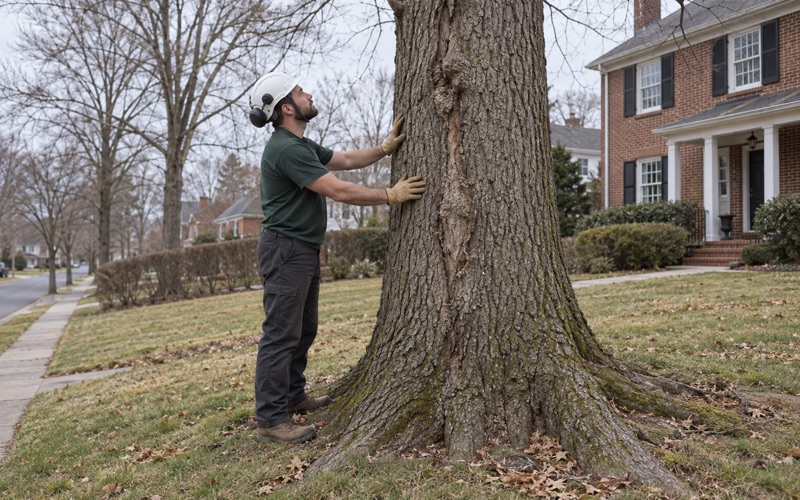
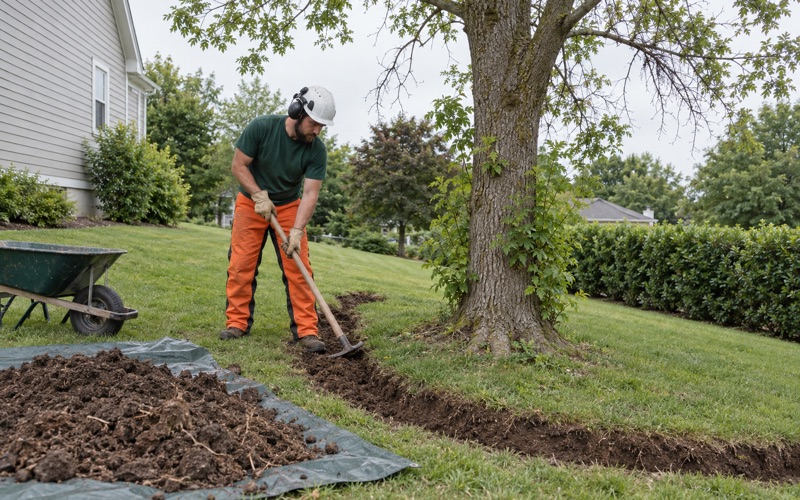
Fill also buries the root flare, and a buried flare hides the decay and girdling roots that a Level 2 basic tree risk assessment is meant to find. Root collar excavation with an air spade is often the only honest way to see it. We would rather spend an hour opening the flare than guess at a trunk we cannot actually see.
Basin, buffer and parking-island trees that were set rather than grown
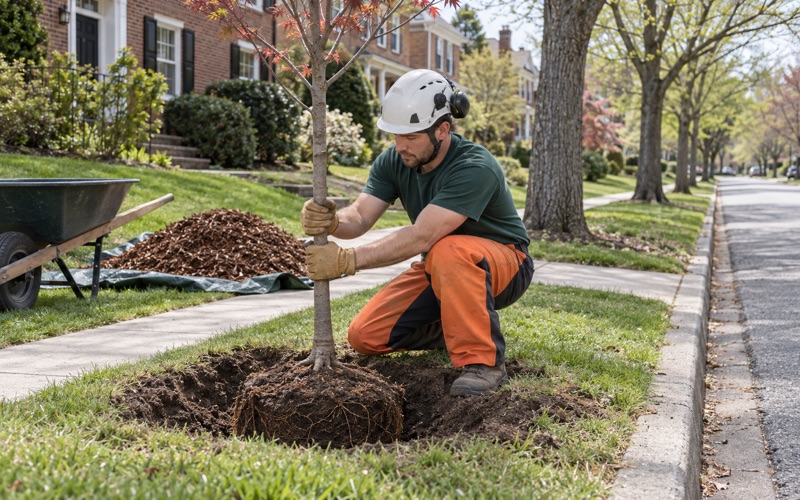
Detention basins, screening strips and parking islands on those developments were planted, not grown. Nursery stock carries staking scars, bred branch unions and co-dominant stems with included bark held at heights a forest tree would have shed, and detention basins add periodic saturation on top of that. The failure mode is a stem splitting at the union rather than a whole tree going over.
Where a union is still sound enough to keep, cabling and bracing is usually cheaper than a removal and a replacement. We will tell you when that is the case, what a dynamic cabling system costs against a crown reduction, and when the tree is simply past it.
Looking for tree-removal closer to Williamston? See Williamston Tree-Removal.
Stump grinding in fill, where the machine sets the depth
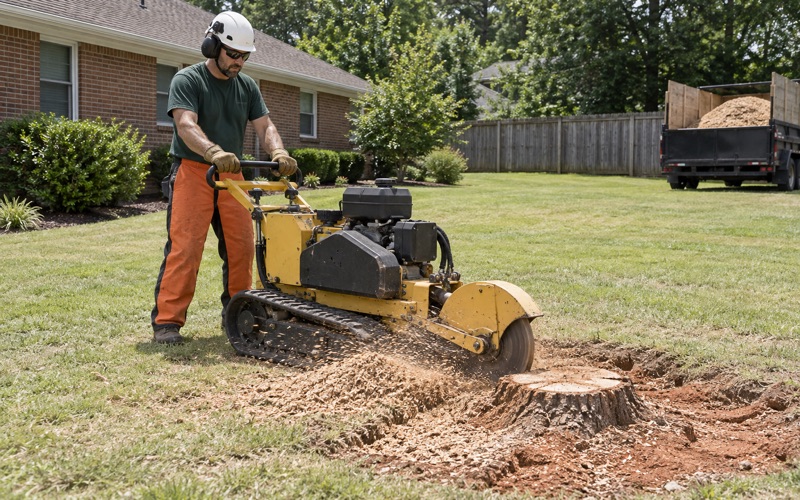
The residual soils of this part of the Piedmont, the Cecil, Pacolet and Madison series, run more than 60 inches to bedrock. A tracked stump grinder is rated for a cut somewhere between 12 and 25 inches. Depth to rock is therefore never what stops a grind here; the machine’s rated reach is.
On the filled ground the wheel meets something else. Imported fill has an unknown gradation, so instead of the weathered saprolite the soil survey describes it can hit brick, concrete rubble or graded stone at any depth. We quote fill grinding with that in mind rather than discovering it at the second tooth.
Wear and slope, the two things that really end a grind
Quartz and rock fragments run through the A horizon of these soils, and on the native ground that abrasion, not depth, is what governs how long a set of teeth lasts. Slope is the other practical limit. On Piedmont ground of this kind the question is usually whether the machine can be positioned safely, not whether it can cut deep enough.
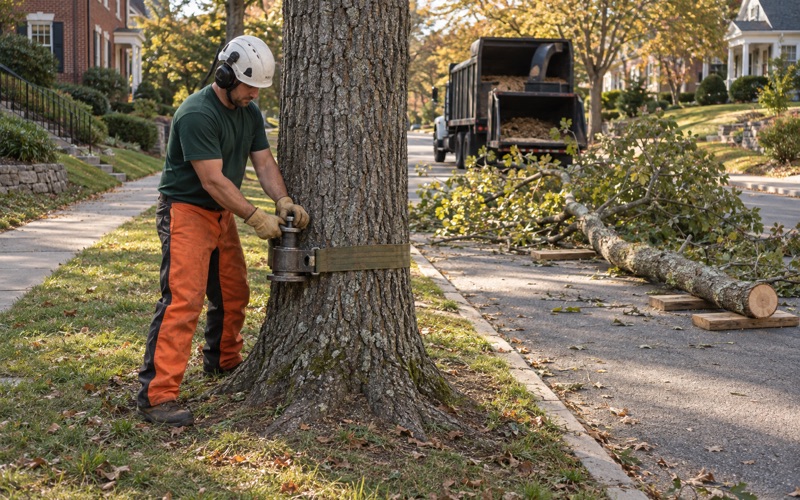
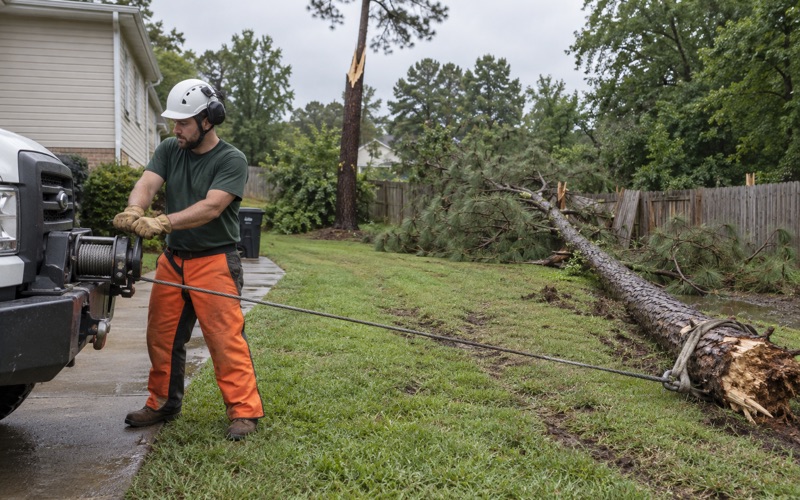
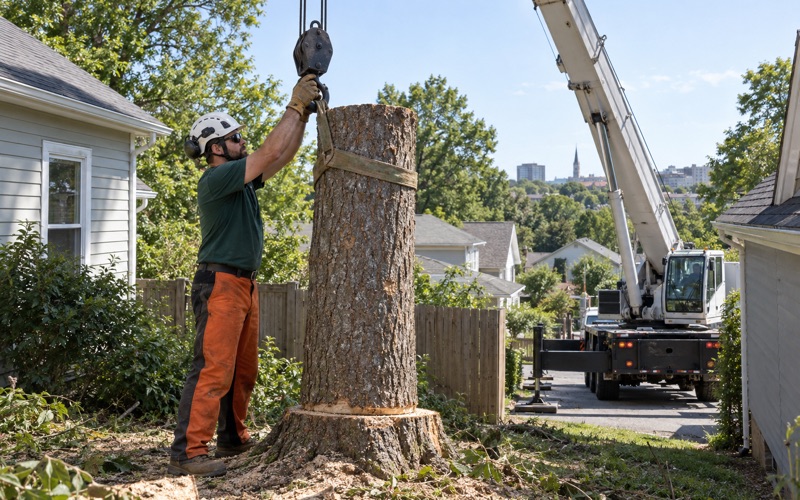
Compact tracked equipment gets us through a back-yard gate on the older streets, which keeps a routine removal from turning into a crane job. Where the canopy genuinely needs one, we have crane and rigging capacity for it, worked with a friction lowering device and rigging blocks inside a stated working load limit.
Callery pear, and the roots that come back without the stump
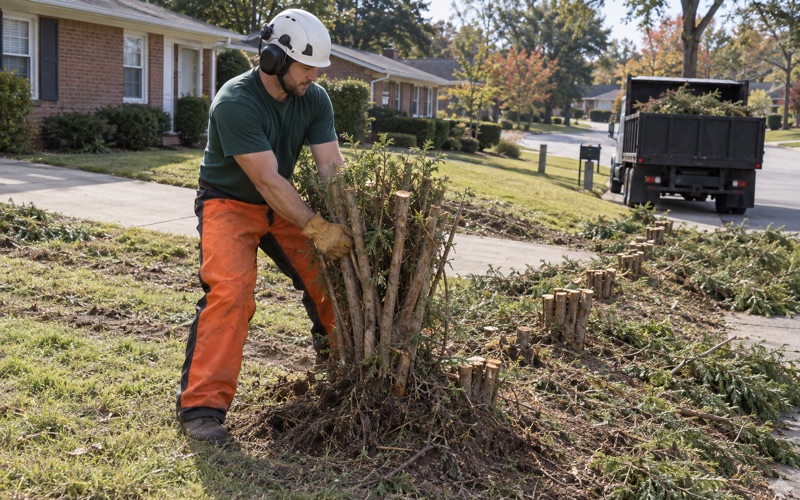
Callery pear went onto the South Carolina State Plant Pest List and nursery sale ended on 1 October 2024. The ban covers sale rather than possession, so the Bradford pears already in yards and along old fence lines are staying where they are. The relevant part for a removal is that the tree resprouts from lateral roots unless those roots come out with the stump.
So we put the inclusions in writing before anything starts: the trunk rounds, the stump, the grindings and the chips. A quote that says removal and stops there is where the argument happens later.
What the town collects, and what leaves on our truck
The Town of Duncan runs a yard waste pickup, and its published policy is short and specific. Limbs must be smaller than six feet in length. Items go at the side of the road with clear space above and around them for access, and no more than 8 feet off the road.
Limbs smaller than six feet, and the diameter limit the policy never states
That length rule is the one hard number in it. Other jurisdictions in this region publish a diameter cap alongside a length limit; the Duncan policy states none at all. It is worth knowing which rule you are actually under before you cut a limb into pieces that fit the wrong one.
Two other conditions matter more than the measurement. The service is stated to be for town residents only, and the policy says in plain terms that all services are equipment and weather dependent. Leaves have to be bagged except in November, December and January, and limbs are named among the items that may not go in a leaf pile.
None of that is written for a contractor’s brush pile, and we do not ask it to be. Debris from work we do leaves with us.
Where removal wood actually goes
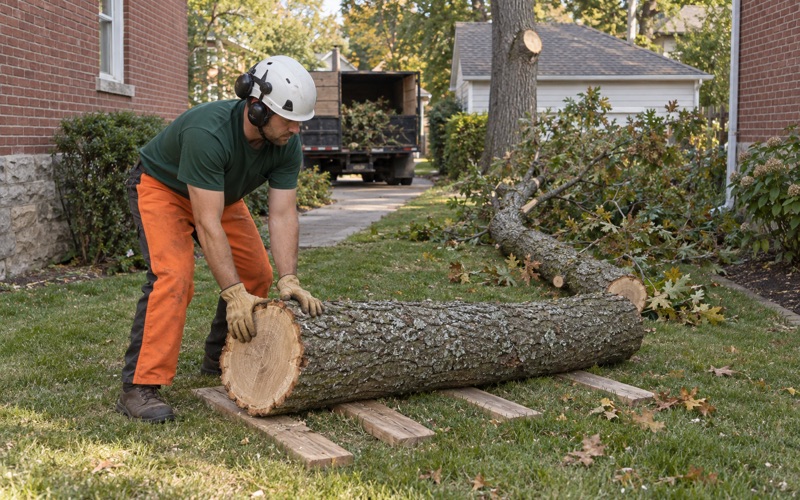
Removal wood that exceeds the town’s rules goes to the Spartanburg County Wellford Landfill Facility, which runs a wood chipping and grinding operation alongside a Class Two construction, demolition and land clearing debris landfill and a Class Three municipal solid waste landfill. The county’s current fee schedule prices Yard Waste Debris at $30.00 per ton, shown struck through from $20.00.
We price disposal for the county the job is actually in, because one gate charges by the cubic yard, the next by the ton, and a couple of them are free only to their own residents. On a large corridor removal that line is a real number, not a rounding error, so it goes on the estimate rather than into a surprise.
Four outside authorities, and the county rule behind them
The town supplies none of its own utilities. Its own list names Duke Energy for electricity, the Startex-Jackson-Wellford-Duncan Water District for water and sewer, and the Greer Commission of Public Works for natural gas. A service drop question, a water line question and a gas locate on one job therefore reach three different organizations, and none of them is town hall.
Three phone numbers before the saw starts
Because the gas provider is a municipal utility headquartered in another city, a gas locate on a Duncan address is not something the town can answer for you. We check which company actually serves the address before we quote work near a line, rather than assuming every pole and every meter belongs to the same provider. South Carolina 811 goes in before a grinder touches ground, not after.
Work near energized conductors follows the ANSI Z133 safety requirements, including the weather limits that stop a crew rather than push it. Pruning is worked to the objectives, systems and cut types defined by the ANSI A300 standard, and we do not top trees.
Where the county’s land disturbance rule reaches
Spartanburg County defines land disturbance broadly, as any use of land that changes the natural cover or topography, including clearing, removal of vegetation that disturbs the soil, stripping, grading, grubbing, excavating, filling and logging. The county also states that no grading permit shall be issued in the absence of an approved storm water management plan. That article governs unincorporated county land and municipalities that contract with the county to administer it.
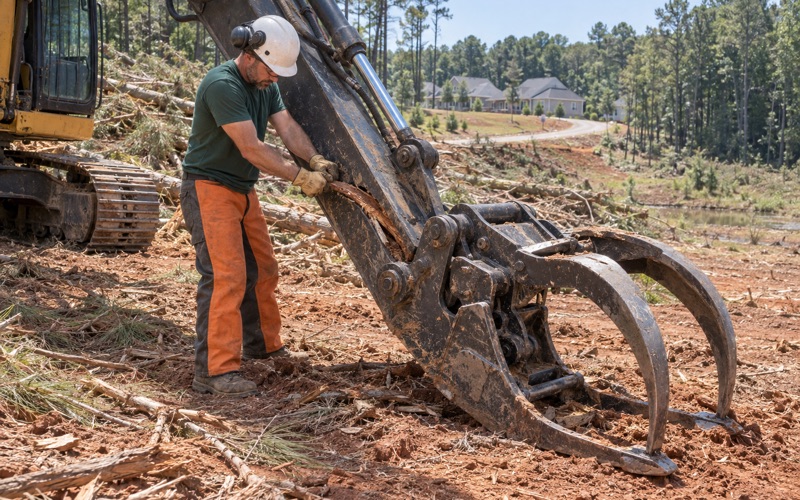
For a single yard tree that language rarely bites. For a clearing job on a corridor parcel it decides the sequence, so we establish which permit the site is already operating under before a machine moves, and we say plainly when a question belongs to the design engineer rather than to us.
Riverfront trees, corridor frontage and what we hand you afterward
The Middle Tyger River passes through the northern part of the town, which puts floodplain and riparian trees inside the municipal limit rather than out in the county. Those trees sit in wetter ground with softer access, and the equipment decision there is usually about ground pressure and reach rather than about the cut itself.
Commercial and industrial frontage along Highway 290 and the Interstate 85 approaches is a different job again, with parking, loading and pedestrian movement running while we work. We plan the drop zone around that, and we leave a written tree condition report a property manager can hand to an insurer, a neighbor or a review committee.
One last thing is worth saying out loud, because it comes up on every commercial quote. South Carolina issues no arborist license and requires none, and the Contractors’ Licensing Board, which licenses construction work above $10,000 in total cost, carries no tree, arborist or land clearing classification. We would rather tell you what the state actually asks for than dress up a credential that does not exist.
- 20+ Years in the Upstate
- Free Estimates
- Written Tree Condition Reports