Greenville Tree Removal Team has spent more than 20 years on Upstate tree work, and tree removal in Clemson University is unlike almost anything else we handle. The land here is campus land, managed by an institution that keeps its own tree crew and works to written standards. That changes who makes the call on a tree, what an outside contractor is actually asked to do, and how a job on this ground gets scoped.
So this page is not written as a pitch to a household, because the record does not put one on this ground. It is a plain account of who manages the canopy here, what an owner just outside the line is responsible for, and which state rule reaches an address in this corner of Pickens County. Where the work belongs to somebody else, we would rather say so than sell around it.
We read the rules for the exact city and county a tree stands in rather than assuming an answer travels across a line, and near this campus that habit earns its keep. Four different counties answer questions within a few miles of here, and the county header on a document has to be checked every time. Estimates are free, and the scope goes in writing before anyone starts cutting.
Who Manages the Trees on the Main Campus
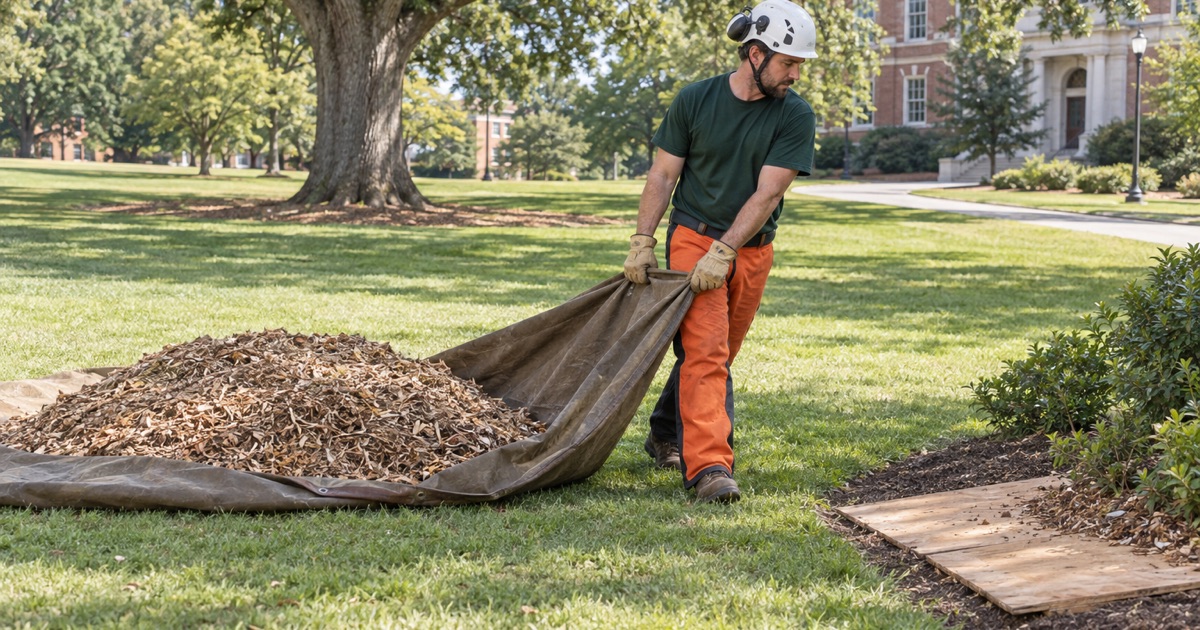
Clemson University Landscape Services runs an Arbor Crew that, in the university’s own words, provides a comprehensive Tree Management Program for the over 7,000 inventoried trees on Clemson University’s Main Campus. The university publishes a public tree inventory database, maintains a Tree Advisory Committee, and posts upcoming planting and removal projects online with detailed explanations for the removals. Replanting and removal are handled inside that program rather than farmed out by default.
That crew works to ANSI A300, the standard that defines tree care performance, and to ANSI Z133, which sets the safety requirements for arboricultural operations. It also runs a documented risk management program that, again in the university’s own description, describes in detail how the trees are maintained and cared for. Those are the two standards our own pruning and rigging practice is worked to, which makes the comparison easy and is not a claim of shared status.
The Incumbent Is Not a Prospect
The practical consequence is blunt. On the ground this page covers, an institution with an inventory of over 7,000 trees, a written standard and a crew of its own is not a buyer waiting to be sold a removal. We do not know whether the university contracts specialist work such as large tree rigging or crane picks to outside firms, and nothing we found settles it in either direction, so we make no claim about it.
What the University Is in This Trade, and What It Is Not
Clemson is South Carolina’s land-grant university and the state’s forestry school, and much of the species, pest and hazard guidance this trade leans on in South Carolina comes out of its units. That makes it a real source to cite, and we cite it. It is not a credential anybody holds: South Carolina issues no arborist license and requires none, there is no Clemson certification for tree removal, and we claim no affiliation with or endorsement from it.
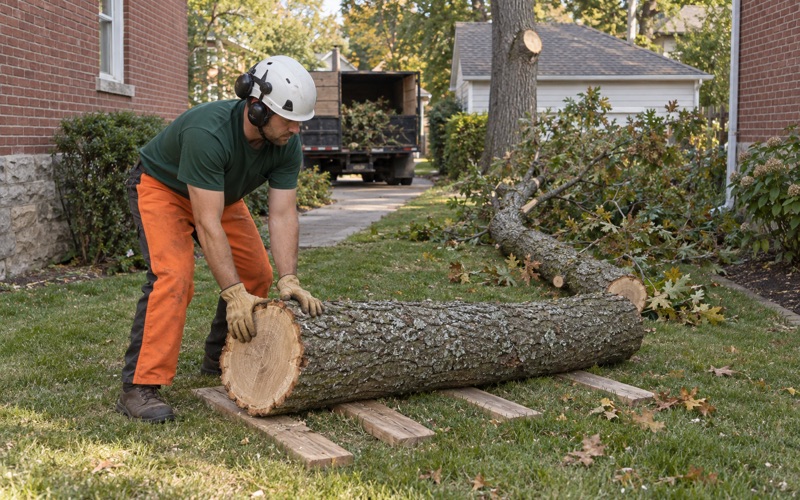
The things worth checking on any contractor are simpler than a logo: an ISA Certified Arborist on site, current certificates of insurance, and a written scope naming what the price includes. We put our own scope in writing before we start, down to the trunk rounds, the stump, the grindings and the chips.
Looking for tree-removal closer to Gantt? See Tree-Removal in Gantt.
What the Numbers Record Here: 7,015 People and 54 Housing Units
Clemson University CDP is a Census Designated Place, which means it is an unincorporated statistical area drawn around the campus rather than a town. It has no mayor, no council and no ordinances of its own, and it is a different place from the incorporated City of Clemson next door, which has its own government and its own code. Mixing the two is the fastest way to quote the wrong rule here.
The counts explain why. The place holds a population of 7,015, of whom 6,920 are group quarters population, which is to say 98.6 percent of the people counted here sleep in residence halls. Group quarters are recorded as population but not as housing units, so the resident number and the housing number describe two different things.
The housing side is 54 units in total, 25 of them occupied, with zero owner-occupied units and zero one-unit-detached units on the record. Year built runs 25 units from 1940 to 1949, 14 from 1960 to 1969, and 15 from 1980 to 1989, with nothing added since. Across 2.117 square miles that works out to roughly 25 housing units per square mile against roughly 3,314 people per square mile.
What That Means for a Removal Quote
There is no detached, owner-occupied housing stock recorded here to generate the ordinary residential removal call, and we would rather write that down than pretend otherwise. The demand this page can honestly speak to sits at the edges: private ground on the other side of the campus line, and the owners and managers who hold it. Those calls we take, and we quote them against the county and municipality the tree actually stands in.
The 19,200-Acre Forest Around the Campus, and Why Forestry Is Not Removal Work
The university publishes that Clemson University is surrounded by the Clemson University Forest, a 19,200-acre landscape dedicated to research, teaching and outreach, and describes it as the largest university-managed forest contiguous with its campus in the United States. It carried the name Clemson Experimental Forest until the Board of Trustees renamed it, and the older name still turns up in secondary sources alongside a stale acreage figure. The current first-party number is 19,200 acres.
That land is certified under the Sustainable Forestry Initiative Forest Management Standard, and its management includes prescribed fire, timber harvesting and invasive-species control. It was established nearly a century ago on degraded farmland, and some of its recreation infrastructure dates to New Deal work in the 1930s.
Forestry and Arboriculture Are Different Trades
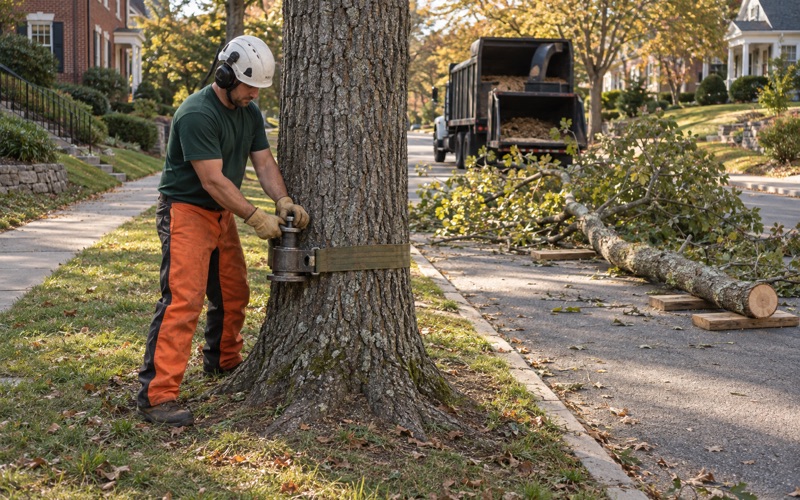
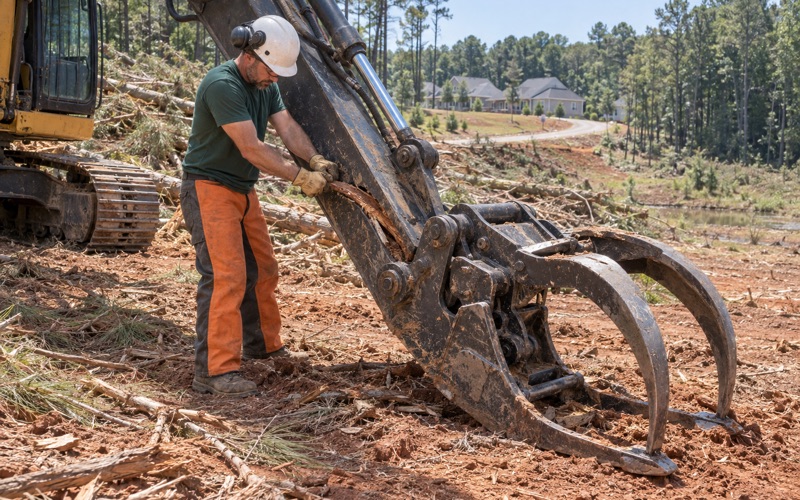
A timber harvest and a removal in a landscape are not the same job. Forestry works stands by the acre with mechanized felling and a mill at the other end, while arboriculture works single trees next to things that break, with a rigging block, a friction lowering device and a bull rope doing what a felling cut cannot. Treating one as the other is the error a reader in the Upstate spots fastest, so we do not describe that forest as a market for removals.
What the 45a Read Does and Does Not Say
This ground sits in EPA Level IV ecoregion 45a, Southern Inner Piedmont, inside Level III 45 Piedmont. The published 45a description carries oak-pine and oak-hickory forest with less loblolly-shortleaf pine than the outer Piedmont band that covers our Greenville work. The agency’s own text calls that boundary transitional or fuzzy, so we read the code as a regional characterization and not as a description of what is standing on a given acre.
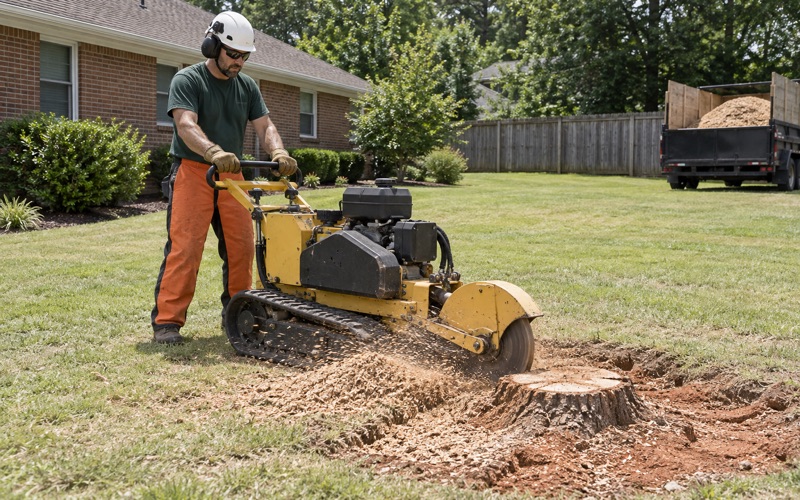
Soils give the same Piedmont answer. Cecil, Pacolet and Madison publish depths to bedrock beyond 60 inches, while a stump grinder cuts roughly 12 to 25 inches below grade, so the machine’s own stop binds long before rock does. What limits a day here is wear from quartz and rock fragments in the upper soil, and slope, since Pacolet commonly runs 15 to 25 percent and a loaded truck is slope-limited well before it is depth-limited.
Burn Notification on Unincorporated Ground, and Where the Campus Ends
The South Carolina Forestry Commission requires notification before outdoor burning, and states that the requirement applies only to unincorporated areas of the state, naming the burning of leaves, limbs and branches along with land-clearing burns. Because this place is unincorporated, an address here falls on the side of that line where the state notification requirement applies, which is not the case for an address inside an incorporated town next door. That is a real state obligation rather than a courtesy, and it is one of the few things about this ground that is genuinely a rule.
Whatever institutional controls on open burning the university keeps for its own land sit alongside that requirement rather than replacing it, and we did not establish them. When a job of ours would put a pile on the ground, we handle the notification as part of the scope, and we state in writing whether the debris is burned, chipped or hauled.
Reading the Line, and Reading the County
Campus ground ends, and the answers change when it does. This statistical area sits in Pickens County; the City of Clemson beside it spans Pickens and Anderson counties; and the university’s plant-pest and pesticide regulatory departments sit at a Pendleton address in Anderson County rather than on this campus. Those answers sit within a few miles of each other, so we check which set applies to an address before we price anything.
Utilities get the same treatment. Duke Energy Carolinas and Blue Ridge Electric Cooperative both hold territory in Pickens County, and the campus is additionally served through university distribution infrastructure, so we confirm which provider serves a specific address before quoting work near a conductor instead of assuming every pole belongs to one company. Disposal is settled the same way, because the gate rules and fees are not uniform across the counties this crew works in, and we price the haul for the gate the load is actually going to.
What the Work Looks Like on the Private Side
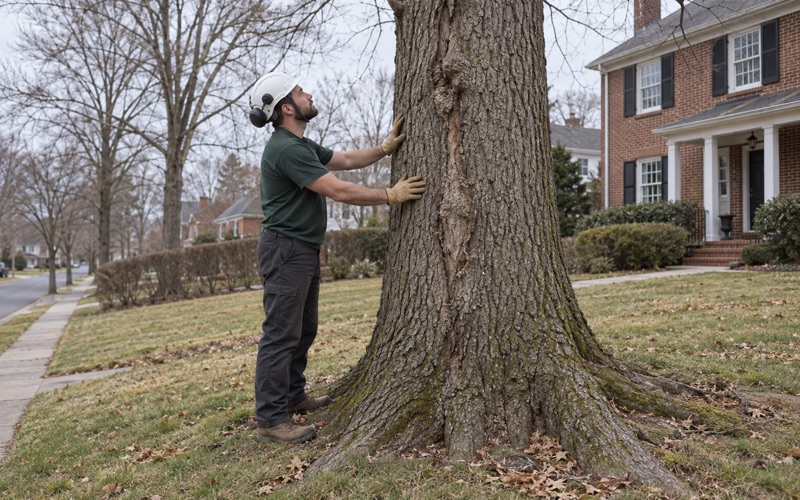
Off the campus line our work looks like it does anywhere else in the Upstate. We give a straight answer on whether a tree can be cabled, braced or pruned instead of removed and what each option costs, we prune to the objectives and cut types ANSI A300 defines, and we do not top trees. A written tree condition report can go to an insurer or a review committee when one is needed.
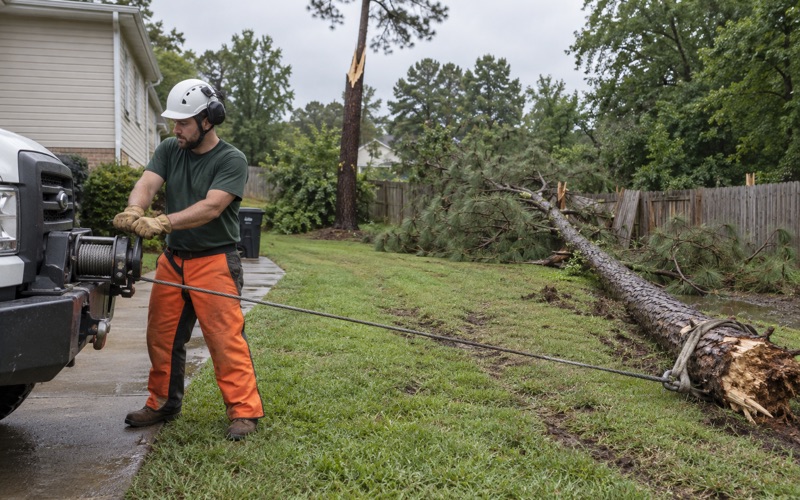
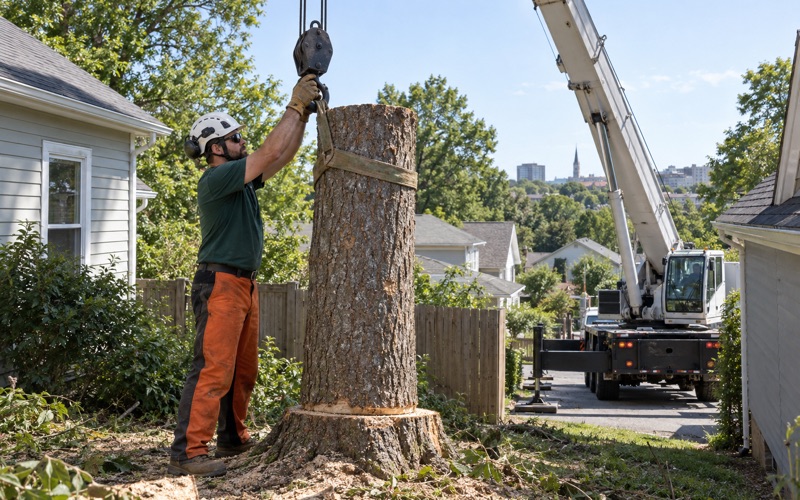
Compact tracked equipment gets through a gate where a crane would be overkill, and crane and rigging capacity is there for mature canopy when it is not. Storm work is planned around what the Upstate actually records, including the September 2024 hurricane, rather than a generic coastal script. If a tree near this campus needs a decision, we will say who owns the call before we say what it costs.
- 20+ Years in the Upstate
- Free Estimates
- Written Tree Condition Reports