Greenville Tree Removal Team handles tree removal in Clemson with more than twenty years of Upstate crew experience, and we start every quote here by settling one question: which tree are we actually talking about, and who is allowed to say yes to it. That is not a formality in this city. The tree at the curb belongs to the municipality, and the tree in the yard often belongs to someone who does not live there.
Getting that wrong is expensive rather than embarrassing. A crew that drops a limb into a street tree, or rigs a back-yard removal over one, has damaged a tree the city owns, and the City of Clemson does not settle that with a flat fine. We would rather sort the ownership out on the estimate than explain it afterward.
We work across Greenville, Spartanburg, Anderson, Pickens and Laurens counties, and we read the ordinance for the place a tree actually stands in, because the answer changes at the line. Clemson sits in Pickens County, and it carries its own public tree ordinance, its own municipal officer, and its own published rules for what a contractor may leave at the street. What follows is how that shapes a removal here.
Clemson street trees have an owner, and it is not the house they stand in front of
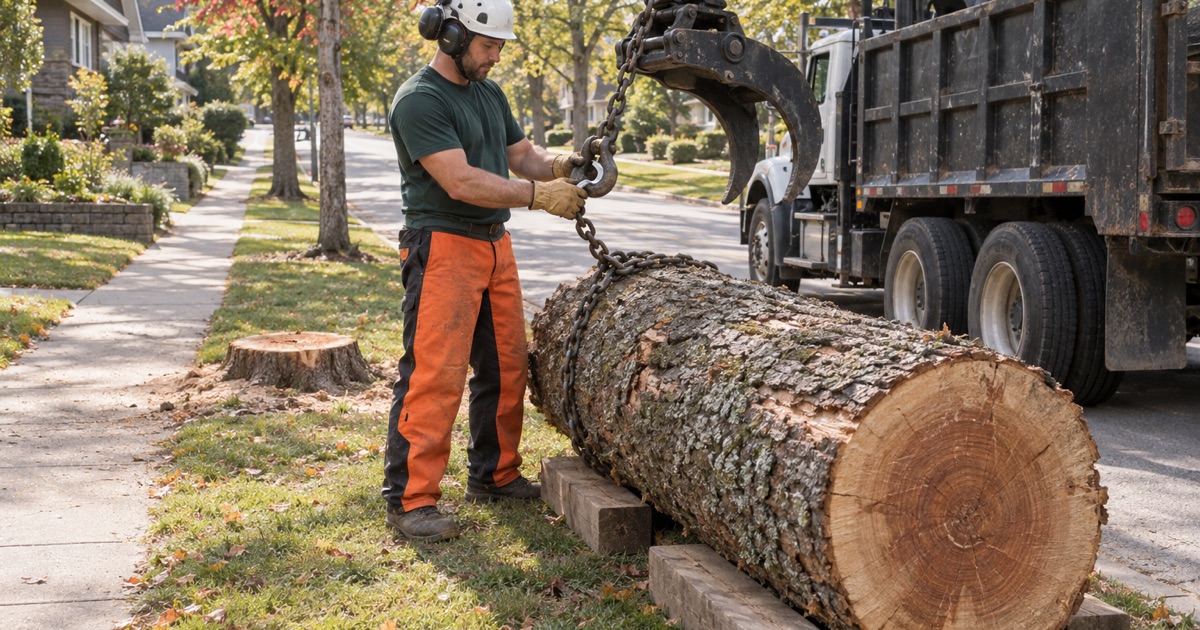
The City of Clemson Code of Ordinances, Chapter 14, Article II, is the Public Tree Ordinance, adopted as Ordinance CC-2003-23 and effective November 17, 2003. Section 14-13 is the line that matters most to a homeowner hiring anybody with a saw: ‘No person shall damage, destroy, remove, or otherwise harm a tree located on public property without expressed written permission of the city horticulturist/arborist.’ Read it twice, because it does not say remove, it says damage or otherwise harm.
The remedy is the part nobody expects. The city requires payment equal to the appraised value of the tree prior to the damage, reserves the right to prosecute, and treats the violation as a misdemeanor penalized under Section 1-8. An appraised value is not a line item on a price list, and it is not capped by what the removal was worth.
The permission is written, and it comes from a named officer
The ordinance does not describe a phone call or a friendly understanding. It names an office, the city horticulturist/arborist, and it requires expressed written permission before a public tree is touched. That cuts both ways in your favor: it can be obtained in advance, and it can be produced afterward if anybody asks.
Section 14-9 sets out what that officer does, and one duty is worth knowing before you call the power company. The city horticulturist/arborist advises city leadership on arboricultural matters, consults on construction projects, maintains recommended species lists, and liaises with Duke Power on easement trimming. If a line-clearance cut in a city easement leaves you unhappy, there is a municipal officer on the other end of it.
Looking for tree-removal closer to Clemson University? See Clemson University Tree-Removal.
Where the city tree ends and your tree begins
Section 14-8 draws the boundary the whole chapter turns on. The Public Tree Ordinance reaches trees on city-owned property such as parks, rights-of-way and municipal building grounds, public rights-of-way the city maintains under agreement with the South Carolina Department of Transportation, and property held under city lease or encroachment permit. Everything outside that is private ground, and on private ground the public tree rules do not apply.
We are careful about how far we take that. We did not locate a City of Clemson permit requiring a private owner to get approval before removing a tree from a finished private lot, and South Carolina has no statewide tree-removal permit either. Chapter 19, the zoning chapter, does state a purpose of protecting and enhancing the city tree canopy in its design review standards, and we could not read that chapter at primary grade, so we treat the private-lot answer as none located rather than none exists.
Who on your street can actually authorize the work
Tenure is the other half of the ownership problem here. American Community Survey figures for the city record 7,868 occupied units at 34.3% owner-occupied, against 5,172 renter-occupied units. On a typical call there can be four parties with authority over three different trees: the tenant who dialed, the manager who signs, the off-site owner who pays, and the city horticulturist/arborist who owns the one at the curb.
So we ask who owns the property before we quote, and we put the answer in writing with the estimate. A tenant can let us onto the lot; a tenant cannot authorize the removal of the landlord’s tree, and neither can a management company whose authority nobody has checked. In a city with that much rented housing, establishing which tree is whose before a saw starts is the job rather than the paperwork around it.
Where an association is involved, the claim has a record behind it. South Carolina Code Section 27-30-130(A)(1) makes homeowners association governing documents unenforceable unless they are recorded with the county register of deeds, and rules and regulations have to be re-recorded by January tenth each year. That record sits at the Pickens County Register of Deeds, and it is checkable.
Brush lengths, contractor loads, and the city grinding site fee
The City of Clemson publishes its residential brush rule plainly: ‘Large limbs and branches of 6 feet or less in length can be stacked at the street side for pickup,’ with three to four feet preferred, and ‘No brush over 6 feet will be picked up.’ Limbs, prunings, leaves and grass clippings have to be kept separate from other discards. There is no published diameter cap; length is the published constraint.
Then comes the sentence that decides who hauls your pile, and it is unqualified: ‘No limbs generated by contractors will be picked up by the City.’ The Sanitation Department says the same thing from its own side, listing tree surgeon waste among the contractor-generated debris it will not remove. If we cut it, it is ours to carry, and we say that on the estimate rather than leaving a heap at the curb for a truck that is never coming.
What the haul actually costs
Clemson is unusual in publishing a price for the contractor route. Material can be taken to the city grinding site for $7.50 per cubic yard, provided it is cut into six-foot or smaller lengths, which means the disposal side of a quote here can be estimated rather than guessed. The county gate is a different animal: Pickens County Landfill on Old Liberty Road in Liberty publishes brush intake hours, free mulch and a decal requirement for admittance, but publishes no rate at all for brush, limbs or stumps.
Because the gates differ, we price disposal for the jurisdiction the job is actually in, and we put the inclusions in writing before we start: the trunk rounds, the stump, the grindings and the chips. Burning is not the shortcut some people assume, either. South Carolina’s outdoor burning notification requirement applies only to unincorporated areas of the state, so it does not reach an address inside the city limits, and that is a statement about the notification rather than permission to light a pile.
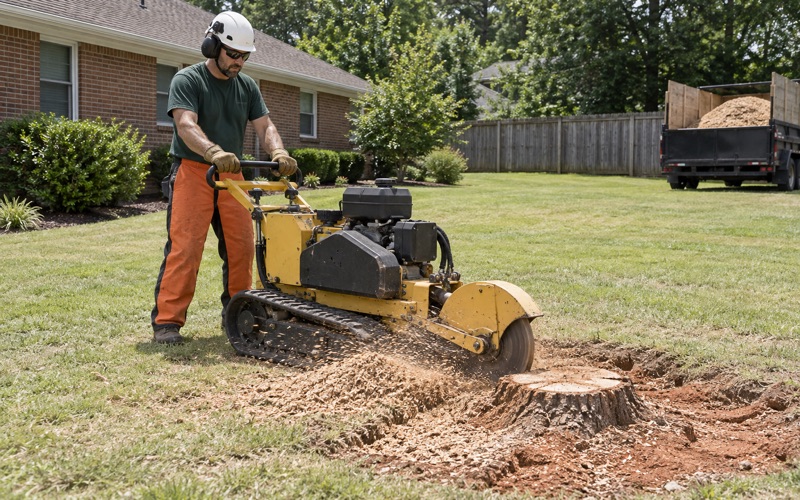
Stumps here are limited by wear and slope, not by rock. The Cecil and Pacolet soils common to this part of the Piedmont publish depth to bedrock at greater than 60 inches, and Madison at greater than 72 inches, against a stump grinder rated to roughly 12 to 25 inches below grade, so the machine’s own stop binds first. What actually decides the job is quartz in the topsoil chewing teeth, and slope, since the Pacolet series commonly runs 15 to 25 percent. On the multifamily parcels that make up much of this city, a grinder that cannot be walked to the stump is the real constraint.
The standards we work to, and the institutions we cite rather than claim
Clemson made a trade standard locally binding. Section 14-12 adopts American National Standards Institute guidelines for public tree maintenance, covering nursery stock, arboricultural safety operations, pruning, fertilization, support systems and lightning protection, and the city’s own tree page states that it follows ANSI A300 standards for pruning. On the ground that means a topping cut on a city street tree is a code problem and not merely poor practice.
We prune to the same standard on private work, to the objectives, systems and cut types ANSI A300 defines, and we do not top trees. Our rigging and any work near energized conductors follows the ANSI Z133 safety requirements, including the weather limits that stop work. Where a tree can be cabled, braced, thinned or reduced instead of removed, we say so and price both.
What the state asks for, and what it does not
South Carolina issues no arborist license and requires none to cut trees for money. The state contractor board covers construction above $10,000 in total cost with no tree, arborist or land-clearing classification, and the state registers foresters under its own title. We tell you that plainly instead of dressing it up, and we point you where the South Carolina Forestry Commission points homeowners: to the ISA Certified Arborist credential, and to verifying a contractor’s insurance with the carrier directly.
The same discipline applies to the institutions people associate with this address. The state extension service and the state plant pest regulator are legitimate authorities to quote on a pest question, and we quote them. Neither one certifies, endorses or partners with us, there is no such thing as a Clemson certification for tree work, and commercial pesticide application is a separate regulated activity we do not hold out.
Two more answers save arguments. A healthy tree that fails in a storm runs on an act-of-God and negligence frame in South Carolina, where notice is the mechanism and self-help is bounded twice: cut only to the boundary line, and you cannot kill the tree. On the insurance side, the state Department of Insurance has noted that some homeowner policies provide up to $500 for tree removal, and that the limit applies to all downed trees per loss rather than per tree, which is why we give a straight answer on whether a job is worth a claim.
Everything above ends up in the same place: a written estimate that names the tree, the owner, the standard we will work to, and where the wood is going. Written tree condition reports are available too, the kind a homeowner can hand to a neighbor, an adjuster or an architectural review committee. Estimates are free, and the first thing we settle in Clemson is which tree we are allowed to touch.
- 20+ Years in the Upstate
- Free Estimates
- Written Tree Condition Reports