Greenville Tree Removal Team has handled tree removal in Central for property owners, resident managers and off-site landlords across more than twenty years of work in the South Carolina Upstate. The first question we ask on a Central address is not which tree, it is who is allowed to say yes to cutting it. In a town where most dwellings are rented, that question decides whether the rest of the estimate is worth writing.
That is not a formality. South Carolina lets an owner recover up to three times the fair market value of a tree cut without authority, and the state wants that value established by a registered forester. We would rather spend ten minutes confirming authority than hand anyone that bill.
So we work a Central job in a fixed order. We establish who holds the authority to authorize the work, we read the rules that apply to the parcel the tree actually stands on, and we put the scope, the debris and the price in writing before a saw comes off the truck. Estimates are free, and we will tell you when pruning or cabling beats removal.
Who owns the tree in a town that mostly rents
The American Community Survey five-year estimates put Central at 1,942 occupied housing units, of which 26.4 percent are owner-occupied and 1,429 are rented. Only 473 units in the town are both owner-occupied and one-unit detached. The single-family homeowner who calls their own tree service is the minority buyer here, and the majority of our calls come from someone standing next to a tree they do not own.
Tenant, resident manager, or an owner who lives elsewhere
A tenant cannot authorize the removal of a tree they do not own, however clearly they can see the crack in it. A resident manager can usually clear a limb hanging over a parking bay on their own signature, and usually cannot approve a crane-assisted removal without the owner behind them. So we ask early, in plain terms, and we put the answer on the estimate.
That call often ends with a phone number for a property manager who has never seen the tree. It is a different conversation from a homeowner’s: they want a written scope, a certificate of insurance, a schedule that does not run through a leasing tour, and a number they can forward to an owner in another state. We write for that reader, and we keep the file, because a manager with one address usually has several.
The line between two managed properties
Property lines on a dense rental street produce the other version of the same problem. South Carolina lets you cut the limbs that grow onto your property, but you cannot kill the tree, and the trimming stops at the boundary line. On a parcel line between two managed properties the person holding the saw is often a grounds contractor working from an instruction, and neither of them owns either tree.
Where an association is involved, its governing documents are unenforceable in South Carolina unless they are recorded with the county register of deeds, and rules and regulations have to be re-recorded by January tenth each year. That makes the claim that the association will not allow a removal a checkable one, at the Pickens County Register of Deeds. We will write the tree condition report either way, so the owner, the neighbor or the committee is arguing about a document rather than a memory.
Looking for tree-removal closer to Spartanburg? See Tree-Removal Services in Spartanburg.
What the state charges for cutting without authority
South Carolina Code Section 16-11-615 allows recovery of up to three times the fair market value of trees cut without the owner’s authority, and it requires that the value be established by a registered forester. The criminal side, Section 16-11-580, defines forest products as timber, trees, logs, lumber, or pine straw and tiers the offense under $1,000, between $1,000 and $5,000, and over $5,000. Put that beside a town where most dwellings are rented and the arithmetic is obvious: a cut made on the wrong person’s word is not a customer service problem, it is a treble damages problem with a purchased valuation attached.
The state registers foresters and no arborists
That valuation comes from a registered profession because South Carolina registers foresters under Title 48, Chapter 27, while registering no arborists at all. There is no state arborist credential to hold and none is required to cut trees for money here, which is why we tell you what the state actually asks for instead of dressing the question up. The Forestry Commission points homeowners at the ISA Certified Arborist credential and at calling the insurance carrier directly to confirm a policy is current, and we would rather you did both.
Notice is the mechanism that moves the risk
South Carolina reads a fallen tree through negligence rather than a flat rule about branches. A healthy tree that fails in a storm carries no liability; a tree that was decayed, diseased, dead or otherwise dangerous beforehand can, and written notice of that condition to the tree’s owner is what shifts the exposure. On rented ground that notice has to travel from a tenant to a manager to an owner, and it tends to stop at the first step.
So we write the condition report as a document that survives being forwarded. A Level 2 basic tree risk assessment, the defect we found, the part of the tree it sits in, and what we recommend, in language an adjuster or an owner three states away can act on. Insurance is worth knowing about before the storm too: the South Carolina Department of Insurance has noted that some homeowner policies pay up to $500 for tree removal, and that the limit applies to all downed trees per loss rather than to each tree.
What grows on 45a ground and how it comes apart
Central sits in EPA Level IV ecoregion 45a, the Southern Inner Piedmont, inside the larger Level III Piedmont region. The EPA describes 45a as carrying oak-pine and oak-hickory forest with less loblolly-shortleaf pine than the Southern Outer Piedmont subregion to the east, and it describes the boundary between the two as transitional. That is a difference in what is growing, not in the shape of the ground, and it is the honest way to use the line.
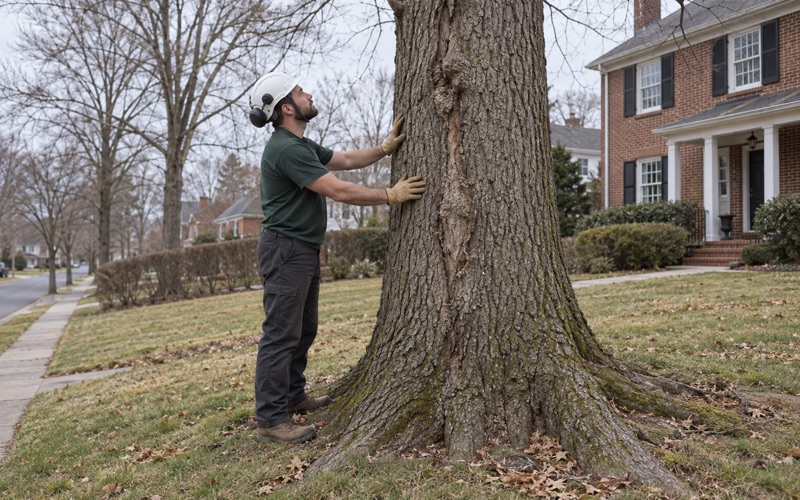
A higher hardwood share means hardwood failure modes. We look for included bark at co-dominant stems, decay columns behind old topping cuts and storm wounds, conks at the root flare, and root plate lift after saturated ground and wind. Those are the defects that turn a shade tree over a parking bay into a removal, and they are usually visible years before the failure.
Hurricane Helene made that point across this county in September 2024, inside a federal incident period that ran into October. The Forestry Commission counted Pickens among the five heaviest-loss counties in the state, and the National Weather Service summary for the Upstate says only that many trees were uprooted or snapped. No published source names the species that went over, so we do not name one either; we plan storm work around what the record actually holds.
Stumps, slope and the gate you have to fit through
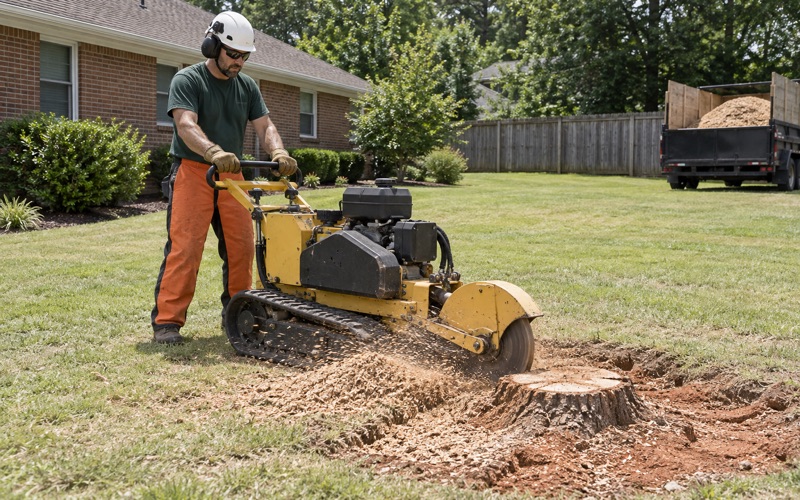
The Piedmont soils under this town, the Cecil, Pacolet and Madison series, publish depth to bedrock beyond sixty inches, against a stump grinder that cuts roughly twelve to twenty-five inches below grade. Rock is not what stops the machine here. Wear from quartz and rock fragments in the surface horizon is real, and so is slope: the Pacolet series commonly runs fifteen to twenty-five percent.
On a managed apartment parcel, slope compounds with access. A tracked stump grinder that cannot be walked to the stump is a stump that has to come out another way, so we look at the gate, the grade and the turf before we price the grinding rather than after. We also do not promise a below-grade depth sight unseen, because the dominant soil series on a given parcel is not something we can know from the street.
No tree ordinance, so the debris rule is a work order
The Town of Central’s primary land-use instrument is its Zoning Ordinance, running one hundred thirty-six pages across twelve articles in the version the town posts, updated in February 2025. Its table of contents contains no tree protection article, no tree preservation section, no heritage or specimen tree definition and no tree removal permit. The only landscaping instrument in it is Section 726, Bufferyards, which sets plant quantities per one hundred feet of buffer where a property line borders less intense zoning, and says nothing about taking down a tree that is already there.
The town also maintains a separate Land Development Regulations document and a codified town code, and we read the instrument that governs the parcel before we quote, because this service area crosses five counties and the answer changes at the line. What we can say for Central is that no removal permit was located, and the reason is that the town has never written one.
Brush leaves on our truck, and that is in writing
Central runs its own sanitation, on a rollcart, once a week for residential customers inside town limits, with everything to be removed inside the cart. For anything that does not fit, furniture and bagged leaves and brush included, the town’s published instruction is to contact town hall and submit a work order for the street crew. There is no published diameter cap, no published length cap and no published contractor exclusion; the answer is discretionary and it comes from town hall at (864) 639-6381.
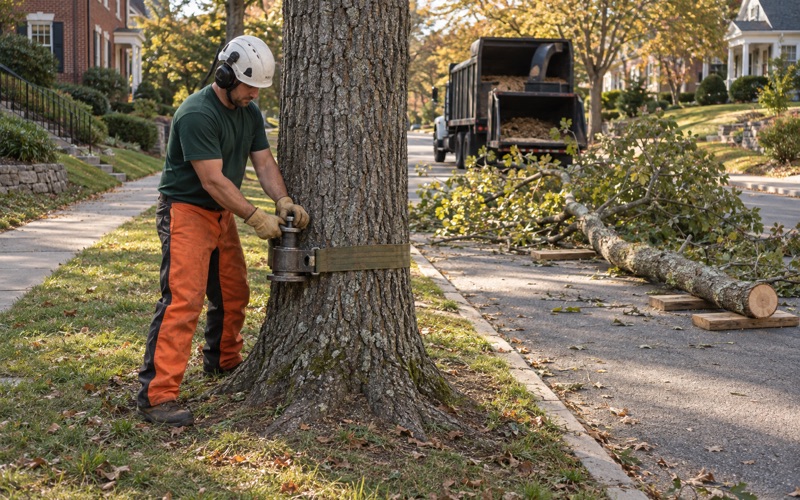
None of that reaches a removal, which is the part worth being blunt about. Trunk rounds, root balls and a chipper load are not rollcart material and no street crew collects them, so the debris leaves on our truck and the inclusions go on the estimate: the rounds, the stump, the grindings and the chips. Disposal gets priced for the county the job is actually in, and here that gate is the Pickens County Landfill on Old Liberty Road, which requires a decal for admittance and publishes no rate for brush at all.
The town sells water, not electricity
The Town of Central provides water, sewer and sanitation, and it does not sell electricity. Its own new-resident page sends residents to two outside providers, Duke Energy and Blue Ridge Electric Cooperative, which is why we confirm which one serves an address before we quote anything near a conductor rather than assuming every pole belongs to the same company. Blue Ridge Electric Cooperative publishes planting distances worth knowing when you are replacing what came out: trees growing up to forty feet at least twenty-five feet from overhead lines, larger trees at least fifty feet.
Work near energized conductors follows the ANSI Z133 safety requirements, including the weather limits that stop the job, and our pruning follows the ANSI A300 standard, which is also why we will not top a tree. Where the answer is a cable and a brace rather than a removal, we will say so and price both.
- 20+ Years in the Upstate
- Free Estimates
- Written Tree Condition Reports