Greenville Tree Removal Team handles tree removal in Boiling Springs with more than twenty years of Upstate experience behind the crew. The first question we answer on any job here is not about the tree at all. It is about who holds authority over the ground it stands on.
That answer is unusual. Boiling Springs has no municipal government, so there is no city hall to call and no municipal code to read. Permitting, disposal and enforcement route through Spartanburg County or through a special purpose district instead.
We read the ordinance that governs the county a tree actually stands in, because our service area crosses county lines and the answer changes at each one. For an address here that ordinance is the Unified Land Management Ordinance, and the part of it that matters most to a homeowner is not about private yards. It is about the ground a neighborhood owns together.
The county and the deed set the rules, because there is no town
Boiling Springs is a census-designated place rather than a municipality, so the instrument that reaches it belongs to the county. Spartanburg County runs the Unified Land Management Ordinance across the unincorporated part of the county, adopted at the end of 1999 and amended through 2022.
Its landscaping requirements reach commercial, institutional and industrial development, and the ordinance states plainly that landscaping is not required for existing uses. Nothing in it creates a residential tree-removal permit or a tree ordinance covering a homeowner’s own yard.
So a dead pine in a fenced back yard is a private decision, and we quote it as one. What changes is the ground past the property line: the common open space, the drainage easement behind the lots, and the strip of right-of-way where a utility crew has its own standing.
Before we quote work near a line we check which electric provider serves the address. The county’s own utility listing names four electric providers, Duke Energy is the predominant supplier in Spartanburg County, and Broad River Electric Cooperative territory is present as well. Which company owns the pole is an address question rather than a place-name question, and it decides whose right-of-way rules govern the clearing.
One thing the state does not do is license this trade. South Carolina issues no arborist license and requires none, and the Contractors’ Licensing Board carries no tree, arborist or land-clearing classification, so we never call ourselves licensed. We would rather tell you what the state actually asks for and let the work stand on its own.
The districts that answer instead of a city
Much of the remaining authority here sits with special purpose districts. The Boiling Springs Fire District is listed by the South Carolina Secretary of State as a Water, Sewer, Fire and Rescue District, and it operates from stations on Rainbow Lake Road, Mountain View Road and Candlenut Lane.
County records pair the Inman-Campobello Water District with that fire district as a tax district combination, and list the Spartanburg Sanitary Sewer District separately. Which body serves a given unincorporated address is settled by district boundary rather than by community name. That is worth knowing before anyone assumes a familiar utility will handle a limb on the ground.
Looking for tree-removal closer to Anderson? See Tree-Removal in Anderson.
The sentence in the county ordinance that makes a dead tree somebody’s job
The ordinance sets out the types of common open space in a subdivision and the maintenance each type requires. The operative line is short: maintenance is limited to ‘removal of litter, dead trees, plant materials, and brush,’ and natural watercourses are to be kept free flowing and devoid of debris. A dead tree standing in a common area is a duty written into county ordinance, not a matter of taste.
The same section says who may hold that ground. Open space can be under common ownership by a homeowners association, which assumes full responsibility for its maintenance, and that is how most subdivisions here are platted.
Then comes the remedy. Where a private owner of open space fails to maintain it, the county may, following reasonable notice, demand that the deficiency of maintenance be corrected and enter the open space to maintain it. The cost of that maintenance is charged to those persons having the primary responsibility for maintenance of the open space, which in a platted subdivision means the association and its members.
What an association has to have on record
South Carolina Code Section 27-30-130 makes an association’s governing documents unenforceable unless they are recorded with the county register of deeds, and it requires rules and regulations to be re-recorded by January tenth each year to remain enforceable. An association’s authority over a tree on common ground is therefore a records question with an annual clock attached to it.
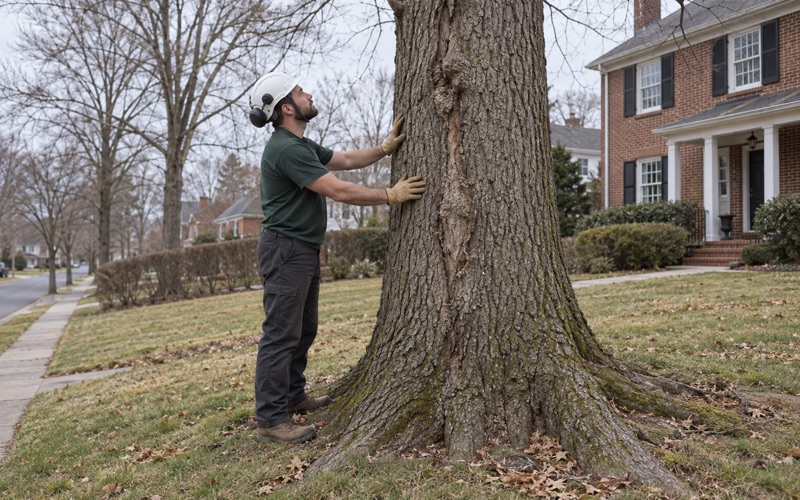
We write our findings so a board can act on them. A written tree condition report is something a homeowner can hand to a neighbor, an insurance adjuster or an architectural review committee, and on common ground it is usually what turns an argument into a work order. Where the tree can be saved we say so, including when cabling, bracing or pruning is the better call and what each of those costs.
Two things are lengthening the list of dead trees on that common ground. Emerald ash borer has been confirmed in Spartanburg County since 2017, and Hurricane Helene left roughly 99 percent of the county without power in the fall of 2024, loading young trees that have been presenting delayed failures since. No published source names a species that failed in that storm, so we assess the tree in front of us rather than a headline.
What a stump grinder actually meets under subdivision ground
The housing stock here is young, and that changes the work more than a species list does. The census counts no housing unit built before 1940, and 1,995 units built since 2010. The trees arrived with the houses.
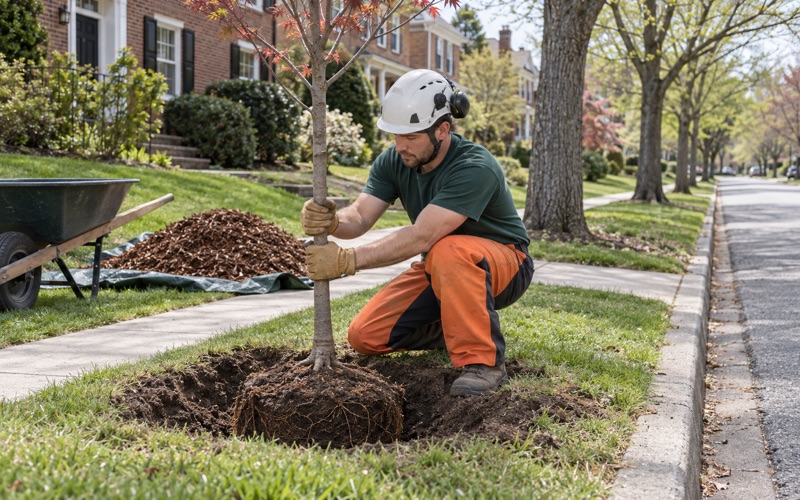
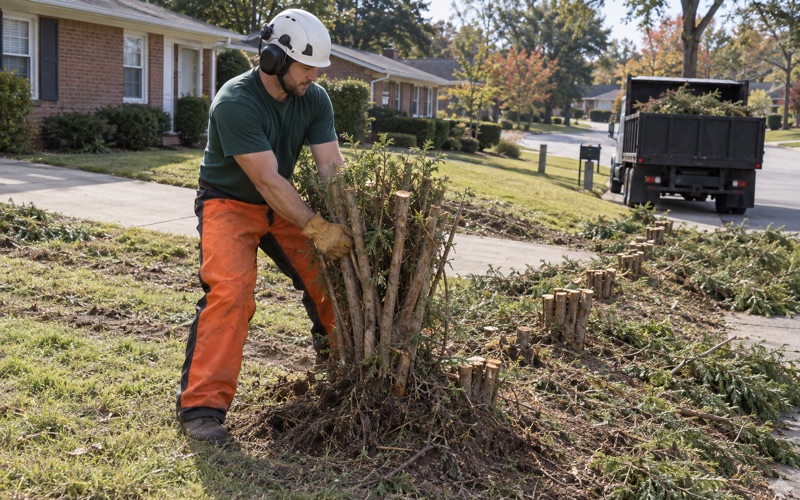
That produces cohort plantings rather than remnant canopy. A street planted at one time fails at one time, at bred unions and on close centers, and the screen rows show it first. The county’s own suggested plant table lists Leyland cypress as a large evergreen with an approximate mature height of 70 feet and a width of 12 feet at a maintenance level of low, and a row planted to that guidance is the stock that later comes out in runs rather than singly.
Fill rather than soil survey
The native profile under a stump here is Piedmont ultisol, the Cecil, Pacolet and Madison series, with depth to bedrock past 60 to 72 inches against a grinder rated for a cut of 12 to 25 inches. Depth is not the constraint on that ground. Quartz and rock fragments in the upper horizon are, because abrasion is what takes the teeth.
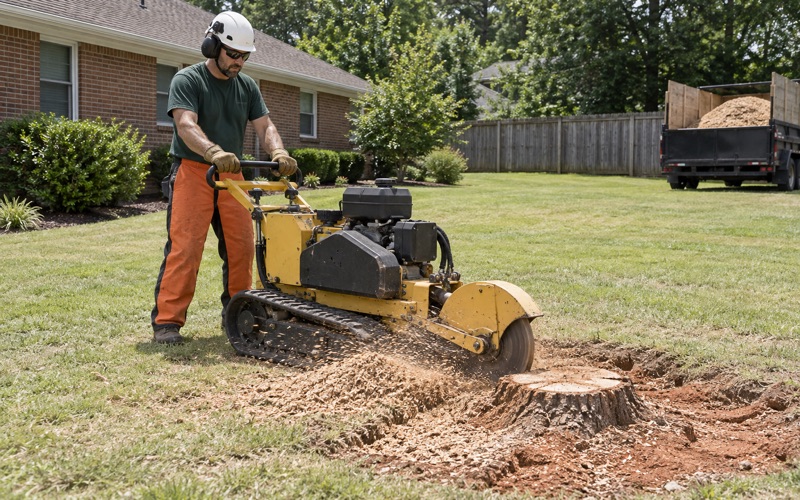
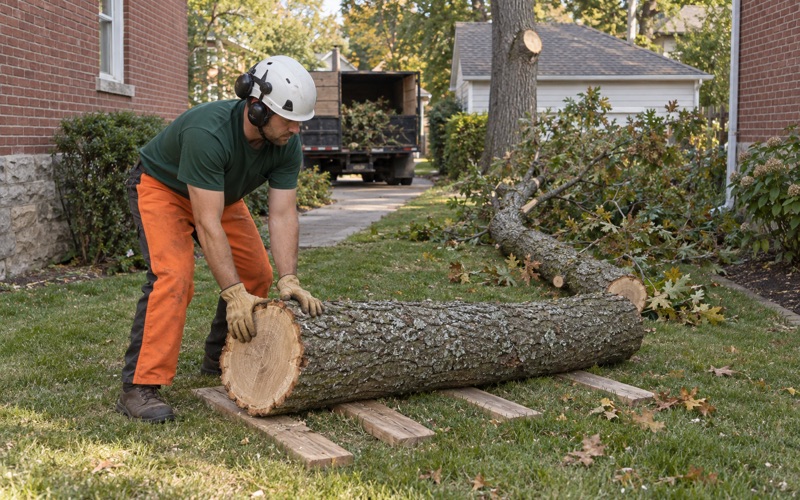
On subdivision ground built since 1980 the grinder frequently never reaches that profile. What it meets instead is imported fill and compacted subgrade, which the soil survey does not describe, so on a newer lot the medium is a construction question rather than a soils question. We read the root flare before we price the stump, and we put the inclusions in writing first: the trunk rounds, the stump, the grindings and the chips.
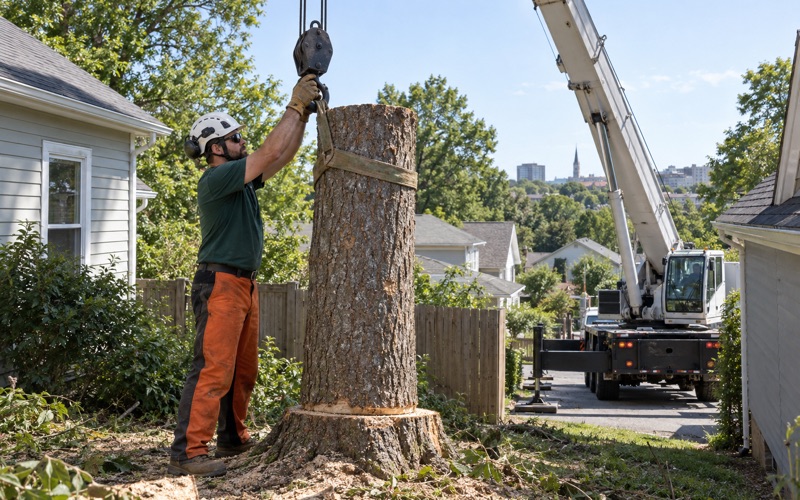
Access is the other subdivision variable, and it is usually solved with equipment rather than with a bigger machine. Compact tracked gear fits a back-yard gate, which keeps a routine removal from becoming a crane job on a lot that sits close to its neighbors.
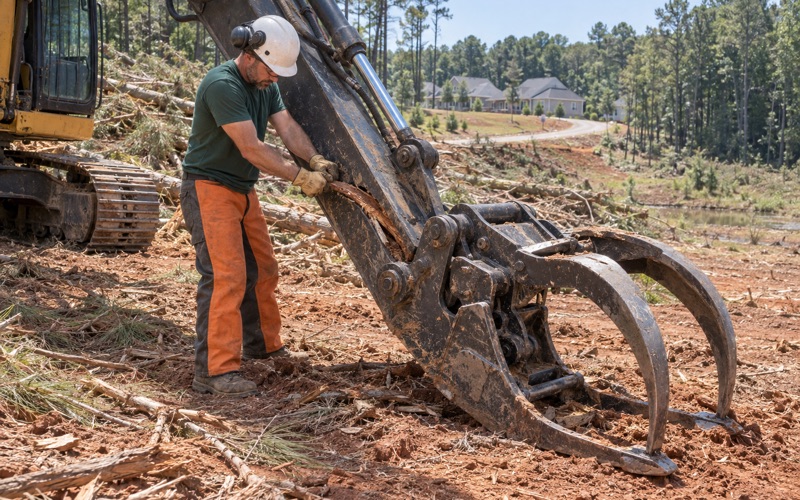
A larger clearing job crosses a different line. A grading permit from the Spartanburg County Public Works Department, Engineering Division is required before any land disturbing activity covered by the county stormwater rules, and no grading permit issues without an approved Storm Water Management Plan. We flag that threshold before a lot clearing quote goes out, not after the machines are on site.
Where the wood goes, and what the state asks before a burn
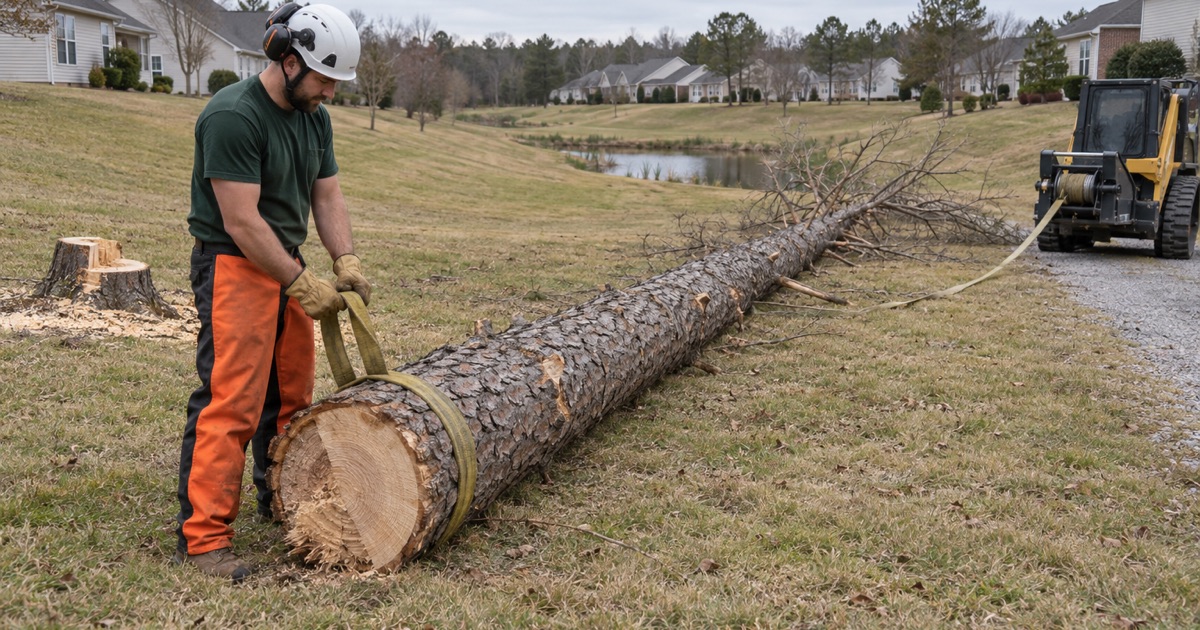
Because there is no municipality attached to this community, there is no municipal curbside brush collection to set a pile out for. Spartanburg County’s published recycling directory accepts yard debris at exactly one site, the Wellford Landfill, and none of its seventeen recycling and collection centers takes yard debris.
That single outlet sets the terms for the pile. Limbs have to be six feet or smaller to go in, and the current county schedule prices yard waste debris at $30 per ton. Disposal on this side of the county line is a haul and a tipping fee rather than a set-out, so we price it for the county the job is actually in, where one gate charges by the cubic yard, the next by the ton, and some are free only to their own residents.
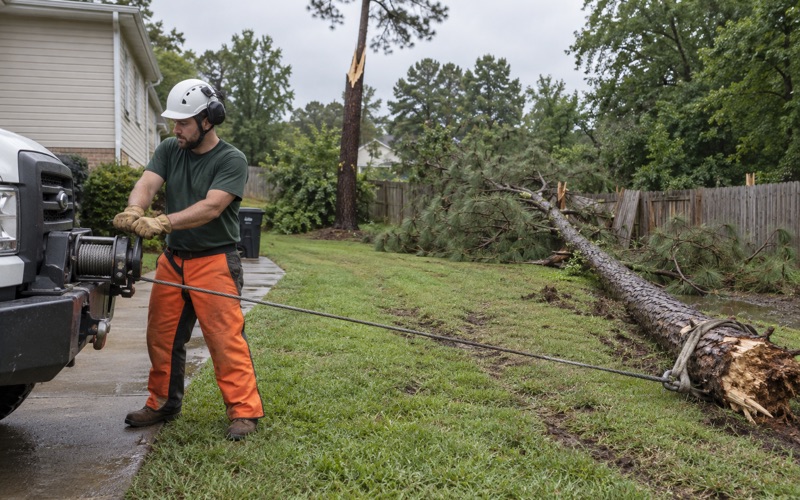
Line clearance work adds material that a public gate will not take for free either. Broad River Electric Cooperative’s right-of-way policy holds a zone of fifteen feet on either side of a utility pole, asks that limbs stay twenty feet clear of a power line, and leaves limbs over 12 inches for the property owner as firewood while smaller material is chipped and hauled away. Trees marked with orange ribbons are cut completely to the ground, and the wood from those is somebody’s problem the same afternoon.
The burn notification that reaches an unincorporated address
Burning is where this address gets a different answer from one a few miles inside a city limit. Notification to the South Carolina Forestry Commission before an outdoor burn is required by state law, and that requirement applies only to unincorporated areas of the state. This community is unincorporated, so it applies here, and it covers leaves, limbs and branches as well as land-clearing burns.
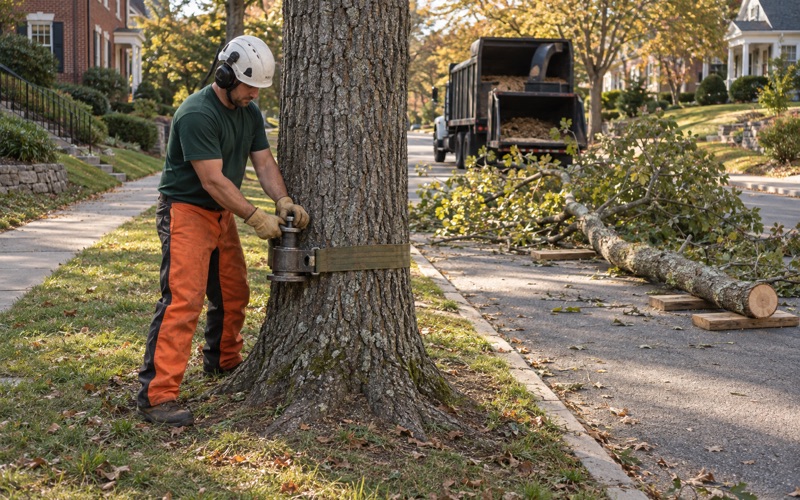
We would rather say all of this before the saw comes out. Pruning is worked to the objectives, systems and cut types the ANSI A300 standard defines, and we do not top trees. Rigging and line-clearance practice follows the ANSI Z133 safety requirements, including the weather limits that stop work near energized conductors.
Estimates are free, and our storm planning is built on what the Upstate actually recorded in September 2024 rather than a generic coastal script. When a job is worth an insurance claim we will say so, and when it is not, we will say that too.
- 20+ Years in the Upstate
- Free Estimates
- Written Tree Condition Reports