Greenville Tree Removal Team has handled tree-removal in Belton for more than twenty years, and the first thing we settle on a Belton job is not the saw work but the pile. The city runs its own brush and limb collection, and it draws a hard line at four inches. A removal produces trunk wood on the wrong side of that line before the first log hits the ground.
That matters because the same notice that sets the four-inch cap also says, in its own capitals, that debris generated by hired contractors, tree trimming named first among them, is the responsibility of the contractor and will not be collected by the City. Hiring us does not shift the wood to the curb. It shifts it into our truck, and we price it that way from the estimate forward.
We give a free estimate that puts the inclusions in writing before anyone climbs: the trunk rounds, the stump, the grindings and the chips. We also tell you when a tree can be cabled, braced or pruned instead of taken down, and what each of those costs.
The four-inch line, and the ward calendar behind it
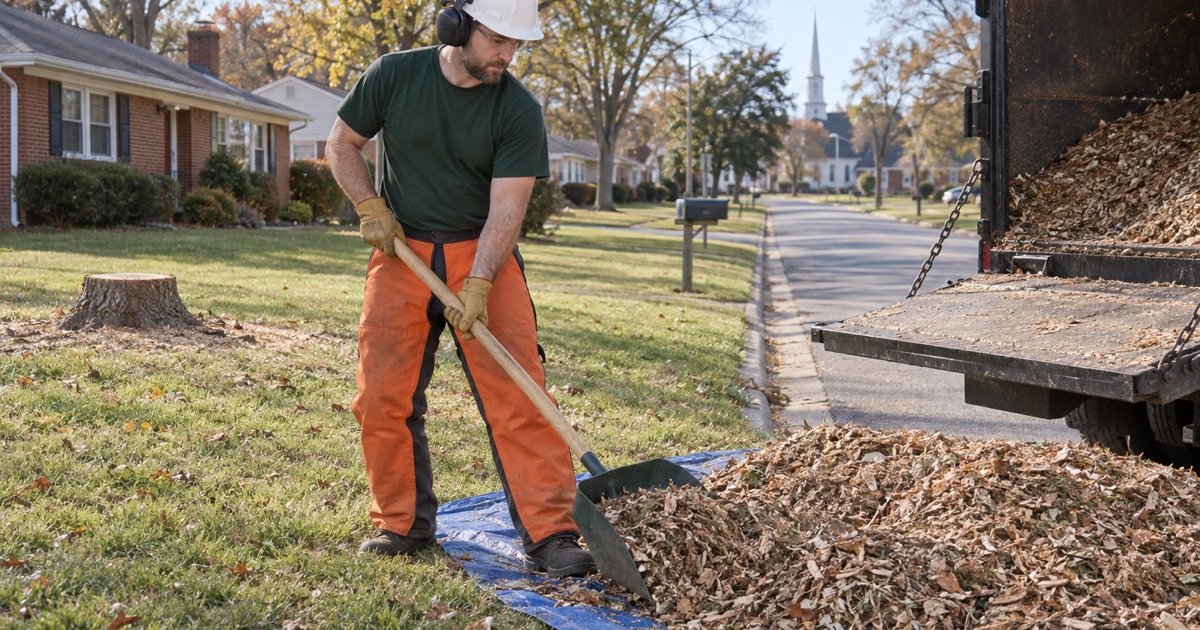
The city’s brush notice is short and specific. It refuses limbs more than four inches in diameter, refuses anything longer than fifteen feet, and refuses stumps with root balls and dirt attached. Those three refusals cover almost everything a removal generates, which is why we treat the curb as closed on this kind of work and plan haul-off instead.
The four-inch figure is worth repeating because it is lower than the cap most cities in our service range use, and a crew that works the whole ring can carry the wrong number in its head. We read the rule for the city the tree actually stands in, which here means the Belton notice and not a neighbor’s.
Timing, and why a pile can sit
Collection runs by ward, and it starts in the middle of each month beginning with Ward I. A homeowner whose address falls later in that rotation can watch a legal pile of small limbs sit for weeks, which is a different problem from wood the truck was never going to take. We schedule around it rather than leaving you to find out.
The notice also governs where a pile goes. Brush is not to be set around a utility pole or on top of a storm drain, and the city asks for piles stacked vertically rather than spread down the curb line. Those are small rules, but they are the ones that get a pile skipped for another month.
One department for water and waste, another company for the wire
The City of Belton Combined Utilities Department covers water, sewer and sanitation, and that is where the debris question lands. Electricity is not on that list. Duke Energy Carolinas is the regulated electric utility for the Upstate including Anderson County, and Little River Electric Cooperative serves parts of the county as well, so we confirm the provider at the service address before quoting anything near a conductor.
Looking for tree-removal closer to Central? See Tree-Removal in Central.
A half-mile of depot-era streets, and a canopy that aged with the houses
Belton was named for John Belton O’Neall, first president of the Columbia and Greenville Railroad, and the town incorporated in 1855 with boundaries within a half-mile radius of the depot. That radius is still legible in the street grid, and the Belton Depot, built about 1910 as the Southern Railway Combined Depot, was listed on the National Register of Historic Places in 1979. The city puts the depot and the Belton Standpipe on its own seal, under the words The Standpipe City.
The standpipe itself is a 155-foot reinforced concrete water tower of 165,000-gallon capacity near downtown, begun in 1908, finished in 1909 and listed on the National Register in 1987. We mention it because it is the tallest fixed thing in that core and it sets the frame for how a tall removal reads from the ground. Work in a half-mile core is close work, with houses, wires and a street on at least two sides of most trees.
Housing built in one stretch, and trees that went in with it
The census estimates count 1,637 housing units here, of which 83.6% predate 1980 and 48.7% were built between 1940 and 1959. Nearly half the housing stock arrived inside a twenty-year window, and the shade trees planted with those houses are now reaching removal age on the same schedule. That is why a street can look fine one year and produce several failures the next.
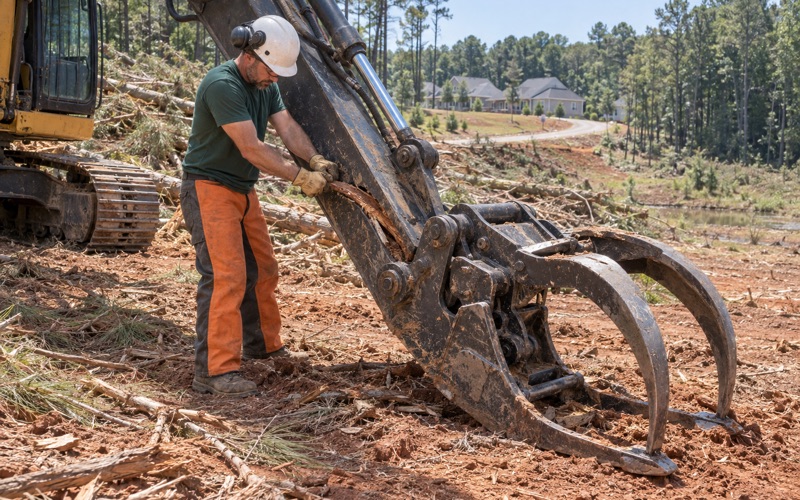
With 85.2% of those units one-unit detached, most of the work is back-yard work behind a fence. Our compact tracked equipment fits a standard gate, so a subdivision tree does not automatically become a crane job, and we keep crane and rigging capacity for the mature canopy where it genuinely earns it.
What we look at before a tree comes down
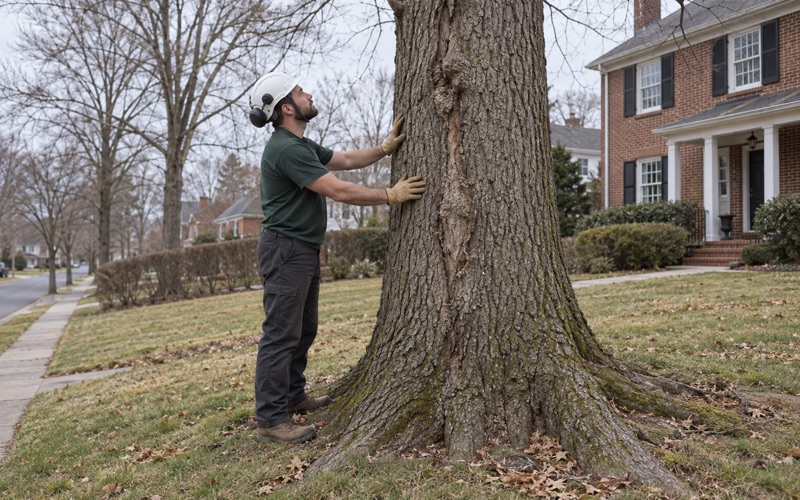
A Level 2 basic tree risk assessment on a cohort like this usually turns on co-dominant stems with included bark, a conk at the root flare, or a root plate already lifting on the uphill side. Where the defect is structural rather than terminal, cabling and bracing with extra high strength cable, or crown reduction and crown cleaning worked to the ANSI A300 pruning standard, keeps the tree standing. We do not top trees, and we will say so before we quote.
Bufferyards the ordinance will not let you clear
The Belton Zoning Ordinance, adopted in September 2018 and produced by the South Carolina Appalachian Council of Governments, runs ten articles and contains no tree-preservation, tree-protection or heritage-tree article anywhere in it. The only vegetation rules in the book sit in the bufferyard article. That surprises people who expect a permit step, and it is worth knowing before you call anyone.
The bufferyard rules cut the other way. The ordinance allows a bufferyard to be used for passive recreation, but states plainly that no plant material may be removed and that the use shall not be a nuisance to abutting properties. A tree standing inside a required bufferyard is not yours to clear because it has grown inconvenient.
When the tree in the buffer is already dead
Maintenance of a required bufferyard is the property owner’s responsibility under the same article, and failure to maintain it is a violation of the ordinance, remediable in the manner prescribed for other violations. So a dead or failing tree in that strip is two obligations at once: it has to come out, and the buffering it provided has to come back. We write that up as one job rather than leaving the second half for a code letter to find.
The replacement is specified by size, not by species alone. The ordinance’s minimum plant sizes put a single-stem canopy tree at 2.5 inch caliper in an open bufferyard, and at 1.5 inch caliper where the bufferyard abuts a structure, fence or berm, with understory trees at 1.5 inch caliper or four feet in height. Existing healthy, well-formed plant material may be counted toward the requirement, which is one reason we would rather save a marginal tree in a buffer than take it.
Where the wood goes after the city truck passes
Anderson County Solid Waste runs the backstop, and the rule there is about who is paying, not what is in the trailer. County residents are not charged for construction, demolition and land-clearing debris, but the county states that if a resident pays someone to haul their material to the Starr Landfill, the person hauling or the commercial business is charged for disposal. Commercial disposal runs $33.00 per ton.
That is a cost, not a surprise, and we would rather show it on the estimate than discover it at the scale house. Disposal on our quotes is priced for the county the job is actually in, because one gate charges by the cubic yard, the next by the ton, and some are free only to their own residents.
Sectioning is a gate requirement, not a preference
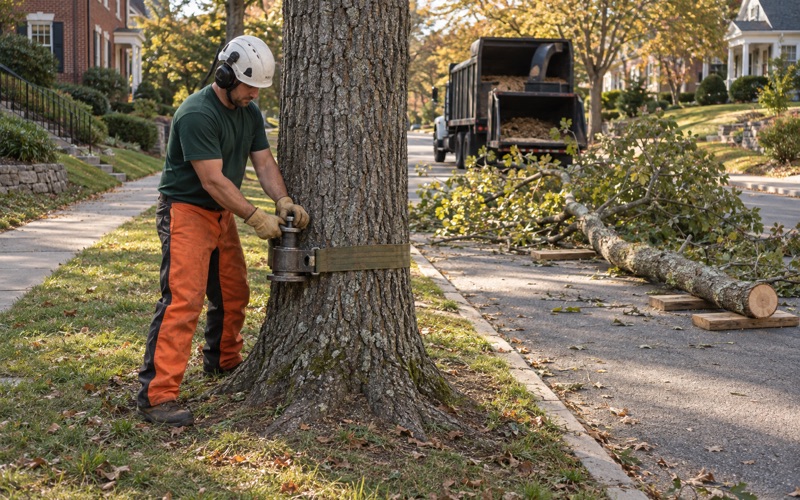
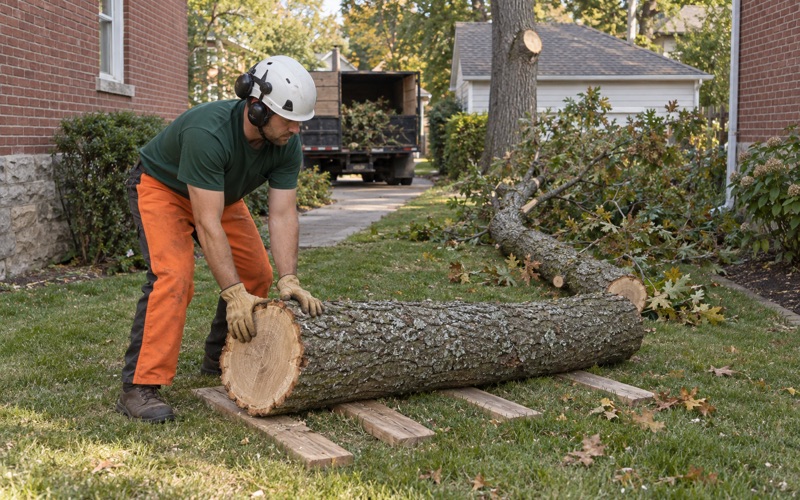
The Starr construction and demolition landfill accepts vegetation, logs, tree stumps, brush, limbs and roots, but with size rules attached: material 18 inches wide or smaller cut to six feet or shorter, material 19 inches wide or larger cut to two feet or shorter. It also will not take stumps two feet high and three feet wide or larger. Those limits decide how a trunk is cut on your lawn, hours before anything reaches a gate.
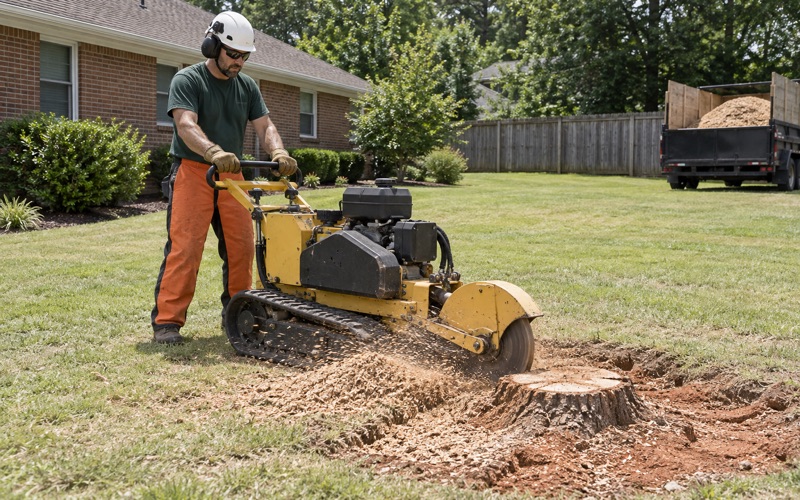
Stumps are their own question. The residual Piedmont soils under Belton, the Cecil, Pacolet and Madison series, run more than 60 inches to bedrock, while a tracked stump grinder is rated for a cut of 12 to 25 inches, so the machine’s depth binds long before the soil does. What actually costs time here is wear from quartz and rock fragments in the upper horizon, and slope on the steeper lots.
Before you call the adjuster or light a burn pile
South Carolina’s insurance regulator has published that where a homeowner’s policy covers tree removal, the limit of up to $500 applies to all of the downed trees per loss and is not paid on a per tree basis. Removal of a tree off a damaged structure is paid under the dwelling portion of the policy, and a tree on a car is covered only where the auto policy includes comprehensive coverage. We will give you a straight answer on whether a job is worth a claim at all.
On burning, the state forestry agency requires notification before an outdoor burn only in unincorporated areas, so an address inside the city limits sits outside that requirement while adjoining county ground does not. And on the two species we are asked about most: Callery and Bradford pear can no longer be sold in South Carolina since the first of October 2024, though owning one is still legal, and it will resprout from lateral roots unless they come out with the stump. Emerald ash borer is confirmed present in Anderson County, which changes how we look at an ash before we quote it.
One last thing we say plainly: South Carolina issues no arborist license and requires none to cut trees for money, so nobody working here can honestly claim a state license. What we can offer instead is twenty years of Upstate work, rigging and line-clearance practice worked to the ANSI Z133 safety requirements, and a written tree condition report you can hand to a neighbor, an adjuster or a review committee.
- 20+ Years in the Upstate
- Free Estimates
- Written Tree Condition Reports